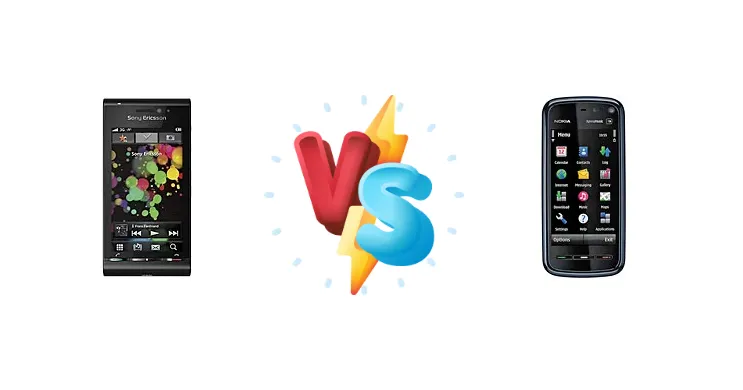
The late 2000s were a golden age for feature phones, packed with innovation and unique designs. Two titans of the era, the Sony Ericsson Satio (also known as Idou) and the Nokia 5800 XpressMusic, battled for smartphone supremacy. Let's revisit this classic comparison and see how they stack up today.
🏆 Quick Verdict
The Satio boasted a superior camera and a more modern design, while the 5800 offered a smoother user experience and a more robust build. Ultimately, the Satio's camera and design edge give it a slight advantage, but both were excellent phones for their time.
| Network |
|---|
| 2G bands | GSM 850 / 900 / 1800 / 1900 | GSM 850 / 900 / 1800 / 1900 |
| 3G bands | HSDPA 900 / 2100 | HSDPA 900 / 2100 |
| Speed | HSPA 7.2/3.6 Mbps | HSPA 3.6/0.384 Mbps |
| Technology | GSM / HSPA | GSM / HSPA |
| | HSDPA 850 / 1900 / 2100 - Satio(a) for the Americas | HSDPA 850 / 1900 - American version |
| Launch |
|---|
| Announced | 2009, February. Released 2009, October | 2008, October. Released 2008, November |
| Status | Discontinued | Discontinued |
| Body |
|---|
| Dimensions | 112 x 55 x 13 mm (4.41 x 2.17 x 0.51 in) | 111 x 51.7 x 15.5 mm, 83 cc (4.37 x 2.04 x 0.61 in) |
| SIM | Mini-SIM | Mini-SIM |
| Weight | 126 g (4.44 oz) | 109 g (3.84 oz) |
| Display |
|---|
| Resolution | 360 x 640 pixels, 16:9 ratio (~210 ppi density) | 360 x 640 pixels, 16:9 ratio (~229 ppi density) |
| Size | 3.5 inches, 33.8 cm2 (~54.8% screen-to-body ratio) | 3.2 inches, 28.2 cm2 (~49.2% screen-to-body ratio) |
| Type | TFT resistive touchscreen, 16M colors | TFT resistive touchscreen, 16M colors |
| | - | Handwriting recognition |
| Platform |
|---|
| CPU | 600 MHz Cortex-A8 | 434 MHz ARM 11 |
| GPU | PowerVR SGX | - |
| OS | Symbian 9.4, Series 60 rel. 5 | Symbian 9.4, Series 60 rel. 5 |
| Memory |
|---|
| Card slot | microSDHC (dedicated slot), 8 GB included | microSDHC (dedicated slot), 8 GB included |
| Internal | 128MB; 256MB RAM | 81MB 128MB RAM |
| Main Camera |
|---|
| Features | xenon flash, video LED flash | Carl Zeiss optics, dual-LED flash |
| Single | 12 MP, AF | 3.15 MP, AF |
| Video | w480p@30fps (via SW update) | 480p@30fps |
| Selfie camera |
|---|
| Single | VGA videocall camera | QVGA videocall camera |
| Sound |
|---|
| 3.5mm jack | No | Yes |
| 35mm jack | No | Yes |
| Loudspeaker | Yes | Yes, with stereo speakers |
| Comms |
|---|
| Bluetooth | 2.0, A2DP | 2.0, A2DP |
| Positioning | GPS, A-GPS | GPS, A-GPS; Nokia Maps 2.0 Touch |
| Radio | Stereo FM radio | Stereo FM radio, RDS |
| USB | 2.0 | microUSB 2.0 |
| WLAN | Wi-Fi 802.11 b/g, DLNA | Wi-Fi 802.11 b/g, UPnP technology |
| Features |
|---|
| Browser | WAP 2.0/HTML, RSS reader | WAP 2.0/xHTML, HTML, Adobe Flash Lite |
| Sensors | Accelerometer, proximity | Accelerometer, proximity |
| | Gesture control
MP4/H.264/WMV player
MP3/WAV/WMA/eAAC+ player
TV-out
Office document viewer
Organizer
Predictive text input | MP4/H.264/WMV player
MP3/WAV/еAAC+/WMA player
Photo editor
Organizer
Voice command/dial
TV-out
Predictive text input |
| Battery |
|---|
| Music play | - | Up to 35 h |
| Stand-by | Up to 360 h (2G) / Up to 340 h (3G) | Up to 406 h (2G) / Up to 406 h (3G) |
| Talk time | Up to 11 h (2G) / Up to 4 h 50 min (3G) | Up to 8 h 45 min (2G) / Up to 5 h (3G) |
| Type | Removable Li-Po 1000 mAh battery | Removable Li-Ion 1320 mAh battery (BL-5J) |
| Misc |
|---|
| Colors | Black, Silver, Bordeaux | Black, Red, Blue |
| Price | About 180 EUR | About 130 EUR |
| SAR | - | 1.11 W/kg (head) 0.90 W/kg (body) |
| SAR EU | 1.58 W/kg (head) | 0.97 W/kg (head) |
| Tests |
|---|
| Audio quality |
Noise -87.0dB / Crosstalk -84.3dB |
Noise -92.2dB / Crosstalk -75.0dB |
| Camera |
Photo | - |
| Loudspeaker |
Voice 71dB / Noise 66dB / Ring 78dB |
Voice 75dB / Noise 66dB / Ring 68dB |
Sony Ericsson Satio (Idou)
- Superior Camera (12.1MP)
- Vibrant OLED Display
- Faster Processor (600 MHz)
- Sleek Design
- Shorter Battery Life
- Symbian OS limitations
- Less Durable Build
Nokia 5800 XpressMusic
- Better Battery Life
- User-Friendly Symbian Experience
- Robust Build Quality
- Dedicated Music Keys
- Lower Resolution Camera (5MP)
- LCD Display (less vibrant)
- Slower Processor (434 MHz)
Display Comparison
The Satio featured a 3.2-inch OLED display, offering vibrant colors and deeper blacks compared to the 5800's 3.2-inch LCD screen. While both had similar resolutions, the OLED technology gave the Satio a noticeable edge in visual quality. The Satio's display also had better viewing angles.
Camera Comparison
The Satio's 12.1-megapixel camera was a standout feature, offering significantly higher resolution than the 5800's 5-megapixel camera. While image processing wasn't perfect by today's standards, the Satio captured more detail and offered better zoom capabilities. The Satio also had Xenon flash, providing better low-light performance.
Performance
The Satio's 600 MHz Cortex-A8 processor significantly outperformed the 5800's 434 MHz ARM 11 processor. This resulted in snappier app loading times and a generally more responsive user interface on the Satio. However, both phones ran Symbian OS, which could feel sluggish by modern standards.
Battery Life
The Nokia 5800 generally had better battery life than the Satio. The Satio's power-hungry OLED display and more powerful processor took a toll on battery performance. Expect around 10 hours of talk time on the 5800 versus roughly 7-8 on the Satio.
Buying Guide
The Sony Ericsson Satio (Idou) is for those who prioritize camera quality and a sleek, premium design. The Nokia 5800 XpressMusic is ideal for music lovers and users seeking a reliable, user-friendly experience with a focus on multimedia.
Frequently Asked Questions
❓ Which phone was the first to have a 12MP camera?
The Sony Ericsson Satio (Idou) was the first commercially available phone with a 12.1-megapixel camera.
❓ Was the Nokia 5800 a smartphone?
The Nokia 5800 ran Symbian OS and had smartphone capabilities like internet browsing and email, but it was often categorized as a feature phone due to its design and focus on multimedia.