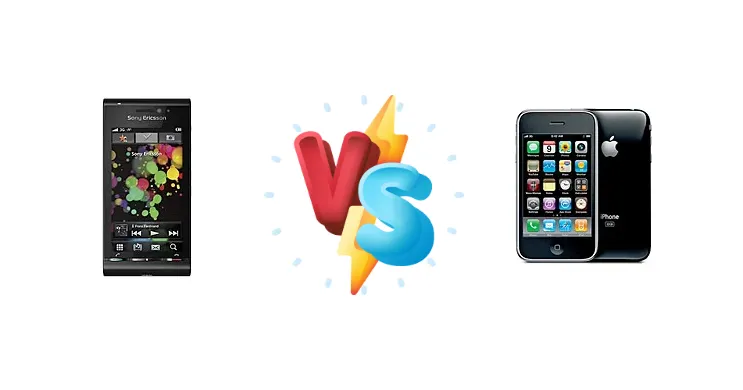
The mid-2000s were a pivotal time for mobile phones, witnessing the rise of the smartphone. Two contenders emerged: the Sony Ericsson Satio (also known as Idou) and the Apple iPhone 3GS. Both promised cutting-edge features, but which one truly delivered? Let's dive into a detailed comparison.
🏆 Quick Verdict
The iPhone 3GS ultimately wins due to its superior user experience, app ecosystem, and overall polish. While the Satio boasted a higher megapixel camera, the iPhone's software and ease of use provided a more compelling and lasting impact, solidifying Apple's dominance.
| Network |
|---|
| 2G bands | GSM 850 / 900 / 1800 / 1900 | GSM 850 / 900 / 1800 / 1900 |
| 3G bands | HSDPA 900 / 2100 | HSDPA 850 / 1900 / 2100 |
| Speed | HSPA 7.2/3.6 Mbps | HSPA 7.2/0.384 Mbps |
| Technology | GSM / HSPA | GSM / HSPA |
| | HSDPA 850 / 1900 / 2100 - Satio(a) for the Americas | - |
| Launch |
|---|
| Announced | 2009, February. Released 2009, October | 2009, June. Released 2009, June |
| Status | Discontinued | Discontinued |
| Body |
|---|
| Dimensions | 112 x 55 x 13 mm (4.41 x 2.17 x 0.51 in) | 115.5 x 62.1 x 12.3 mm (4.55 x 2.44 x 0.48 in) |
| SIM | Mini-SIM | Mini-SIM |
| Weight | 126 g (4.44 oz) | 135 g (4.76 oz) |
| Display |
|---|
| Protection | - | Corning Gorilla Glass, oleophobic coating |
| Resolution | 360 x 640 pixels, 16:9 ratio (~210 ppi density) | 320 x 480 pixels, 3:2 ratio (~165 ppi density) |
| Size | 3.5 inches, 33.8 cm2 (~54.8% screen-to-body ratio) | 3.5 inches, 36.5 cm2 (~50.9% screen-to-body ratio) |
| Type | TFT resistive touchscreen, 16M colors | TFT |
| Platform |
|---|
| CPU | 600 MHz Cortex-A8 | 600 MHz Cortex-A8 |
| GPU | PowerVR SGX | PowerVR SGX535 |
| OS | Symbian 9.4, Series 60 rel. 5 | iOS 3, upgradable to iOS 6.1.6 |
| Memory |
|---|
| Card slot | microSDHC (dedicated slot), 8 GB included | No |
| Internal | 128MB; 256MB RAM | 8GB 256MB RAM, 16GB 256MB RAM, 32GB 256MB RAM |
| Main Camera |
|---|
| Features | xenon flash, video LED flash | - |
| Single | 12 MP, AF | 3.15 MP, f/2.8, AF |
| Video | w480p@30fps (via SW update) | 480p@30fps |
| Selfie camera |
|---|
| Single | VGA videocall camera | - |
| | - | No |
| Sound |
|---|
| 3.5mm jack | No | Yes |
| 35mm jack | No | Yes |
| Loudspeaker | Yes | Yes |
| Comms |
|---|
| Bluetooth | 2.0, A2DP | 2.1, A2DP (headset support only) |
| Positioning | GPS, A-GPS | GPS, A-GPS |
| Radio | Stereo FM radio | No |
| USB | 2.0 | 2.0 |
| WLAN | Wi-Fi 802.11 b/g, DLNA | Wi-Fi 802.11 b/g |
| Features |
|---|
| Browser | WAP 2.0/HTML, RSS reader | HTML (Safari) |
| Sensors | Accelerometer, proximity | Accelerometer, proximity, compass |
| | Gesture control
MP4/H.264/WMV player
MP3/WAV/WMA/eAAC+ player
TV-out
Office document viewer
Organizer
Predictive text input | iCloud cloud service
Maps
Organizer
TV-out
Audio/video player/editor
Photo viewer/editor
Voice command/dial
Predictive text input |
| Battery |
|---|
| Stand-by | Up to 360 h (2G) / Up to 340 h (3G) | - |
| Talk time | Up to 11 h (2G) / Up to 4 h 50 min (3G) | Up to 5 h (3G) |
| Type | Removable Li-Po 1000 mAh battery | Li-Ion 1400 mAh, non-removable |
| Misc |
|---|
| Colors | Black, Silver, Bordeaux | Black, White |
| Models | - | A1325, A1303, iPhone2,1 |
| Price | About 180 EUR | About 110 EUR |
| SAR | - | 0.26 W/kg (head) 0.79 W/kg (body) |
| SAR EU | 1.58 W/kg (head) | 0.45 W/kg (head) 0.40 W/kg (body) |
| Tests |
|---|
| Audio quality |
Noise -87.0dB / Crosstalk -84.3dB |
Noise -92.1dB / Crosstalk -95.0dB |
| Camera |
Photo |
Photo |
| Display | - |
Contrast ratio: 201:1 (nominal) |
| Loudspeaker |
Voice 71dB / Noise 66dB / Ring 78dB |
Voice 69dB / Noise 69dB / Ring 71dB
|
Sony Ericsson Satio (Idou)
- High-resolution camera (12.1MP)
- Vibrant OLED display
- Unique design
- Expandable storage (Memory Stick Micro)
- FM Radio
- Sluggish performance
- Outdated Symbian OS
- Subpar image processing
- Less intuitive user interface
- Shorter battery life
Apple iPhone 3GS
- Smooth iOS performance
- Excellent app ecosystem
- User-friendly interface
- Good camera quality
- Better battery life
- Strong resale value (for a retro phone)
- Lower resolution camera (3.2MP) compared to Satio
- Limited storage options
- Older technology
- No expandable storage
Display Comparison
The iPhone 3GS featured a 3.5-inch 320x480 pixel display, while the Satio had a 3.2-inch OLED screen. While the Satio's OLED offered vibrant colors and deeper blacks, the iPhone 3GS's display was generally considered more accurate and readable in various lighting conditions. The iPhone's responsiveness also contributed to a better user experience.
Camera Comparison
The Satio's headline feature was its 12.1-megapixel camera, significantly higher than the iPhone 3GS's 3.2-megapixel camera. However, image quality wasn't solely about megapixels. The iPhone 3GS's camera produced better-looking photos with more accurate colors and better dynamic range, thanks to Apple's image processing algorithms. The Satio's photos often appeared over-processed.
Performance
Both devices share a 600 MHz Cortex-A8 processor. However, Apple's iOS was significantly more optimized than the Satio's Symbian OS. This resulted in noticeably smoother performance and faster app loading times on the iPhone 3GS. The Satio often felt sluggish by comparison.
Battery Life
The iPhone 3GS generally offered slightly better battery life than the Satio, lasting around 8-10 hours of moderate use. The Satio's battery life was typically around 6-8 hours, impacted by its larger screen and more power-hungry features.
Buying Guide
The Sony Ericsson Satio (Idou) might appeal to nostalgia enthusiasts or those fascinated by early smartphone designs and camera-focused devices. The Apple iPhone 3GS is a better choice for anyone seeking a more refined and user-friendly experience, even with its age, and appreciates the foundation of the modern smartphone.
Frequently Asked Questions
❓ Was the Satio's 12.1MP camera really better than the iPhone 3GS's?
While the Satio had a higher megapixel count, the iPhone 3GS produced better overall image quality due to superior image processing and software optimization. Megapixels aren't everything.
❓ Why didn't the Satio become as popular as the iPhone?
The Satio suffered from a combination of factors, including a sluggish operating system, a less intuitive user interface, and Apple's rapidly growing app ecosystem and overall user experience.