
Sony Ericsson Satio (Idou) vs. Apple iPhone 14: A Generational Leap
| Phones Images | |||||
|---|---|---|---|---|---|
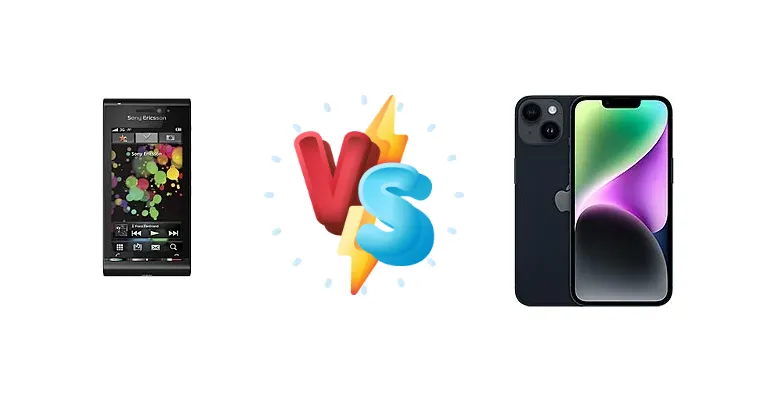
|
🏆 Quick Verdict
The iPhone 14 utterly dominates this comparison. While the Satio holds nostalgic appeal, the iPhone 14's superior performance, camera capabilities, display quality, and modern features make it the clear winner for any user seeking a contemporary smartphone experience. It's a David vs. Goliath battle.
| PHONES | ||
|---|---|---|
| Phone Names | Sony Ericsson Satio (Idou) | Apple iPhone 14 |
| Network | ||
|---|---|---|
| 2G bands | GSM 850 / 900 / 1800 / 1900 | GSM 850 / 900 / 1800 / 1900 |
| 3G bands | HSDPA 900 / 2100 | HSDPA 850 / 900 / 1700(AWS) / 1900 / 2100 |
| 4G bands | - | 1, 2, 3, 4, 5, 7, 8, 12, 13, 17, 18, 19, 20, 25, 26, 28, 30, 32, 34, 38, 39, 40, 41, 42, 46, 48, 66 - A2882, A2884 |
| 5G bands | - | 1, 2, 3, 5, 7, 8, 12, 20, 25, 26, 28, 30, 38, 40, 41, 48, 66, 70, 77, 78, 79 SA/NSA/Sub6 - A2882, A2884 |
| Speed | HSPA 7.2/3.6 Mbps | HSPA, LTE, 5G, EV-DO Rev.A 3.1 Mbps |
| Technology | GSM / HSPA | GSM / CDMA / HSPA / EVDO / LTE / 5G |
| HSDPA 850 / 1900 / 2100 - Satio(a) for the Americas | 1, 2, 3, 5, 7, 8, 12, 20, 25, 26, 28, 30, 38, 40, 41, 48, 66, 70, 77, 78, 79 SA/NSA/Sub6 - A2883 | |
| Launch | ||
|---|---|---|
| Announced | 2009, February. Released 2009, October | 2022, September 07 |
| Status | Discontinued | Available. Released 2022, September 16 |
| Body | ||
|---|---|---|
| Build | - | Glass front, glass back, aluminum frame |
| Dimensions | 112 x 55 x 13 mm (4.41 x 2.17 x 0.51 in) | 146.7 x 71.5 x 7.8 mm (5.78 x 2.81 x 0.31 in) |
| SIM | Mini-SIM | · Nano-SIM + eSIM + eSIM (max 2 at a time; International)· eSIM + eSIM (8 or more, max 2 at a time; USA)· Nano-SIM + Nano-SIM (China) |
| Weight | 126 g (4.44 oz) | 172 g (6.07 oz) |
| - | IP68 dust/water resistant (up to 6m for 30 min) Apple Pay (Visa, MasterCard, AMEX certified) | |
| Display | ||
|---|---|---|
| Protection | - | Ceramic Shield glass |
| Resolution | 360 x 640 pixels, 16:9 ratio (~210 ppi density) | 1170 x 2532 pixels, 19.5:9 ratio (~460 ppi density) |
| Size | 3.5 inches, 33.8 cm2 (~54.8% screen-to-body ratio) | 6.1 inches, 90.2 cm2 (~86.0% screen-to-body ratio) |
| Type | TFT resistive touchscreen, 16M colors | Super Retina XDR OLED, HDR10, Dolby Vision, 800 nits (HBM), 1200 nits (peak) |
| Platform | ||
|---|---|---|
| CPU | 600 MHz Cortex-A8 | Hexa-core (2x3.23 GHz Avalanche + 4x1.82 GHz Blizzard) |
| Chipset | - | Apple A15 Bionic (5 nm) |
| GPU | PowerVR SGX | Apple GPU (5-core graphics) |
| OS | Symbian 9.4, Series 60 rel. 5 | iOS 16, upgradable to iOS 26.1 |
| Memory | ||
|---|---|---|
| Card slot | microSDHC (dedicated slot), 8 GB included | No |
| Internal | 128MB; 256MB RAM | 128GB 6GB RAM, 256GB 6GB RAM, 512GB 6GB RAM |
| - | NVMe | |
| Main Camera | ||
|---|---|---|
| Dual | - | 12 MP, f/1.5, 26mm (wide), 1/1.7", 1.9µm, dual pixel PDAF, sensor-shift OIS 12 MP, f/2.4, 13mm, 120˚ (ultrawide) |
| Features | xenon flash, video LED flash | Dual-LED dual-tone flash, HDR (photo/panorama) |
| Single | 12 MP, AF | 12 MP, f/1.9, 23mm (wide), 1/3.6", PDAF SL 3D, (depth/biometrics sensor) |
| Video | w480p@30fps (via SW update) | 4K@24/25/30/60fps, 1080p@25/30/60/120/240fps, HDR, Dolby Vision HDR (up to 60fps), stereo sound rec. |
| Selfie camera | ||
|---|---|---|
| Features | - | HDR |
| Single | VGA videocall camera | 12 MP, f/1.9, 23mm (wide), 1/3.6", 1.0µm, PDAF SL 3D, (depth/biometrics sensor) |
| Video | - | 4K@24/25/30/60fps, 1080p@25/30/60/120fps, gyro-EIS |
| Sound | ||
|---|---|---|
| 3.5mm jack | No | No |
| 35mm jack | No | No |
| Loudspeaker | Yes | Yes, with stereo speakers |
| Comms | ||
|---|---|---|
| Bluetooth | 2.0, A2DP | 5.3, A2DP, LE |
| NFC | - | Yes |
| Positioning | GPS, A-GPS | GPS, GLONASS, GALILEO, BDS, QZSS |
| Radio | Stereo FM radio | No |
| USB | 2.0 | Lightning, USB 2.0 |
| WLAN | Wi-Fi 802.11 b/g, DLNA | Wi-Fi 802.11 a/b/g/n/ac/6, dual-band, hotspot |
| Features | ||
|---|---|---|
| Browser | WAP 2.0/HTML, RSS reader | - |
| Sensors | Accelerometer, proximity | Face ID, accelerometer, gyro, proximity, compass, barometer |
| Gesture control MP4/H.264/WMV player MP3/WAV/WMA/eAAC+ player TV-out Office document viewer Organizer Predictive text input | Ultra Wideband (UWB) support Emergency SOS via satellite (SMS sending/receiving) | |
| Battery | ||
|---|---|---|
| Charging | - | Wired, PD2.0, 50% in 30 min 15W wireless (MagSafe) 15W wireless (Qi2) - requires iOS 17.2 update |
| Stand-by | Up to 360 h (2G) / Up to 340 h (3G) | - |
| Talk time | Up to 11 h (2G) / Up to 4 h 50 min (3G) | - |
| Type | Removable Li-Po 1000 mAh battery | Li-Ion 3279 mAh (12.68 Wh) |
| Misc | ||
|---|---|---|
| Colors | Black, Silver, Bordeaux | Midnight, Purple, Starlight, Blue, Red, Yellow |
| Models | - | A2882, A2649, A2881, A2884, A2883, iphone14,7 |
| Price | About 180 EUR | € 344.00 / $ 277.58 / £ 300.00 / ₹ 64,900 |
| SAR | - | 1.15 W/kg (head) 1.16 W/kg (body) |
| SAR EU | 1.58 W/kg (head) | 0.98 W/kg (head) 0.98 W/kg (body) |
| Tests | ||
|---|---|---|
| Audio quality | Noise -87.0dB / Crosstalk -84.3dB | - |
| Battery life | - | Endurance rating 90h |
| Camera | Photo | Photo / Video |
| Display | - | Contrast ratio: Infinite (nominal) |
| Loudspeaker | Voice 71dB / Noise 66dB / Ring 78dB | -25.2 LUFS (Very good) |
| Performance | - | AnTuTu: 817125 (v9) GeekBench: 4761 (v5.1) GFXBench: 60fps (ES 3.1 onscreen) |
Sony Ericsson Satio (Idou)
- Nostalgic design
- Relatively compact size
- Historical significance
- Outdated performance
- Poor battery life
- Limited app support
- Difficult to find replacement parts
- Low-resolution display
Apple iPhone 14
- Exceptional performance
- Excellent camera system
- Long battery life
- Modern features
- Wide app ecosystem
- Bright and vibrant display
- Fast charging
- Higher price point
- Can be fragile
- Relatively large size
Display Comparison
The iPhone 14's display is in a different league. With 804 nits of brightness and an infinite contrast ratio, it offers vibrant colors, deep blacks, and excellent visibility even in direct sunlight. The Satio's display, while decent for its time, is significantly smaller, lower resolution, and lacks the modern technologies found in the iPhone 14.
Camera Comparison
While the Satio's 8.1MP camera was impressive for 2008, the iPhone 14's camera system is vastly superior. It offers significantly better image quality, dynamic range, low-light performance, and video recording capabilities. The iPhone 14 also benefits from computational photography features like Smart HDR and Cinematic mode.
Performance
The A15 Bionic chip in the iPhone 14 is a monumental upgrade over the Satio's 600 MHz Cortex-A8 processor. The iPhone 14 handles demanding apps, games, and multitasking with ease, while the Satio struggles with modern software and can feel sluggish. The Hexa-core architecture of the iPhone 14 provides a significant performance advantage.
Battery Life
The iPhone 14 boasts an endurance rating of 90 hours, a testament to its efficient design and battery optimization. The Satio's battery life was considerably shorter, and finding replacement batteries can be challenging. The iPhone 14 also supports fast charging (wired and wireless).
Buying Guide
Who should buy the Sony Ericsson Satio (Idou)? Collectors of vintage phones, those interested in early smartphone technology, or individuals seeking a purely nostalgic experience. Who should buy the Apple iPhone 14? Practically everyone else! It's a reliable, powerful, and feature-rich smartphone suitable for everyday use, photography, and demanding applications.