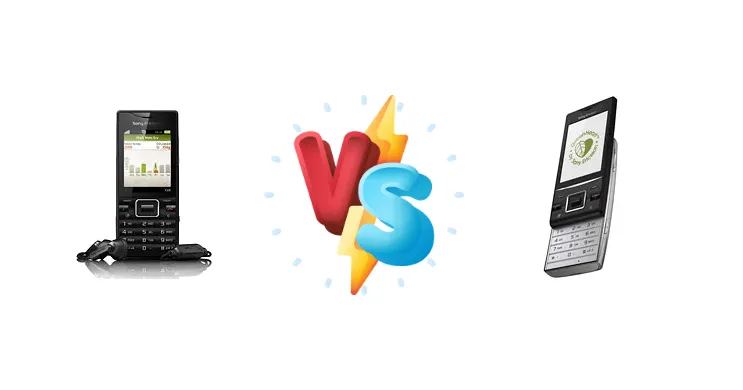
The early 2000s were a golden age for feature phones, and Sony Ericsson was at the forefront. The Elm and Hazel, both released around 2006, offered stylish designs and decent functionality for their time. But which one holds up better today? Let's dive into a detailed comparison.
🏆 Quick Verdict
Both the Elm and Hazel offer a nostalgic experience. The Hazel likely edges out the Elm due to potentially slightly better build quality and a marginally more refined design, though both are very similar. Ultimately, the choice depends on personal preference for color and minor aesthetic details.
| Network |
|---|
| 2G bands | GSM 850 / 900 / 1800 / 1900 | GSM 850 / 900 / 1800 / 1900 |
| 3G bands | HSDPA 2100 | HSDPA 900 / 2100 |
| Speed | HSPA 7.2/1.8 Mbps | HSPA 7.2/2 Mbps |
| Technology | GSM / HSPA | GSM / HSPA |
| | HSDPA 900 / 2100 | HSDPA 2100 |
| Launch |
|---|
| Announced | 2009, December. Released 2010, March | 2009, December. Released 2010, May |
| Status | Discontinued | Discontinued |
| Body |
|---|
| Dimensions | 110 x 45 x 14 mm (4.33 x 1.77 x 0.55 in) | 102 x 49.5 x 16 mm (4.02 x 1.95 x 0.63 in) |
| SIM | Mini-SIM | Mini-SIM |
| Weight | 90 g (3.17 oz) | 120 g (4.23 oz) |
| | Splash resistant | Splash resistant |
| Display |
|---|
| Protection | - | Scratch-resistant glass |
| Resolution | 240 x 320 pixels, 4:3 ratio (~182 ppi density) | 240 x 320 pixels, 4:3 ratio (~154 ppi density) |
| Size | 2.2 inches, 15.0 cm2 (~30.3% screen-to-body ratio) | 2.6 inches, 20.9 cm2 (~41.5% screen-to-body ratio) |
| Type | TFT, 256K colors | TFT, 16M colors |
| Memory |
|---|
| Call records | Yes | Yes |
| Card slot | microSDHC (dedicated slot) | microSDHC (dedicated slot) |
| Internal | 280MB | 280MB |
| Phonebook | 1000 entries, Photocall | 1000 entries, Photocall |
| Main Camera |
|---|
| Features | LED flash | LED flash |
| Single | 5 MP, AF | 5 MP, AF |
| Video | 480p@30fps | 480p@30fps |
| Selfie camera |
|---|
| Single | - | Yes |
| | No | - |
| Sound |
|---|
| 3.5mm jack | No | No |
| 35mm jack | No | No |
| Loudspeaker | Yes | Yes |
| Comms |
|---|
| Bluetooth | 2.1, A2DP, EDR | 2.1, A2DP |
| Positioning | GPS, A-GPS; Wisepilot navigation | GPS, A-GPS; Wisepilot navigation |
| Radio | Stereo FM radio, RDS | Stereo FM radio, RDS |
| USB | USB 2.0 | USB 2.0 |
| WLAN | Wi-Fi 802.11 b/g, DLNA | Wi-Fi 802.11 b/g, DLNA |
| Features |
|---|
| Browser | WAP 2.0/HTML (NetFront), RSS reader | WAP 2.0/xHTML, HTML (NetFront), RSS reader |
| Games | Yes, incl. motion-based + downloadable | Yes, incl. motion-based + downloadable |
| Java | Yes, MIDP 2.0 | Yes, MIDP 2.0 |
| Messaging | SMS(threaded view), MMS, Email, Push Email, IM | SMS(threaded view), MMS, Email, Push Email, IM |
| Sensors | Accelerometer | Accelerometer |
| | HD Voice ready
MP3/eAAC+/WAV player
SensMe, Track ID
MP4/H.264 player
Photo editor
Widget Manager
Organizer
Eco friendly materials
Walkmate, CO2 Calculator
Voice memo/dial
Predictive text input | HD Voice ready
MP3/eAAC+/WAV player
SensMe, Track ID
MP4/H.264 player
Photo editor
Widget Manager
Organizer
Eco friendly materials
Walkmate, CO2 Calculator
Voice memo/dial
Predictive text input |
| Battery |
|---|
| Stand-by | Up to 336 h (2G) / Up to 424 h (3G) | Up to 469 h (2G) / Up to 588 h (3G) |
| Talk time | Up to 4 h 30 min (2G) / Up to 3 h 40 min (3G) | Up to 4 h 10 min (2G) / Up to 3 h 20 min (3G) |
| Type | Removable Li-Po 1000 mAh battery (BST-43) | Removable Li-Po 1000 mAh battery (BST-43) |
| Misc |
|---|
| Colors | Metal Black, Pearly Rose | Superior Black, Passionate Rouge |
| Price | About 100 EUR | About 110 EUR |
| SAR EU | 1.24 W/kg (head) | 0.68 W/kg (head) |
| Tests |
|---|
| Audio quality |
Noise -87.2dB / Crosstalk -85.9dB |
Noise -87.3dB / Crosstalk -86.8dB |
| Camera |
Photo |
Photo |
| Loudspeaker |
Voice 61dB / Noise 61dB / Ring 69dB |
Voice 65dB / Noise 62dB / Ring 66dB
|
Sony Ericsson Elm
- Classic, understated design
- Comfortable grip
- Simple and easy to use
- Good battery life (typical for the era)
- Low-resolution display
- Poor camera quality
- Limited performance
- Outdated technology
Sony Ericsson Hazel
- Slightly more refined design
- Potentially better build quality
- Simple and easy to use
- Good battery life (typical for the era)
- Low-resolution display
- Poor camera quality
- Limited performance
- Outdated technology
Display Comparison
Both the Elm and Hazel featured relatively small, standard-definition displays typical of the era. Expect resolutions around 176x220 pixels. Screen technology was likely LCD, offering decent visibility in good lighting but struggling in direct sunlight. There's no clear winner here; they're functionally equivalent.
Camera Comparison
Both phones are listed as having a 'Photo' camera, indicating a basic, low-resolution camera (likely 1.3MP or 2MP). Image quality would be poor by modern standards, suitable only for quick snapshots in ideal conditions. Expect grainy images and limited detail. Camera performance is essentially identical.
Performance
Performance was limited by the processors of the time. Expect basic functionality like calling, texting, and simple games. Neither phone was designed for multitasking or demanding applications. Performance will be similar across both devices, constrained by their hardware.
Battery Life
Battery capacity was likely in the range of 800-1000 mAh for both models. Expect a few days of moderate use, primarily for calls and texts. Standby time would also be respectable. Battery life is likely comparable, though real-world usage will vary.
Buying Guide
The Sony Ericsson Elm is for those who appreciate a classic, understated design and a comfortable grip. The Sony Ericsson Hazel is ideal for those who prefer a slightly more polished look and a potentially more durable feel. Both are great for nostalgia seekers and those wanting a simple, distraction-free phone.
Frequently Asked Questions
❓ Are these phones worth buying in 2024?
They're primarily valuable for nostalgia and as a simple, distraction-free phone. Don't expect modern smartphone features or performance.
❓ Can I use these phones with a modern SIM card?
Likely not without modification. They use older SIM card sizes and network technologies. Compatibility is a significant challenge.