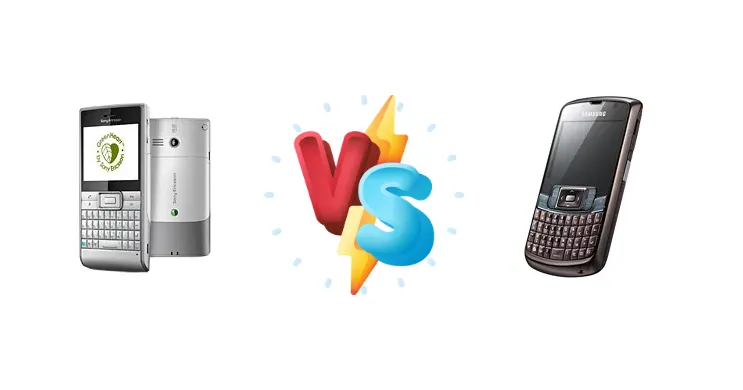
Remember the days of physical keyboards and early smartphone experimentation? The Sony Ericsson Aspen and Samsung B7320 OmniaPRO represent that era. Both devices offered unique features and aimed to bridge the gap between feature phones and full-fledged smartphones. Let's see how they stack up today.
🏆 Quick Verdict
The Sony Ericsson Aspen edges out the OmniaPRO thanks to its slightly faster processor and generally more appealing design. However, the OmniaPRO's broader feature set and potentially better software support (at the time) make it a close contender. Both are relics, but the Aspen offers a marginally better experience.
| Network |
|---|
| 2G bands | GSM 850 / 900 / 1800 / 1900 | GSM 850 / 900 / 1800 / 1900 |
| 3G bands | HSDPA 900 / 2100 | HSDPA 900 / 1900 / 2100 |
| Speed | HSPA 7.2/2 Mbps | HSPA 7.2/2 Mbps |
| Technology | GSM / HSPA | GSM / HSPA |
| | HSDPA 850 / 900 / 2100 | - |
| Launch |
|---|
| Announced | 2010, February. Released 2010, July | 2009, May. Released 2009, August |
| Status | Discontinued | Discontinued |
| Body |
|---|
| Dimensions | 117 x 60 x 12.5 mm (4.61 x 2.36 x 0.49 in) | 111.8 x 59.6 x 12.6 mm (4.40 x 2.35 x 0.50 in) |
| Keyboard | QWERTY | QWERTY |
| SIM | Mini-SIM | Mini-SIM |
| Weight | 130 g (4.59 oz) | 110 g (3.88 oz) |
| Display |
|---|
| Resolution | 320 x 240 pixels, 4:3 ratio (~167 ppi density) | 320 x 240 pixels, 4:3 ratio (~167 ppi density) |
| Size | 2.4 inches, 17.8 cm2 (~25.4% screen-to-body ratio) | 2.4 inches, 17.8 cm2 (~26.8% screen-to-body ratio) |
| Type | TFT resistive touchscreen, 65K colors | TFT, 65K colors |
| | XPERIA Panels | - |
| Platform |
|---|
| CPU | 600 MHz ARM 11 | 528 MHz ARM 11 |
| Chipset | Qualcomm MSM7227 Snapdragon S1 | Qualcomm MSM7201A |
| GPU | Adreno 200 | Adreno 130 GPU |
| OS | Microsoft Windows Mobile 6.5.3 Professional | MS Windows Mobile 6.1 Standard, upgradable to Windows Mobile 6.5 |
| Memory |
|---|
| Card slot | microSDHC (dedicated slot), 4 GB included | microSDHC (dedicated slot) |
| Internal | 256MB RAM, 256MB ROM, 100MB | 100MB 256MB RAM 256MB ROM |
| Main Camera |
|---|
| Single | 3.15 MP | 3.15 MP |
| Video | 480p@15fps | Yes |
| Sound |
|---|
| 3.5mm jack | Yes | No |
| 35mm jack | Yes | No |
| Loudspeaker | Yes | Yes |
| Comms |
|---|
| Bluetooth | 2.1, A2DP | 2.0, A2DP |
| Positioning | GPS, A-GPS | GPS, A-GPS |
| Radio | Stereo FM radio, RDS | Stereo FM radio, RDS |
| USB | microUSB 2.0 | 2.0 |
| WLAN | Wi-Fi 802.11 b/g | Wi-Fi 802.11 b/g |
| Features |
|---|
| Browser | WAP 2.0/HTML (IE), RSS feeds | WAP 2.0 / xHTML, HTML, Adobe Flash Lite |
| | MP3/eAAC+/WAV/WMA player
MP4/H.264/WMV player
Pocket Office
Organizer
Eco friendly materials
Voice memo/dial
Predictive text input | MP4/H.264/WMV player
MP3/eAAC+/WMA player
Windows Live, Yahoo!, AOL
Microsoft Outlook Mobile
Pocket Office
Voice memo/dial
Predictive text input |
| Battery |
|---|
| Music play | Up to 12 h | - |
| Stand-by | Up to 560 h (2G) / Up to 500 h (3G) | Up to 590 h |
| Talk time | Up to 6 h 30 min (2G) / Up to 7 h 30 min (3G) | Up to 10 h |
| Type | Removable Li-Po 1500 mAh battery | Removable Li-Ion 1480 mAh battery |
| Misc |
|---|
| Colors | Iconic Black, White Silver | Black |
| Price | About 70 EUR | About 110 EUR |
| SAR EU | 1.05 W/kg (head) | 0.64 W/kg (head) |
| Tests |
|---|
| Audio quality |
Noise -79.5dB / Crosstalk -79.8dB | - |
| Camera |
Photo | - |
| Loudspeaker |
Voice 71dB / Noise 66dB / Ring 75dB | - |
Sony Ericsson Aspen
- Slightly faster processor
- Classic Sony Ericsson design
- Physical keyboard
- Potentially better software support (historically)
- Limited display quality
- Basic camera
- Outdated software
- Difficult to find parts/support
Samsung B7320 OmniaPRO
- Windows Mobile OS (at the time)
- Physical keyboard
- Business-oriented features
- Potentially more robust build quality
- Slower processor
- Limited display quality
- Basic camera
- Outdated software
- Difficult to find parts/support
Display Comparison
Both phones featured relatively small displays by modern standards, typically around 2.8-3.0 inches. The Aspen likely had a slightly better resolution, but both suffered from limited viewing angles and color accuracy. Expect a dim and grainy experience compared to today's screens.
Camera Comparison
Both phones featured basic cameras, likely in the 3.2MP range. Image quality was poor by today's standards, with limited dynamic range and noticeable noise. The Aspen's camera might have slightly better color reproduction, but overall, don't expect impressive photos from either device.
Performance
The Sony Ericsson Aspen boasts a 600 MHz Qualcomm MSM7227 Snapdragon S1 chipset, giving it a slight edge over the Samsung B7320 OmniaPRO's 528 MHz Qualcomm MSM7201A. This translates to marginally faster app loading and smoother multitasking, though neither phone is a powerhouse by any stretch. Expect lag and slowdowns with demanding tasks.
Battery Life
Battery life was a strong point for both devices, typical of the era. Expect a full day of moderate use, though heavy usage (web browsing, video playback) would drain the battery more quickly. The Aspen's slightly more efficient chipset might give it a small advantage.
Buying Guide
The Sony Ericsson Aspen is for collectors and those nostalgic for Sony Ericsson's design language and physical keyboards. The Samsung B7320 OmniaPRO might appeal to those interested in Samsung's early Windows Mobile attempts and a more business-oriented device, though finding working software is a challenge.
Frequently Asked Questions
❓ Are these phones still usable today?
Technically yes, but with significant limitations. Finding working software and compatible accessories is challenging. They are primarily collector's items now.
❓ Where can I find these phones?
Online marketplaces like eBay and specialized retro phone retailers are your best bet. Be prepared to pay a premium for a working model.
❓ What operating systems did these phones run?
The Sony Ericsson Aspen ran Sony Ericsson's proprietary UI on top of Android. The Samsung B7320 OmniaPRO ran Windows Mobile.