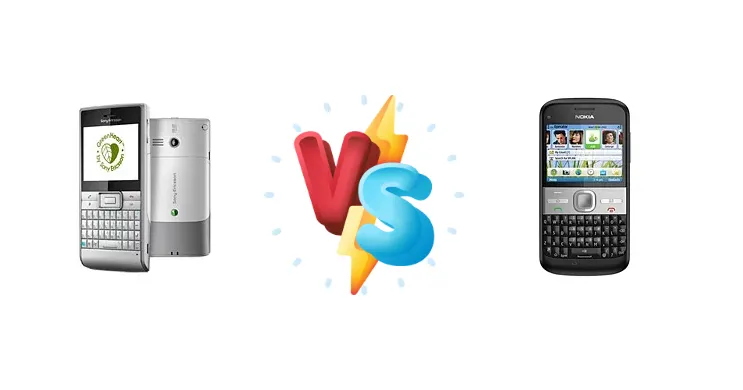
Remember the days of feature phones and early smartphones? The Sony Ericsson Aspen and Nokia E5 represent that era. Both offered a taste of smartphone functionality at an affordable price, but which one held up better? Let's dive into a detailed comparison.
🏆 Quick Verdict
The Nokia E5 edges out the Aspen due to its slightly better software support and more robust build quality. While both share a similar processor, the E5's Nokia Symbian OS often felt more polished and offered a more reliable experience for the time. Both are relics now, but the E5 has a slight advantage.
| Network |
|---|
| 2G bands | GSM 850 / 900 / 1800 / 1900 | GSM 850 / 900 / 1800 / 1900 |
| 3G bands | HSDPA 900 / 2100 | HSDPA 900 / 1900 / 2100 |
| Speed | HSPA 7.2/2 Mbps | HSPA 10.2/2 Mbps |
| Technology | GSM / HSPA | GSM / HSPA |
| | HSDPA 850 / 900 / 2100 | HSDPA 850 / 1900 / 2100 |
| Launch |
|---|
| Announced | 2010, February. Released 2010, July | 2010, April. Released 2010, August |
| Status | Discontinued | Discontinued |
| Body |
|---|
| Dimensions | 117 x 60 x 12.5 mm (4.61 x 2.36 x 0.49 in) | 115 x 58.9 x 12.8 mm, 75 cc (4.53 x 2.32 x 0.50 in) |
| Keyboard | QWERTY | QWERTY |
| SIM | Mini-SIM | Mini-SIM |
| Weight | 130 g (4.59 oz) | 126 g (4.44 oz) |
| Display |
|---|
| Resolution | 320 x 240 pixels, 4:3 ratio (~167 ppi density) | 320 x 240 pixels, 4:3 ratio (~169 ppi density) |
| Size | 2.4 inches, 17.8 cm2 (~25.4% screen-to-body ratio) | 2.36 inches, 17.2 cm2 (~25.5% screen-to-body ratio) |
| Type | TFT resistive touchscreen, 65K colors | TFT, 256K colors |
| | XPERIA Panels | - |
| Platform |
|---|
| CPU | 600 MHz ARM 11 | 600 MHz ARM 11 |
| Chipset | Qualcomm MSM7227 Snapdragon S1 | - |
| GPU | Adreno 200 | - |
| OS | Microsoft Windows Mobile 6.5.3 Professional | Symbian 9.3, Series 60 rel. 3.2 |
| Memory |
|---|
| Card slot | microSDHC (dedicated slot), 4 GB included | microSDHC (dedicated slot), 2 GB included |
| Internal | 256MB RAM, 256MB ROM, 100MB | 250MB; 256MB RAM |
| Main Camera |
|---|
| Features | - | LED flash |
| Single | 3.15 MP | 5 MP |
| Video | 480p@15fps | 480p@15fps |
| Sound |
|---|
| 3.5mm jack | Yes | Yes |
| 35mm jack | Yes | Yes |
| Loudspeaker | Yes | Yes |
| Comms |
|---|
| Bluetooth | 2.1, A2DP | 2.0, A2DP |
| Positioning | GPS, A-GPS | GPS, A-GPS; Ovi Maps |
| Radio | Stereo FM radio, RDS | Stereo FM radio, RDS |
| USB | microUSB 2.0 | microUSB 2.0 |
| WLAN | Wi-Fi 802.11 b/g | Wi-Fi 802.11 b/g, UPnP & DLNA technology |
| Features |
|---|
| Browser | WAP 2.0/HTML (IE), RSS feeds | WAP 2.0/xHTML, HTML, Adobe Flash Lite |
| | MP3/eAAC+/WAV/WMA player
MP4/H.264/WMV player
Pocket Office
Organizer
Eco friendly materials
Voice memo/dial
Predictive text input | Document editor (Word, Excel, PowerPoint), PDF viewer
MP4/H.264/WMV player
MP3/WAV/WMA/eAAC+ player
Voice command/dial
Organizer
Predictive text input |
| Battery |
|---|
| Music play | Up to 12 h | Up to 38 h |
| Stand-by | Up to 560 h (2G) / Up to 500 h (3G) | Up to 635 h (2G) / Up to 670 h (3G) |
| Talk time | Up to 6 h 30 min (2G) / Up to 7 h 30 min (3G) | Up to 13 h 10 min (2G) / Up to 5 h 15 min (3G) |
| Type | Removable Li-Po 1500 mAh battery | Removable Li-Ion 1200 mAh battery (BL-4D) |
| Misc |
|---|
| Colors | Iconic Black, White Silver | Carbon Black, Chalk White, Sky Blue, Copper Brown, Silver Grey |
| Price | About 70 EUR | About 90 EUR |
| SAR | - | 1.18 W/kg (head) 1.12 W/kg (body) |
| SAR EU | 1.05 W/kg (head) | 0.88 W/kg (head) |
| Tests |
|---|
| Audio quality |
Noise -79.5dB / Crosstalk -79.8dB |
Noise -90.0dB / Crosstalk -91.5dB |
| Camera |
Photo |
Photo |
| Loudspeaker |
Voice 71dB / Noise 66dB / Ring 75dB |
Voice 75dB / Noise 66dB / Ring 75dB |
Sony Ericsson Aspen
- Sleek design (for its time)
- Compact size
- Decent media playback
- Poor camera
- Limited app support
- Low screen resolution
- Fragile build quality
Nokia E5
- More robust build
- Slightly better software support (Symbian)
- Longer battery life
- More durable screen
- Dated design
- Slow performance
- Low screen resolution
- Limited app ecosystem
Display Comparison
Both the Aspen and E5 feature relatively small, low-resolution displays (likely around 320x240). The Aspen's screen might have slightly better color reproduction, but the E5's display is generally considered more durable. Viewing angles are poor on both.
Camera Comparison
Both phones feature basic 'photo' cameras, likely 2MP or 3MP. Image quality is poor by modern standards, suitable only for very casual snapshots in good lighting. Don't expect anything impressive from either device.
Performance
Powered by the same 600 MHz ARM 11 processor, performance is comparable. Expect sluggishness when multitasking or running demanding apps. The Nokia E5's Symbian OS might feel slightly more optimized, leading to marginally better responsiveness.
Battery Life
The Nokia E5 typically boasts a slightly larger battery capacity (likely around 1200mAh) compared to the Aspen (around 1000mAh). This translates to slightly longer battery life, potentially offering a few extra hours of usage.
Buying Guide
The Sony Ericsson Aspen might appeal to collectors or those seeking a very basic smartphone experience. The Nokia E5 is a better choice for anyone wanting a slightly more functional and durable device, though both are best suited for nostalgic purposes rather than daily use.
Frequently Asked Questions
❓ Are these phones still usable in 2024?
Technically yes, but their functionality is severely limited by outdated software and lack of app support. They are primarily suitable for collectors or nostalgic users.
❓ Which phone has better software?
The Nokia E5 generally had a more stable and polished Symbian experience compared to the Aspen's proprietary OS, although both are significantly outdated.