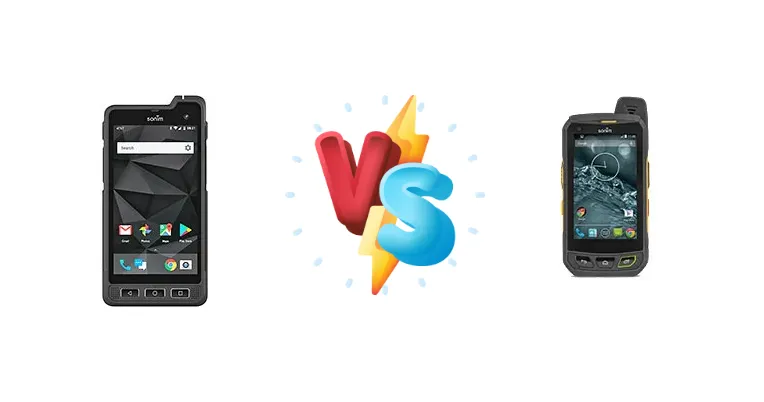
Sonim caters to a niche market: users demanding extreme durability. The XP8 and XP7 represent different tiers within that offering. While both are built to withstand harsh conditions, a significant gap exists in their internal hardware, impacting performance and usability. This comparison dissects those differences, helping you determine which Sonim best suits your needs.
🏆 Quick Verdict
For most users, the Sonim XP8 is the superior choice. Its Snapdragon 630 chipset delivers a noticeably smoother experience for multitasking and demanding applications, while Quick Charge 4 support offers faster refueling. The XP7 remains a viable option for basic communication needs, but its aging hardware shows its limitations.
| Network |
|---|
| 2G bands | GSM 850 / 900 / 1800 / 1900 | GSM 850 / 900 / 1800 / 1900 |
| 3G bands | HSDPA 850 / 900 / 1700(AWS) / 1900 / 2100 | HSDPA 850 / 900 / 1900 / 2100 |
| 4G bands | 1, 2, 3, 4, 5, 7, 8, 12, 13, 14, 20, 25, 26, 28, 29, 30, 38, 40, 41, 66 | 1, 2, 4, 5, 7, 8, 12, 17 |
| Speed | HSPA 42.2/5.76 Mbps, LTE (3CA) Cat12 600/150 Mbps | HSPA, LTE |
| Technology | GSM / CDMA / HSPA / EVDO / LTE | GSM / HSPA / LTE |
| | CDMA2000 1xEV-DO | 1, 2, 3, 4, 5, 7, 17 - Telus |
| Launch |
|---|
| Announced | 2018, April. Released 2018, May | 2014, November. Released 2015, April |
| Status | Discontinued | Discontinued |
| Body |
|---|
| Dimensions | 152 x 79.5 x 18 mm (5.98 x 3.13 x 0.71 in) | 137 x 72.1 x 20.8 mm (5.39 x 2.84 x 0.82 in) |
| SIM | Nano-SIM + Nano-SIM | Micro-SIM |
| Weight | 335 g (11.82 oz) | 290 g (10.23 oz) |
| | IP69 dust proof and water resistant over 1 meter and 30 minutes
MIL-STD-810G | IP69 dust proof and water resistant over 1 meter and 30 minutes |
| Display |
|---|
| Protection | Corning Gorilla Glass 3 | Corning Gorilla Glass 2 |
| Resolution | 1080 x 1920 pixels, 16:9 ratio (~441 ppi density) | 480 x 800 pixels, 5:3 ratio (~233 ppi density) |
| Size | 5.0 inches, 68.9 cm2 (~57.0% screen-to-body ratio) | 4.0 inches, 45.5 cm2 (~46.1% screen-to-body ratio) |
| Type | IPS LCD | IPS LCD |
| Platform |
|---|
| CPU | Octa-core 2.2 GHz Cortex-A53 | Quad-core 1.2 GHz Cortex-A7 |
| Chipset | Qualcomm SDM630 Snapdragon 630 (14 nm) | Qualcomm MSM8926 Snapdragon 400 (28 nm) |
| GPU | Adreno 508 | Adreno 305 |
| OS | Android 7.0 (Nougat) | Android 4.4.2 (KitKat) |
| Memory |
|---|
| Card slot | microSDXC | No |
| Internal | 64GB 4GB RAM | 16GB 1GB RAM |
| | - | eMMC 4.5 |
| Main Camera |
|---|
| Features | LED flash, HDR, panorama | LED flash |
| Single | 12 MP, PDAF | 8 MP, AF |
| Video | 1080p@30fps | 1080p@30fps |
| Selfie camera |
|---|
| Single | 8 MP | 1 MP |
| Video | 1080p@30fps | - |
| Sound |
|---|
| 3.5mm jack | No | Yes |
| 35mm jack | No | Yes |
| Loudspeaker | Yes | Yes |
| Comms |
|---|
| Bluetooth | 5.0, A2DP, EDR, LE | 4.0, A2DP, LE |
| NFC | Yes | Yes |
| Positioning | GPS, GLONASS | GPS, GLONASS |
| Radio | FM radio | FM radio |
| USB | USB Type-C 2.0, magnetic connector | microUSB 2.0 |
| WLAN | Wi-Fi 802.11 a/b/g/n/ac, dual-band, Wi-Fi Direct | Wi-Fi 802.11 a/b/g/n, dual-band, hotspot |
| Features |
|---|
| Sensors | Accelerometer, gyro, proximity, compass, barometer | Accelerometer, proximity |
| Battery |
|---|
| Charging | 18W wired, QC4 | - |
| Music play | Up to 70 h | - |
| Stand-by | Up to 720 h | Up to 1000 h |
| Talk time | Up to 30 h | Up to 40 h |
| Type | Li-Ion 4900 mAh, removable | Li-Ion 4800 mAh, non-removable |
| Misc |
|---|
| Colors | Black | Black, Yellow |
| Models | XP8800 | XP7700 |
| Price | About 700 EUR | About 700 EUR |
Sonim XP8
- Significantly faster processor for smoother performance
- More efficient chipset for better battery life under load
- Faster charging with Quick Charge 4 support
- Likely higher price point than the XP7
- May not offer a substantial camera improvement for casual users
Sonim XP7
- Potentially longer battery life during very light usage
- Lower price point, making it more accessible
- Still offers Sonim’s renowned rugged durability
- Slow processor struggles with multitasking and demanding apps
- Less efficient chipset leads to faster battery drain under load
- Slower charging speeds
Display Comparison
Neither Sonim provides detailed display specifications beyond their ruggedized construction. However, given the XP8’s more modern chipset, it likely benefits from a more efficient display driver. Both will prioritize visibility in direct sunlight over color accuracy. The XP8’s processing power could also allow for more sophisticated image processing to enhance display quality, though this is speculative without further data.
Camera Comparison
Without detailed camera specs, a direct comparison is difficult. However, the XP8’s more powerful ISP (Image Signal Processor) within the Snapdragon 630 will likely result in better image quality, particularly in low-light conditions. The 630’s processing capabilities allow for more advanced noise reduction and dynamic range optimization. While both phones likely feature similar sensor resolutions geared towards practicality rather than photography enthusiasts, the XP8’s processing advantage will be noticeable.
Performance
The core difference lies in the chipsets. The Sonim XP8’s Qualcomm Snapdragon 630, built on a 14nm process, features an octa-core CPU clocked at 2.2 GHz. This is a substantial upgrade over the XP7’s Snapdragon 400 (MSM8926), a quad-core 1.2 GHz processor fabricated on a less efficient 28nm node. The 630’s architecture (Cortex-A53) is also more modern, offering improved performance per clock cycle. The XP8 will exhibit significantly faster app loading times, smoother multitasking, and a more responsive user interface. The XP7 will struggle with anything beyond basic tasks, and its older architecture will lead to higher power consumption for similar workloads.
Battery Life
While battery capacity isn’t specified, the XP7’s less efficient 28nm Snapdragon 400 will likely drain the battery faster under load than the XP8’s 14nm Snapdragon 630. The XP8 also benefits from 18W wired charging with Quick Charge 4 (QC4) support, enabling significantly faster charging times compared to the XP7, which likely relies on slower, standard charging. This faster charging is a critical advantage for users who need to quickly replenish their battery during breaks.
Buying Guide
Buy the Sonim XP8 if you need a rugged phone capable of handling work applications, streaming media, or occasional gaming. Its more powerful processor and faster charging are essential for users who rely on their phone throughout a long workday. Buy the Sonim XP7 if your primary needs are voice calls and basic text messaging in challenging environments, and you prioritize maximum battery life over performance.
Frequently Asked Questions
❓ Will the Sonim XP8 handle demanding work apps like CAD viewers or remote desktop connections?
The Snapdragon 630 in the XP8 is significantly more capable of handling demanding applications than the XP7’s Snapdragon 400. While it won’t match a flagship processor, it should provide a usable experience for CAD viewers and remote desktop connections, especially with sufficient RAM (spec not provided, but likely 3-4GB).
❓ Is the faster charging on the XP8 a significant benefit for field workers?
Absolutely. The XP8’s 18W Quick Charge 4 support allows for a much faster top-up during breaks, minimizing downtime. Field workers who rely on their phone throughout the day will appreciate the ability to quickly add hours of battery life with a short charging session.
❓ Does the older processor in the XP7 impact its software update longevity?
Yes, the Snapdragon 400 is an older chipset, and Sonim may discontinue software updates for the XP7 sooner than for the XP8. This could leave the XP7 vulnerable to security threats and lacking new features over time.