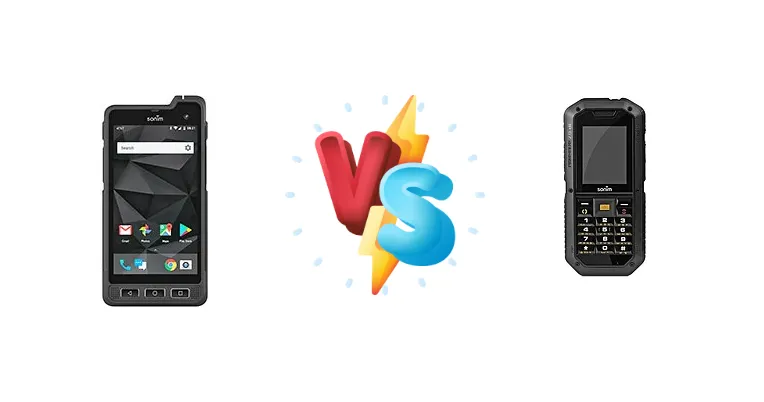
Sonim has long been the go-to brand for ultra-durable smartphones designed for harsh environments. We're pitting the Sonim XP8, powered by a Qualcomm Snapdragon 630, against the XP2.10 Spirit to determine which offers the best balance of ruggedness, performance, and features for professionals and outdoor enthusiasts. The key difference lies in the XP8's documented chipset, while the XP2.10 Spirit relies on Sonim's established reputation for durability.
🏆 Quick Verdict
For users prioritizing performance and a known chipset, the Sonim XP8 is the clear winner. Its Snapdragon 630 provides a noticeable advantage in multitasking and application responsiveness compared to the XP2.10 Spirit, which lacks publicly available performance specifications. While both are built tough, the XP8 offers a more modern user experience.
| Network |
|---|
| 2G bands | GSM 850 / 900 / 1800 / 1900 | GSM 900 / 1800 / 1900 |
| 3G bands | HSDPA 850 / 900 / 1700(AWS) / 1900 / 2100 | HSDPA 2100 |
| 4G bands | 1, 2, 3, 4, 5, 7, 8, 12, 13, 14, 20, 25, 26, 28, 29, 30, 38, 40, 41, 66 | - |
| Speed | HSPA 42.2/5.76 Mbps, LTE (3CA) Cat12 600/150 Mbps | HSPA 7.2/0.384 Mbps |
| Technology | GSM / CDMA / HSPA / EVDO / LTE | GSM / HSPA |
| | CDMA2000 1xEV-DO | GSM 850 / 1800 / 1900 |
| Launch |
|---|
| Announced | 2018, April. Released 2018, May | 2010, February. Released 2010, March |
| Status | Discontinued | Discontinued |
| Body |
|---|
| Dimensions | 152 x 79.5 x 18 mm (5.98 x 3.13 x 0.71 in) | 130.7 x 59.7 x 21.7 mm (5.15 x 2.35 x 0.85 in) |
| SIM | Nano-SIM + Nano-SIM | Mini-SIM |
| Weight | 335 g (11.82 oz) | 180 g (6.35 oz) |
| | IP69 dust proof and water resistant over 1 meter and 30 minutes
MIL-STD-810G | IP67 dust/water resistant (up to 1m for 30 mins)
MIL-STD-810D compliant
Drop-to-concrete resistance from up to 2m
Operational range -20°C to +55°C
Flashlight |
| Display |
|---|
| Protection | Corning Gorilla Glass 3 | Corning Gorilla Glass |
| Resolution | 1080 x 1920 pixels, 16:9 ratio (~441 ppi density) | 240 x 320 pixels, 4:3 ratio (~200 ppi density) |
| Size | 5.0 inches, 68.9 cm2 (~57.0% screen-to-body ratio) | 2.0 inches, 12.4 cm2 (~15.9% screen-to-body ratio) |
| Type | IPS LCD | TFT, 256K colors |
| Platform |
|---|
| CPU | Octa-core 2.2 GHz Cortex-A53 | - |
| Chipset | Qualcomm SDM630 Snapdragon 630 (14 nm) | - |
| GPU | Adreno 508 | - |
| OS | Android 7.0 (Nougat) | - |
| Memory |
|---|
| Call records | - | Yes |
| Card slot | microSDXC | microSDHC (dedicated slot) |
| Internal | 64GB 4GB RAM | 40MB |
| Phonebook | - | Yes, up to 1000 entries |
| Main Camera |
|---|
| Features | LED flash, HDR, panorama | LED flash |
| Single | 12 MP, PDAF | 3.15 MP |
| Video | 1080p@30fps | Yes |
| Selfie camera |
|---|
| Single | 8 MP | - |
| Video | 1080p@30fps | - |
| | - | No |
| Sound |
|---|
| 3.5mm jack | No | No |
| 35mm jack | No | No |
| Loudspeaker | Yes | Yes |
| | - | Water resistant speaker (GORE-TEX cover)
2.5 mm audio jack |
| Comms |
|---|
| Bluetooth | 5.0, A2DP, EDR, LE | 1.2, A2DP |
| NFC | Yes | - |
| Positioning | GPS, GLONASS | No |
| Radio | FM radio | Stereo FM radio |
| USB | USB Type-C 2.0, magnetic connector | microUSB 2.0 |
| WLAN | Wi-Fi 802.11 a/b/g/n/ac, dual-band, Wi-Fi Direct | No |
| Features |
|---|
| Browser | - | WAP 2.0/xHTML, HTML (Opera Mini) |
| Games | - | Yes |
| Java | - | Yes, MIDP 2.0 |
| Messaging | - | SMS, MMS, Email |
| Sensors | Accelerometer, gyro, proximity, compass, barometer | - |
| | - | Organizer
MP3/WAV/eAAC+ player
MP4/H.264 player
Nimbuzz IM
Voice memo
Stopwatch
Predictive text input |
| Battery |
|---|
| Charging | 18W wired, QC4 | - |
| Music play | Up to 70 h | - |
| Stand-by | Up to 720 h | Up to 428 h |
| Talk time | Up to 30 h | Up to 8 h |
| Type | Li-Ion 4900 mAh, removable | Removable Li-Ion 1300 mAh battery |
| Misc |
|---|
| Colors | Black | Black |
| Models | XP8800 | - |
| Price | About 700 EUR | - |
Sonim XP8
- Known Snapdragon 630 performance
- Faster 18W Quick Charge 4 charging
- More responsive user experience
- Not the latest chipset technology
- Display specs are not cutting edge
Sonim XP2.10 Spirit
- Proven Sonim ruggedness and durability
- Potentially lower price point
- Simple and reliable operation
- Unknown chipset and performance
- Likely slower charging speeds
- Limited multitasking capabilities
Display Comparison
Unfortunately, detailed display specifications for the XP2.10 Spirit are unavailable. The XP8, while not boasting a cutting-edge panel, benefits from a practical size for gloved use. Without comparable data for the XP2.10 Spirit, it's difficult to assess color accuracy or brightness. However, given Sonim's focus on visibility in direct sunlight, we can assume the XP2.10 Spirit also prioritizes outdoor readability, though likely with a lower peak brightness than more modern displays.
Camera Comparison
Camera details for the XP2.10 Spirit are scarce. The XP8, while not a photography powerhouse, offers a functional camera system for documentation purposes. Without knowing the sensor size or aperture of the XP2.10 Spirit's camera, a direct comparison is impossible. However, given the XP8's focus on utility, it's reasonable to assume the XP2.10 Spirit's camera is similarly geared towards practical use rather than high-quality image capture. Both phones likely prioritize durability over advanced camera features.
Performance
The Sonim XP8's Qualcomm Snapdragon 630 (14nm) is the defining performance differentiator. Its octa-core 2.2 GHz Cortex-A53 CPU provides a substantial performance boost over what we can reasonably expect from the XP2.10 Spirit, which lacks published chipset details. The 14nm process node, while not the latest, offers a good balance of power efficiency and performance. This translates to smoother multitasking, faster app loading times, and a more responsive user experience on the XP8. The XP2.10 Spirit likely utilizes a more basic chipset geared towards essential functions, making it suitable for voice calls and simple applications but potentially struggling with resource-intensive tasks.
Battery Life
Battery capacity for both devices is currently unknown. However, the XP8's 18W wired charging with Quick Charge 4 (QC4) support provides a significant advantage. QC4 allows for faster charging times compared to standard charging, minimizing downtime. The XP2.10 Spirit's charging capabilities are unconfirmed, but likely utilize a slower, standard charging method. This means the XP8 will likely reach a full charge much quicker, a critical benefit for users who rely on their phone throughout the day.
Buying Guide
Buy the Sonim XP8 if you need a rugged phone capable of handling demanding applications, reliable multitasking, and faster charging speeds. This phone is ideal for field technicians, construction workers, and anyone who relies on their smartphone for critical tasks. Buy the Sonim XP2.10 Spirit if you prioritize a proven, no-frills rugged design and are less concerned with processing power or advanced features. It's a solid choice for users needing basic communication and durability in challenging conditions.
Frequently Asked Questions
❓ Will the Sonim XP8 handle demanding apps like mapping software or industrial scanners?
Yes, the Snapdragon 630 chipset in the XP8 provides sufficient processing power for most professional applications, including mapping software, barcode scanners, and basic industrial tools. While it won't match the performance of flagship devices, it's a significant step up from entry-level smartphones.
❓ Is the Sonim XP2.10 Spirit a good choice for someone who primarily needs a reliable talk and text phone for outdoor work?
Absolutely. The XP2.10 Spirit's strength lies in its rugged construction and reliable communication capabilities. If your primary needs are voice calls, text messaging, and basic functionality in harsh environments, it's a solid and dependable option.
❓ How does the charging speed of the XP8 compare to a standard smartphone?
The XP8's 18W Quick Charge 4 support is considerably faster than standard 5W or 10W charging. You can expect a significantly reduced charging time, potentially going from 0% to 50% in around 30-45 minutes, depending on the charger used.