
Sonim XP8 vs. Motorola One 5G: A Deep Dive into Ruggedness and 5G Connectivity
| Phones Images | |||||
|---|---|---|---|---|---|
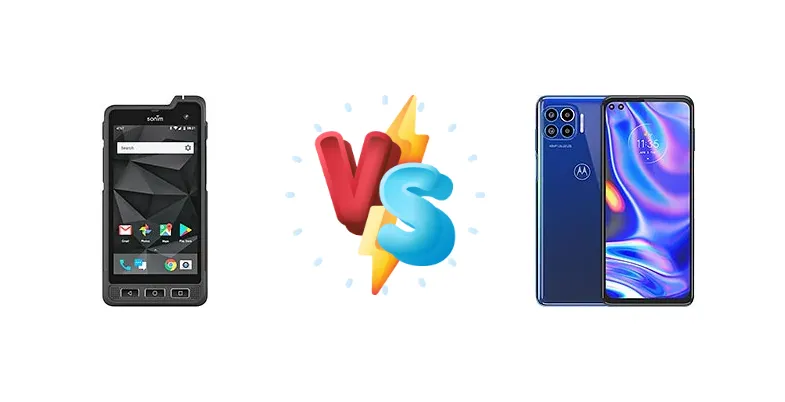
|
🏆 Quick Verdict
For the average user prioritizing connectivity and everyday performance, the Motorola One 5G is the stronger choice. Its Snapdragon 765 offers a significant performance leap over the XP8’s Snapdragon 630, and 5G support future-proofs the device. However, if your work or lifestyle necessitates unparalleled ruggedness, the Sonim XP8 remains the clear winner.
| PHONES | ||
|---|---|---|
| Phone Names | Sonim XP8 | Motorola One 5G |
| Network | ||
|---|---|---|
| 2G bands | GSM 850 / 900 / 1800 / 1900 | GSM 850 / 900 / 1800 / 1900 |
| 3G bands | HSDPA 850 / 900 / 1700(AWS) / 1900 / 2100 | HSDPA 850 / 900 / 1700(AWS) / 1900 / 2100 |
| 4G bands | 1, 2, 3, 4, 5, 7, 8, 12, 13, 14, 20, 25, 26, 28, 29, 30, 38, 40, 41, 66 | 1, 2, 3, 4, 5, 7, 8, 12, 13, 14, 17, 18, 19, 20, 25, 26, 29, 30, 38, 39, 40, 41, 66, 71 |
| 5G bands | - | 2, 5, 25, 41, 66, 71 SA/NSA |
| Speed | HSPA 42.2/5.76 Mbps, LTE (3CA) Cat12 600/150 Mbps | HSPA, LTE, 5G |
| Technology | GSM / CDMA / HSPA / EVDO / LTE | GSM / HSPA / LTE / 5G |
| CDMA2000 1xEV-DO | - | |
| Launch | ||
|---|---|---|
| Announced | 2018, April. Released 2018, May | 2020, September 01. Released 2020, September 14 |
| Status | Discontinued | Discontinued |
| Body | ||
|---|---|---|
| Build | - | Glass front, plastic back, plastic frame |
| Dimensions | 152 x 79.5 x 18 mm (5.98 x 3.13 x 0.71 in) | 168 x 74 x 9 mm (6.61 x 2.91 x 0.35 in) |
| SIM | Nano-SIM + Nano-SIM | Nano-SIM |
| Weight | 335 g (11.82 oz) | 207 g (7.30 oz) |
| IP69 dust proof and water resistant over 1 meter and 30 minutes MIL-STD-810G | Water-repellent coating | |
| Display | ||
|---|---|---|
| Protection | Corning Gorilla Glass 3 | - |
| Resolution | 1080 x 1920 pixels, 16:9 ratio (~441 ppi density) | 1080 x 2520 pixels, 21:9 ratio (~409 ppi density) |
| Size | 5.0 inches, 68.9 cm2 (~57.0% screen-to-body ratio) | 6.7 inches, 104.9 cm2 (~84.3% screen-to-body ratio) |
| Type | IPS LCD | IPS LCD, 90Hz, HDR10 |
| Platform | ||
|---|---|---|
| CPU | Octa-core 2.2 GHz Cortex-A53 | Octa-core (1x2.3 GHz Kryo 475 Prime & 1x2.2 GHz Kryo 475 Gold & 6x1.8 GHz Kryo 475 Silver) |
| Chipset | Qualcomm SDM630 Snapdragon 630 (14 nm) | Qualcomm SM7250 Snapdragon 765 5G (7 nm) |
| GPU | Adreno 508 | Adreno 620 |
| OS | Android 7.0 (Nougat) | Android 10 |
| Memory | ||
|---|---|---|
| Card slot | microSDXC | microSDXC (dedicated slot) |
| Internal | 64GB 4GB RAM | 128GB 4GB RAM |
| - | UFS 2.1 | |
| Main Camera | ||
|---|---|---|
| Features | LED flash, HDR, panorama | Dual-LED flash, ring flash (macro camera), panorama, HDR |
| Quad | - | 48 MP, f/1.8, 26mm (wide), 1/2.0", 0.8µm, PDAF 8 MP, f/2.2, 118˚ (ultrawide), 1.12µm 5 MP (macro), AF Auxiliary lens |
| Single | 12 MP, PDAF | - |
| Video | 1080p@30fps | 4K@30fps, 1080p@30/60fps, gyro-EIS |
| Selfie camera | ||
|---|---|---|
| Dual | - | 16 MP, f/2.0, (wide), 1.0µm 8 MP, f/2.2, (ultrawide), 1.12µm |
| Features | - | HDR |
| Single | 8 MP | - |
| Video | 1080p@30fps | 1080p@30fps |
| Sound | ||
|---|---|---|
| 3.5mm jack | No | Yes |
| 35mm jack | No | Yes |
| Loudspeaker | Yes | Yes |
| Comms | ||
|---|---|---|
| Bluetooth | 5.0, A2DP, EDR, LE | 5.1, A2DP, LE |
| NFC | Yes | Yes |
| Positioning | GPS, GLONASS | GPS (L1+L5), GLONASS, GALILEO |
| Radio | FM radio | FM radio |
| USB | USB Type-C 2.0, magnetic connector | USB Type-C 2.0 |
| WLAN | Wi-Fi 802.11 a/b/g/n/ac, dual-band, Wi-Fi Direct | Wi-Fi 802.11 a/b/g/n/ac, dual-band, Wi-Fi Direct |
| Features | ||
|---|---|---|
| Sensors | Accelerometer, gyro, proximity, compass, barometer | Fingerprint (side-mounted), accelerometer, gyro, proximity, compass |
| Battery | ||
|---|---|---|
| Charging | 18W wired, QC4 | 15W wired |
| Music play | Up to 70 h | - |
| Stand-by | Up to 720 h | - |
| Talk time | Up to 30 h | - |
| Type | Li-Ion 4900 mAh, removable | Li-Po 5000 mAh |
| Misc | ||
|---|---|---|
| Colors | Black | Oxford Blue |
| Models | XP8800 | - |
| Price | About 700 EUR | About 420 EUR |
Sonim XP8
- Unmatched Ruggedness: Built to withstand drops, dust, and water.
- Quick Charge 4 Support: 18W charging offers faster initial charging.
- Long-Term Support: Sonim is known for providing extended software support.
- Outdated Processor: Snapdragon 630 struggles with modern tasks.
- Limited 5G Connectivity: Lacks 5G support, hindering future-proofing.
Motorola One 5G
- 5G Connectivity: Enables faster download and streaming speeds.
- Modern Processor: Snapdragon 765 delivers significantly better performance.
- Improved Power Efficiency: 7nm process reduces power consumption.
- Less Durable: Not as rugged as the Sonim XP8.
- Slower Charging: 15W charging is slower than the XP8’s QC4.
Display Comparison
Neither device boasts a cutting-edge display. While specific display specs (resolution, panel type) are not provided for the Sonim XP8, its focus is on functionality over aesthetics. The Motorola One 5G likely features an LCD panel, common in its price bracket. The key difference lies in processing power impacting UI smoothness; the XP8’s older chipset will struggle with fluid animations compared to the One 5G. Bezels are expected to be larger on the XP8 due to its ruggedized design, prioritizing impact absorption over a modern, edge-to-edge look.
Camera Comparison
Without detailed camera specifications, a direct comparison is limited. However, given the market positioning, the Motorola One 5G likely features a more versatile camera system. While the Sonim XP8 prioritizes durability, its camera is likely a functional, rather than a feature-rich, component. The Snapdragon 765 also includes an integrated Image Signal Processor (ISP) capable of more advanced image processing, potentially resulting in better low-light performance and dynamic range on the Motorola One 5G. The absence of information on OIS or sensor size makes a definitive statement impossible, but the One 5G’s chipset suggests a more capable imaging experience.
Performance
The Motorola One 5G’s Qualcomm SM7250 Snapdragon 765 5G, fabricated on a 7nm process, represents a substantial upgrade over the Sonim XP8’s Snapdragon 630 (14nm). The 765 features a more sophisticated CPU cluster – a Kryo 475 Prime core, a Kryo 475 Gold core, and six Kryo 475 Silver cores – offering significantly improved multi-core performance and efficiency. The XP8’s Octa-core 2.2 GHz Cortex-A53 CPU will feel sluggish in comparison, especially when multitasking or running demanding applications. The 7nm process also translates to better thermal management, reducing the likelihood of throttling during sustained workloads. This benefits users who stream video, browse the web, or use productivity apps for extended periods.
Battery Life
The Sonim XP8’s battery capacity is not specified, but rugged phones often prioritize larger batteries for extended uptime in the field. The Motorola One 5G’s battery size is also unknown, but its 15W charging is slower than the Sonim XP8’s 18W charging with Quick Charge 4 (QC4). However, the Snapdragon 765’s superior power efficiency means the One 5G will likely achieve comparable or even better battery life despite potentially having a smaller capacity. QC4 on the XP8 offers faster initial charging bursts, but the overall impact on daily usage will be less significant than the chipset’s efficiency.
Buying Guide
Buy the Sonim XP8 if you require a virtually indestructible phone for harsh conditions – construction sites, field work, or any environment where drops and exposure to the elements are commonplace. Buy the Motorola One 5G if you prioritize a smoother user experience, faster download speeds with 5G, and a more modern processor for everyday tasks and light gaming, all at a competitive price.