
Sonim XP8 vs Cat S61: A Head-to-Head of Rugged Smartphone Twins
| Phones Images | |||||
|---|---|---|---|---|---|
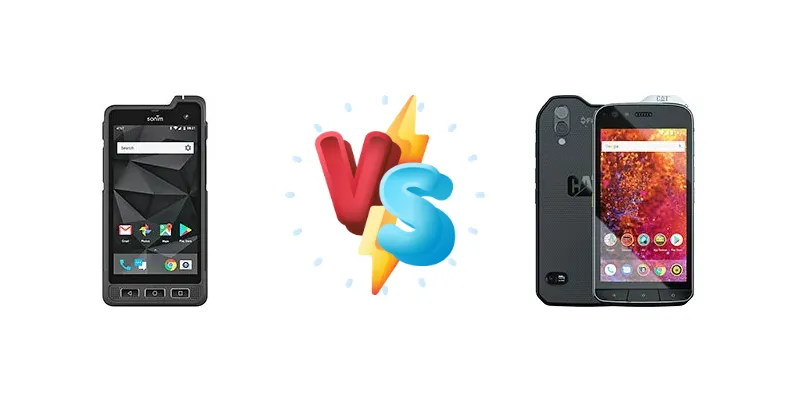
|
🏆 Quick Verdict
For the average user needing a truly rugged phone, the choice between the Sonim XP8 and Cat S61 is largely down to brand preference and software experience. Given their identical core hardware, the Sonim XP8 edges out slightly due to its historically stronger focus on push-to-talk functionality, a key feature for many target users.
| PHONES | ||
|---|---|---|
| Phone Names | Sonim XP8 | Cat S61 |
| Network | ||
|---|---|---|
| 2G bands | GSM 850 / 900 / 1800 / 1900 | GSM 850 / 900 / 1800 / 1900 |
| 3G bands | HSDPA 850 / 900 / 1700(AWS) / 1900 / 2100 | HSDPA 850 / 900 / 1700 / 1900 / 2100 - EU/ROW |
| 4G bands | 1, 2, 3, 4, 5, 7, 8, 12, 13, 14, 20, 25, 26, 28, 29, 30, 38, 40, 41, 66 | 1, 2, 3, 5, 7, 8, 19, 20, 26, 28, 38, 39, 40, 41 - EU/ROW |
| Speed | HSPA 42.2/5.76 Mbps, LTE (3CA) Cat12 600/150 Mbps | HSPA 42.2/5.76 Mbps, LTE (3CA) Cat12 600/150 Mbps |
| Technology | GSM / CDMA / HSPA / EVDO / LTE | GSM / HSPA / LTE |
| CDMA2000 1xEV-DO | 1, 2, 3, 4, 5, 7, 8, 12, 13, 17, 25, 26, 28, 29, 66 - USA | |
| Launch | ||
|---|---|---|
| Announced | 2018, April. Released 2018, May | 2018, February. Released 2018, June |
| Status | Discontinued | Discontinued |
| Body | ||
|---|---|---|
| Build | - | Glass front (Gorilla Glass 5), plastic back, aluminum frame |
| Dimensions | 152 x 79.5 x 18 mm (5.98 x 3.13 x 0.71 in) | 163 x 78 x 13 mm (6.42 x 3.07 x 0.51 in) |
| SIM | Nano-SIM + Nano-SIM | · Nano-SIM (South Africa only)· Nano-SIM + Nano-SIM |
| Weight | 335 g (11.82 oz) | 250 g (8.82 oz) |
| IP69 dust proof and water resistant over 1 meter and 30 minutes MIL-STD-810G | IP68 dust/water resistant (up to 3m for 60 min) Drop-to-concrete resistance from up to 1.8m MIL-STD-810G compliant | |
| Display | ||
|---|---|---|
| Protection | Corning Gorilla Glass 3 | Corning Gorilla Glass 5 |
| Resolution | 1080 x 1920 pixels, 16:9 ratio (~441 ppi density) | 1080 x 1920 pixels, 16:9 ratio (~424 ppi density) |
| Size | 5.0 inches, 68.9 cm2 (~57.0% screen-to-body ratio) | 5.2 inches, 74.5 cm2 (~58.6% screen-to-body ratio) |
| Type | IPS LCD | IPS LCD |
| Platform | ||
|---|---|---|
| CPU | Octa-core 2.2 GHz Cortex-A53 | Octa-core 2.2 GHz Cortex-A53 |
| Chipset | Qualcomm SDM630 Snapdragon 630 (14 nm) | Qualcomm SDM630 Snapdragon 630 (14 nm) |
| GPU | Adreno 508 | Adreno 508 |
| OS | Android 7.0 (Nougat) | Android 8.0 (Oreo), upgradable to Android 9.0 (Pie) |
| Memory | ||
|---|---|---|
| Card slot | microSDXC | microSDXC (uses shared SIM slot) |
| Internal | 64GB 4GB RAM | 64GB 4GB RAM |
| Main Camera | ||
|---|---|---|
| Features | LED flash, HDR, panorama | Thermal imaging, heat palettes, temp. spot meter, dual-LED dual-tone flash, panorama |
| Single | 12 MP, PDAF | 16 MP, PDAF, FLIR thermal camera (Lepton module) |
| Video | 1080p@30fps | 4K@30fps, 1080p@30fps |
| Selfie camera | ||
|---|---|---|
| Single | 8 MP | 8 MP |
| Video | 1080p@30fps | 1080p@30fps |
| Sound | ||
|---|---|---|
| 3.5mm jack | No | Yes |
| 35mm jack | No | Yes |
| Loudspeaker | Yes | Yes |
| Comms | ||
|---|---|---|
| Bluetooth | 5.0, A2DP, EDR, LE | 5.0, A2DP, LE |
| NFC | Yes | Yes |
| Positioning | GPS, GLONASS | GPS, GLONASS, GALILEO, QZSS, SBAS |
| Radio | FM radio | FM radio |
| USB | USB Type-C 2.0, magnetic connector | USB Type-C 2.0, OTG |
| WLAN | Wi-Fi 802.11 a/b/g/n/ac, dual-band, Wi-Fi Direct | Wi-Fi 802.11 a/b/g/n/ac, dual-band, Wi-Fi Direct |
| Features | ||
|---|---|---|
| Sensors | Accelerometer, gyro, proximity, compass, barometer | Accelerometer, gyro, proximity, compass, barometer, indoor air quality sensor |
| - | Laser-assisted distance measurement tool | |
| Battery | ||
|---|---|---|
| Charging | 18W wired, QC4 | 18W wired, QC4 |
| Music play | Up to 70 h | - |
| Stand-by | Up to 720 h | Up to 888 h (3G) |
| Talk time | Up to 30 h | Up to 35 h (3G) |
| Type | Li-Ion 4900 mAh, removable | Li-Ion 4500 mAh, non-removable |
| Misc | ||
|---|---|---|
| Colors | Black | Black |
| Models | XP8800 | - |
| Price | About 700 EUR | About 900 EUR |
Sonim XP8
- Stronger focus on push-to-talk (PTT) functionality.
- Established reputation within the rugged phone market.
- Potentially more durable speaker grill design (based on brand history).
- May have a less refined software experience compared to Cat.
- Limited availability in some regions.
Cat S61
- More mainstream Android software experience.
- Wider availability of accessories.
- Potentially broader carrier support.
- Less specialized for push-to-talk communication.
- May prioritize aesthetics slightly over ultimate ruggedness.
Display Comparison
Both the Sonim XP8 and Cat S61 lack detailed display specifications in the provided data. However, given their target market, we can infer a focus on visibility under direct sunlight and scratch resistance. Expect both to utilize hardened glass, likely Gorilla Glass of some generation, and potentially offer glove mode for operation with work gloves. Without nit brightness or resolution data, a direct comparison is impossible, but both will prioritize functionality over bleeding-edge display technology.
Camera Comparison
Camera specifications are absent from the provided data. However, rugged phones typically prioritize durability over photographic excellence. Expect both the Sonim XP8 and Cat S61 to feature cameras capable of capturing usable images in various conditions, but not competing with flagship smartphone cameras. Image processing will likely focus on clarity and reliability rather than artistic effects. The absence of detailed sensor information suggests neither device will excel in low-light photography.
Performance
The heart of both devices is the Qualcomm Snapdragon 630 (14nm). This chipset, paired with an octa-core 2.2 GHz Cortex-A53 CPU, delivers mid-range performance suitable for essential tasks, communication, and basic productivity. The 14nm process node, while not the most advanced, offers a reasonable balance between power efficiency and performance. Given the identical silicon, real-world performance will be virtually indistinguishable between the two. Thermal management will likely be similar, relying on passive cooling due to the sealed, rugged designs. Neither phone is positioned for demanding gaming or intensive multitasking.
Battery Life
Both devices support 18W wired charging with Quick Charge 4 (QC4) compatibility. While 18W isn't fast by modern standards, it's adequate for a device prioritizing longevity and durability. Without battery capacity (mAh) data, it's impossible to determine which phone offers superior battery life. However, the Snapdragon 630's efficiency suggests both will provide at least a full day of moderate use. QC4 support ensures reasonably quick top-ups when a power source is available.
Buying Guide
Buy the Sonim XP8 if you require seamless integration with push-to-talk (PTT) systems, prioritizing voice communication in demanding environments. Its heritage in this space provides a more refined experience. Buy the Cat S61 if you prefer a more mainstream Android experience with a broader ecosystem of accessories and potentially wider availability, while still benefiting from robust durability.