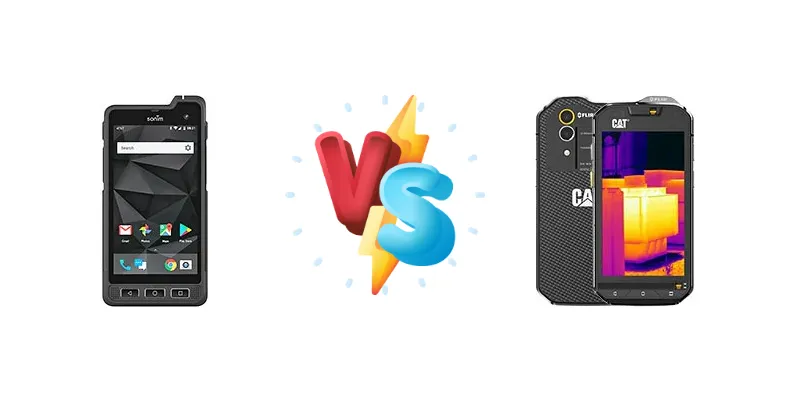
The Sonim XP8 and Cat S60 represent two key players in the rugged smartphone market, catering to professionals and outdoor enthusiasts who demand durability. While both boast robust builds, significant differences lie beneath the surface, particularly in their processing power and efficiency. This comparison dives deep into the specifications to determine which device offers the best balance of performance and resilience.
🏆 Quick Verdict
For most users prioritizing performance and future-proofing, the Sonim XP8 emerges as the better choice. Its newer Snapdragon 630 chipset, built on a smaller 14nm process, delivers a noticeable performance advantage and improved power efficiency over the Cat S60’s older Snapdragon 617.
| Network |
|---|
| 2G bands | GSM 850 / 900 / 1800 / 1900 | GSM 850 / 900 / 1800 / 1900 - SIM 1 & SIM 2 (dual-SIM model only) |
| 3G bands | HSDPA 850 / 900 / 1700(AWS) / 1900 / 2100 | HSDPA 850 / 900 / 2100 - Global |
| 4G bands | 1, 2, 3, 4, 5, 7, 8, 12, 13, 14, 20, 25, 26, 28, 29, 30, 38, 40, 41, 66 | 1, 3, 7, 8, 20 - Global |
| Speed | HSPA 42.2/5.76 Mbps, LTE (3CA) Cat12 600/150 Mbps | HSPA, LTE Cat4 150/50 Mbps |
| Technology | GSM / CDMA / HSPA / EVDO / LTE | GSM / HSPA / LTE |
| | CDMA2000 1xEV-DO | 2, 4, 5, 7, 12, 17 - North America |
| Launch |
|---|
| Announced | 2018, April. Released 2018, May | 2016, February. Released 2016, June |
| Status | Discontinued | Discontinued |
| Body |
|---|
| Build | - | Glass front (Gorilla Glass 4), plastic back, aluminum frame |
| Dimensions | 152 x 79.5 x 18 mm (5.98 x 3.13 x 0.71 in) | 147.9 x 73.4 x 12.7 mm (5.82 x 2.89 x 0.5 in) |
| SIM | Nano-SIM + Nano-SIM | · Nano-SIM (South Africa only)· Nano-SIM + Nano-SIM |
| Weight | 335 g (11.82 oz) | 223 g (7.87 oz) |
| | IP69 dust proof and water resistant over 1 meter and 30 minutes
MIL-STD-810G | IP68 dust/water resistant (up to 5m for 60 min)
Drop-to-concrete resistance from up to 1.8m
MIL-STD-810G compliant |
| Display |
|---|
| Protection | Corning Gorilla Glass 3 | Corning Gorilla Glass 4 |
| Resolution | 1080 x 1920 pixels, 16:9 ratio (~441 ppi density) | 720 x 1280 pixels, 16:9 ratio (~312 ppi density) |
| Size | 5.0 inches, 68.9 cm2 (~57.0% screen-to-body ratio) | 4.7 inches, 60.9 cm2 (~56.1% screen-to-body ratio) |
| Type | IPS LCD | a-Si AHVA |
| Platform |
|---|
| CPU | Octa-core 2.2 GHz Cortex-A53 | Octa-core (4x1.2 GHz Cortex-A53 & 4x1.5 GHz Cortex-A53) |
| Chipset | Qualcomm SDM630 Snapdragon 630 (14 nm) | Qualcomm MSM8952 Snapdragon 617 (28 nm) |
| GPU | Adreno 508 | Adreno 405 |
| OS | Android 7.0 (Nougat) | Android 6.0 (Marshmallow) |
| Memory |
|---|
| Card slot | microSDXC | microSDXC (dedicated slot) |
| Internal | 64GB 4GB RAM | 32GB 3GB RAM |
| | - | eMMC 5.1 |
| Main Camera |
|---|
| Features | LED flash, HDR, panorama | Thermal imaging, heat palettes, temp. spot meter, dual-LED dual-tone flash, panorama |
| Single | 12 MP, PDAF | 13 MP, AF, FLIR thermal camera (Lepton module) |
| Video | 1080p@30fps | 1080p@30fps |
| Selfie camera |
|---|
| Single | 8 MP | 5 MP |
| Video | 1080p@30fps | 1080p@30fps |
| Sound |
|---|
| 3.5mm jack | No | Yes |
| 35mm jack | No | Yes |
| Loudspeaker | Yes | Yes |
| Comms |
|---|
| Bluetooth | 5.0, A2DP, EDR, LE | 4.1, A2DP |
| NFC | Yes | Yes |
| Positioning | GPS, GLONASS | GPS, GLONASS, BDS |
| Radio | FM radio | FM radio |
| USB | USB Type-C 2.0, magnetic connector | microUSB 2.0, OTG |
| WLAN | Wi-Fi 802.11 a/b/g/n/ac, dual-band, Wi-Fi Direct | Wi-Fi 802.11 b/g/n, Wi-Fi Direct |
| Features |
|---|
| Sensors | Accelerometer, gyro, proximity, compass, barometer | Accelerometer, proximity, compass |
| Battery |
|---|
| Charging | 18W wired, QC4 | 18W wired, QC2 |
| Music play | Up to 70 h | - |
| Stand-by | Up to 720 h | - |
| Talk time | Up to 30 h | - |
| Type | Li-Ion 4900 mAh, removable | Li-Ion 3800 mAh, non-removable |
| Misc |
|---|
| Colors | Black | Black |
| Models | XP8800 | - |
| Price | About 700 EUR | About 650 EUR |
Sonim XP8
- More powerful Snapdragon 630 processor
- More efficient 14nm fabrication process
- Faster Quick Charge 4.0 support
- Potentially higher price point
- Rugged design may add bulk
Cat S60
- Potentially lower price point
- Rugged design for demanding environments
- Established brand in the rugged phone market
- Older Snapdragon 617 processor
- Less efficient 28nm fabrication process
- Older Quick Charge 2.0 support
Display Comparison
Neither device's display specifications are provided, so a direct comparison is limited. However, given the target market, both likely utilize hardened glass and prioritize visibility in direct sunlight. The Cat S60, being an older model, may exhibit slightly lower peak brightness and color accuracy. The XP8, benefiting from newer display technology available at its release, likely offers a more vibrant and accurate visual experience, though this is speculative without specific data.
Camera Comparison
Without detailed camera specifications, a precise comparison is difficult. However, the rugged phone market generally prioritizes durability over cutting-edge camera technology. Both devices likely feature capable cameras for documenting work site conditions or outdoor adventures, but image quality will likely be similar. The absence of information regarding sensor size and aperture makes a definitive judgment impossible, but the XP8’s newer chipset may offer slightly improved image processing capabilities.
Performance
The Sonim XP8’s Qualcomm Snapdragon 630 (14nm) represents a clear architectural advantage over the Cat S60’s Snapdragon 617 (28nm). The 630’s Cortex-A53 cores run at a higher clock speed of 2.2 GHz compared to the 617’s mixed configuration of 1.2 GHz and 1.5 GHz Cortex-A53 cores. This translates to faster application loading times and smoother multitasking on the XP8. Crucially, the 14nm fabrication process of the SDM630 results in significantly improved thermal efficiency, reducing the likelihood of performance throttling during sustained workloads. The Cat S60’s older 28nm process is inherently less efficient, potentially leading to overheating and reduced performance under heavy load.
Battery Life
Both the Sonim XP8 and Cat S60 support 18W wired charging with Quick Charge technology, but the Cat S60 utilizes QC2 while the XP8 uses the newer QC4 standard. QC4 offers improved efficiency and potentially faster charging speeds. While battery capacity isn’t specified, the XP8’s more efficient Snapdragon 630 chipset will likely result in longer battery life under similar usage scenarios. The 14nm process reduces power consumption, allowing the XP8 to operate for a longer duration on a single charge, even with comparable battery capacities.
Buying Guide
Buy the Sonim XP8 if you need a rugged phone that can handle demanding tasks, such as running multiple work apps simultaneously or utilizing GPS navigation for extended periods. Its more modern chipset provides a smoother, more responsive experience. Buy the Cat S60 if you prioritize a potentially lower price point and are primarily focused on basic communication and essential apps, accepting a trade-off in processing speed and efficiency.
Frequently Asked Questions
❓ Will the Sonim XP8 handle prolonged GPS use for field work better than the Cat S60?
Yes, the Sonim XP8’s Snapdragon 630 chipset, built on a 14nm process, is significantly more power-efficient than the Cat S60’s Snapdragon 617 (28nm). This means the XP8 will experience less performance throttling and maintain a stable GPS connection for longer periods during demanding tasks like navigation or data logging.
❓ Does the older Snapdragon 617 in the Cat S60 struggle with modern app performance?
The Snapdragon 617 is showing its age. While it can handle basic apps and communication, it may exhibit noticeable lag and slowdowns when running multiple applications simultaneously or using resource-intensive apps. The Sonim XP8’s Snapdragon 630 provides a much smoother and more responsive user experience.
❓ Is Quick Charge 4.0 on the Sonim XP8 a significant advantage over Quick Charge 2.0 on the Cat S60?
Quick Charge 4.0 offers improved efficiency and potentially faster charging speeds compared to Quick Charge 2.0. While both support 18W charging, QC4 dynamically adjusts voltage and current for optimal charging, reducing heat and potentially shortening charging times. This is a subtle but beneficial advantage for the XP8.