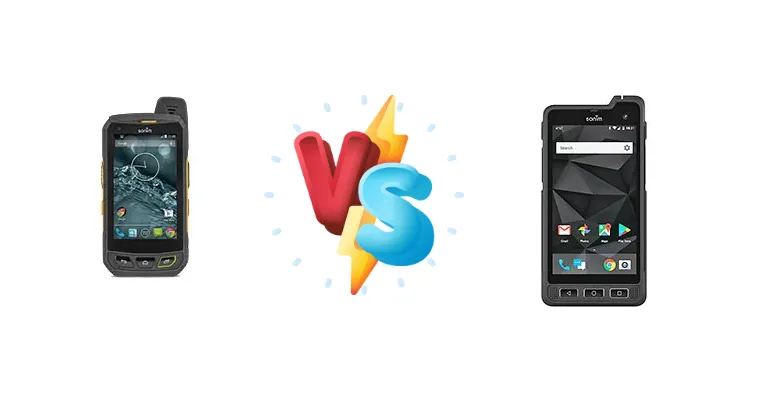
Sonim is synonymous with rugged, durable smartphones built for demanding environments. The XP7 and XP8 represent their commitment to toughness, but with significant differences under the hood. This review dives deep into a head-to-head comparison to help you choose the right device for your needs.
🏆 Quick Verdict
The Sonim XP8 is the clear winner. Its Snapdragon 630 chipset offers a substantial performance boost over the XP7's older Snapdragon 400, alongside faster charging and likely improved camera capabilities. While the XP7 remains a durable option, the XP8 provides a more modern and capable experience.
| Network |
|---|
| 2G bands | GSM 850 / 900 / 1800 / 1900 | GSM 850 / 900 / 1800 / 1900 |
| 3G bands | HSDPA 850 / 900 / 1900 / 2100 | HSDPA 850 / 900 / 1700(AWS) / 1900 / 2100 |
| 4G bands | 1, 2, 4, 5, 7, 8, 12, 17 | 1, 2, 3, 4, 5, 7, 8, 12, 13, 14, 20, 25, 26, 28, 29, 30, 38, 40, 41, 66 |
| Speed | HSPA, LTE | HSPA 42.2/5.76 Mbps, LTE (3CA) Cat12 600/150 Mbps |
| Technology | GSM / HSPA / LTE | GSM / CDMA / HSPA / EVDO / LTE |
| | 1, 2, 3, 4, 5, 7, 17 - Telus | CDMA2000 1xEV-DO |
| Launch |
|---|
| Announced | 2014, November. Released 2015, April | 2018, April. Released 2018, May |
| Status | Discontinued | Discontinued |
| Body |
|---|
| Dimensions | 137 x 72.1 x 20.8 mm (5.39 x 2.84 x 0.82 in) | 152 x 79.5 x 18 mm (5.98 x 3.13 x 0.71 in) |
| SIM | Micro-SIM | Nano-SIM + Nano-SIM |
| Weight | 290 g (10.23 oz) | 335 g (11.82 oz) |
| | IP69 dust proof and water resistant over 1 meter and 30 minutes | IP69 dust proof and water resistant over 1 meter and 30 minutes
MIL-STD-810G |
| Display |
|---|
| Protection | Corning Gorilla Glass 2 | Corning Gorilla Glass 3 |
| Resolution | 480 x 800 pixels, 5:3 ratio (~233 ppi density) | 1080 x 1920 pixels, 16:9 ratio (~441 ppi density) |
| Size | 4.0 inches, 45.5 cm2 (~46.1% screen-to-body ratio) | 5.0 inches, 68.9 cm2 (~57.0% screen-to-body ratio) |
| Type | IPS LCD | IPS LCD |
| Platform |
|---|
| CPU | Quad-core 1.2 GHz Cortex-A7 | Octa-core 2.2 GHz Cortex-A53 |
| Chipset | Qualcomm MSM8926 Snapdragon 400 (28 nm) | Qualcomm SDM630 Snapdragon 630 (14 nm) |
| GPU | Adreno 305 | Adreno 508 |
| OS | Android 4.4.2 (KitKat) | Android 7.0 (Nougat) |
| Memory |
|---|
| Card slot | No | microSDXC |
| Internal | 16GB 1GB RAM | 64GB 4GB RAM |
| | eMMC 4.5 | - |
| Main Camera |
|---|
| Features | LED flash | LED flash, HDR, panorama |
| Single | 8 MP, AF | 12 MP, PDAF |
| Video | 1080p@30fps | 1080p@30fps |
| Selfie camera |
|---|
| Single | 1 MP | 8 MP |
| Video | - | 1080p@30fps |
| Sound |
|---|
| 3.5mm jack | Yes | No |
| 35mm jack | Yes | No |
| Loudspeaker | Yes | Yes |
| Comms |
|---|
| Bluetooth | 4.0, A2DP, LE | 5.0, A2DP, EDR, LE |
| NFC | Yes | Yes |
| Positioning | GPS, GLONASS | GPS, GLONASS |
| Radio | FM radio | FM radio |
| USB | microUSB 2.0 | USB Type-C 2.0, magnetic connector |
| WLAN | Wi-Fi 802.11 a/b/g/n, dual-band, hotspot | Wi-Fi 802.11 a/b/g/n/ac, dual-band, Wi-Fi Direct |
| Features |
|---|
| Sensors | Accelerometer, proximity | Accelerometer, gyro, proximity, compass, barometer |
| Battery |
|---|
| Charging | - | 18W wired, QC4 |
| Music play | - | Up to 70 h |
| Stand-by | Up to 1000 h | Up to 720 h |
| Talk time | Up to 40 h | Up to 30 h |
| Type | Li-Ion 4800 mAh, non-removable | Li-Ion 4900 mAh, removable |
| Misc |
|---|
| Colors | Black, Yellow | Black |
| Models | XP7700 | XP8800 |
| Price | About 700 EUR | About 700 EUR |
Sonim XP7
- Extremely durable
- Long battery life
- Rugged design
- Push-to-Talk functionality
- Outdated chipset
- Slow performance
- Limited camera capabilities
- Slow charging
Sonim XP8
- Improved performance (Snapdragon 630)
- Faster charging (18W)
- Likely better camera
- Rugged design
- Push-to-Talk functionality
- Higher price
- Still not a flagship phone
- Durability may be slightly less than XP7 (unconfirmed)
Display Comparison
Both phones likely feature similar ruggedized displays, prioritizing durability over resolution. Expect a smaller, more resilient screen on both, probably around 4.7-5 inches. The XP8 *might* have slightly improved brightness or color accuracy due to its newer chipset, but this is less critical in a rugged phone.
Camera Comparison
While both phones are not camera-focused, the XP8's newer chipset likely allows for a better camera sensor and image processing. Expect improved low-light performance and potentially higher resolution photos and videos on the XP8. Specific camera specs are often limited on Sonim devices, but the XP8 has an advantage.
Performance
This is where the XP8 shines. The Snapdragon 630 is significantly faster and more efficient than the Snapdragon 400. Expect smoother multitasking, quicker app loading times, and a more responsive overall experience on the XP8. The XP7 will feel noticeably slower, especially with demanding apps.
Battery Life
Both phones are known for their long battery life, but the XP8's 18W fast charging provides a significant advantage. While both likely have similar battery capacities (around 4000-5000 mAh), the XP8 can be recharged much faster. The XP7 will rely on slower, standard charging.
Buying Guide
The Sonim XP7 is ideal for users on a tighter budget who prioritize extreme durability above all else and don't require high-end performance. The Sonim XP8 is the better choice for those needing a balance of ruggedness, performance, and modern features, including faster charging and a more responsive user experience.
Frequently Asked Questions
❓ Are these phones waterproof?
Yes, both the Sonim XP7 and XP8 are IP68 rated, meaning they are dustproof and waterproof up to a certain depth and duration.
❓ Do these phones support 5G?
No, neither the Sonim XP7 nor the XP8 support 5G connectivity. They are primarily designed for reliable communication in rugged environments, not high-speed data.