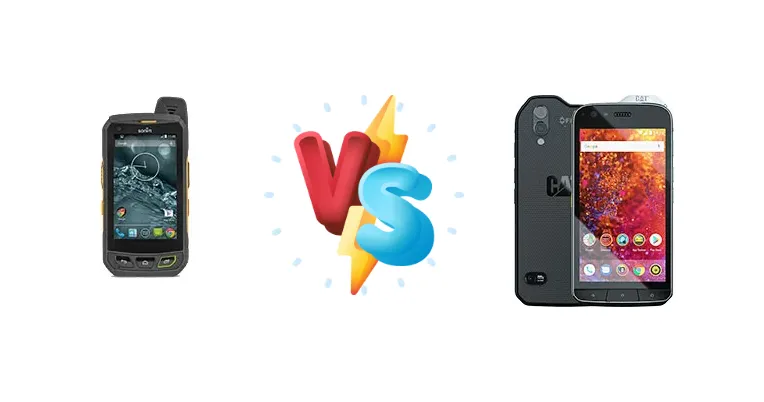
The Sonim XP7 and Cat S61 represent two distinct approaches to the rugged smartphone market. The XP7, built around an older but proven Qualcomm Snapdragon 400, prioritizes core durability and affordability. The Cat S61, leveraging the more modern Snapdragon 630, aims for a balance of ruggedness and improved performance, alongside features like Quick Charge support. This comparison dissects their key differences to determine which device best suits demanding users.
🏆 Quick Verdict
For users prioritizing absolute affordability and proven, if basic, reliability, the Sonim XP7 remains a viable option. However, the Cat S61 is the superior choice for most, offering significantly improved performance thanks to its Snapdragon 630 chipset and faster charging capabilities, justifying its higher price point.
| Network |
|---|
| 2G bands | GSM 850 / 900 / 1800 / 1900 | GSM 850 / 900 / 1800 / 1900 |
| 3G bands | HSDPA 850 / 900 / 1900 / 2100 | HSDPA 850 / 900 / 1700 / 1900 / 2100 - EU/ROW |
| 4G bands | 1, 2, 4, 5, 7, 8, 12, 17 | 1, 2, 3, 5, 7, 8, 19, 20, 26, 28, 38, 39, 40, 41 - EU/ROW |
| Speed | HSPA, LTE | HSPA 42.2/5.76 Mbps, LTE (3CA) Cat12 600/150 Mbps |
| Technology | GSM / HSPA / LTE | GSM / HSPA / LTE |
| | 1, 2, 3, 4, 5, 7, 17 - Telus | 1, 2, 3, 4, 5, 7, 8, 12, 13, 17, 25, 26, 28, 29, 66 - USA |
| Launch |
|---|
| Announced | 2014, November. Released 2015, April | 2018, February. Released 2018, June |
| Status | Discontinued | Discontinued |
| Body |
|---|
| Build | - | Glass front (Gorilla Glass 5), plastic back, aluminum frame |
| Dimensions | 137 x 72.1 x 20.8 mm (5.39 x 2.84 x 0.82 in) | 163 x 78 x 13 mm (6.42 x 3.07 x 0.51 in) |
| SIM | Micro-SIM | · Nano-SIM (South Africa only)· Nano-SIM + Nano-SIM |
| Weight | 290 g (10.23 oz) | 250 g (8.82 oz) |
| | IP69 dust proof and water resistant over 1 meter and 30 minutes | IP68 dust/water resistant (up to 3m for 60 min)
Drop-to-concrete resistance from up to 1.8m
MIL-STD-810G compliant |
| Display |
|---|
| Protection | Corning Gorilla Glass 2 | Corning Gorilla Glass 5 |
| Resolution | 480 x 800 pixels, 5:3 ratio (~233 ppi density) | 1080 x 1920 pixels, 16:9 ratio (~424 ppi density) |
| Size | 4.0 inches, 45.5 cm2 (~46.1% screen-to-body ratio) | 5.2 inches, 74.5 cm2 (~58.6% screen-to-body ratio) |
| Type | IPS LCD | IPS LCD |
| Platform |
|---|
| CPU | Quad-core 1.2 GHz Cortex-A7 | Octa-core 2.2 GHz Cortex-A53 |
| Chipset | Qualcomm MSM8926 Snapdragon 400 (28 nm) | Qualcomm SDM630 Snapdragon 630 (14 nm) |
| GPU | Adreno 305 | Adreno 508 |
| OS | Android 4.4.2 (KitKat) | Android 8.0 (Oreo), upgradable to Android 9.0 (Pie) |
| Memory |
|---|
| Card slot | No | microSDXC (uses shared SIM slot) |
| Internal | 16GB 1GB RAM | 64GB 4GB RAM |
| | eMMC 4.5 | - |
| Main Camera |
|---|
| Features | LED flash | Thermal imaging, heat palettes, temp. spot meter, dual-LED dual-tone flash, panorama |
| Single | 8 MP, AF | 16 MP, PDAF, FLIR thermal camera (Lepton module) |
| Video | 1080p@30fps | 4K@30fps, 1080p@30fps |
| Selfie camera |
|---|
| Single | 1 MP | 8 MP |
| Video | - | 1080p@30fps |
| Sound |
|---|
| 3.5mm jack | Yes | Yes |
| 35mm jack | Yes | Yes |
| Loudspeaker | Yes | Yes |
| Comms |
|---|
| Bluetooth | 4.0, A2DP, LE | 5.0, A2DP, LE |
| NFC | Yes | Yes |
| Positioning | GPS, GLONASS | GPS, GLONASS, GALILEO, QZSS, SBAS |
| Radio | FM radio | FM radio |
| USB | microUSB 2.0 | USB Type-C 2.0, OTG |
| WLAN | Wi-Fi 802.11 a/b/g/n, dual-band, hotspot | Wi-Fi 802.11 a/b/g/n/ac, dual-band, Wi-Fi Direct |
| Features |
|---|
| Sensors | Accelerometer, proximity | Accelerometer, gyro, proximity, compass, barometer, indoor air quality sensor |
| | - | Laser-assisted distance measurement tool |
| Battery |
|---|
| Charging | - | 18W wired, QC4 |
| Stand-by | Up to 1000 h | Up to 888 h (3G) |
| Talk time | Up to 40 h | Up to 35 h (3G) |
| Type | Li-Ion 4800 mAh, non-removable | Li-Ion 4500 mAh, non-removable |
| Misc |
|---|
| Colors | Black, Yellow | Black |
| Models | XP7700 | - |
| Price | About 700 EUR | About 900 EUR |
Sonim XP7
- Extremely affordable
- Proven ruggedness and durability
- Simple and easy to use
- Slow performance
- Outdated chipset
- Slow charging
Cat S61
- Significantly faster performance
- Faster charging with QC4
- More power-efficient chipset
- Higher price point
- Potentially more complex software
- May not be as exceptionally durable as the XP7 in *extreme* conditions
Display Comparison
Neither Sonim nor Cat provide detailed display specifications in the provided data. However, given the XP7's age and target market, it likely utilizes a lower-resolution panel with standard LCD technology. The Cat S61, being a later model, likely benefits from a more refined display, potentially with improved color accuracy and viewing angles. Both will prioritize visibility in direct sunlight, a crucial feature for outdoor use, but the S61's newer chipset *could* allow for more sophisticated display processing.
Camera Comparison
Detailed camera specifications are absent, but the performance difference will likely mirror the chipset disparity. The Cat S61’s more powerful ISP (Image Signal Processor) within the Snapdragon 630 will enable faster image processing, better low-light performance, and potentially more advanced features. While both phones likely prioritize durability over photographic excellence, the S61 will offer a noticeably better camera experience for documenting work sites or personal use. We can assume both will feature basic rear and front cameras, but the S61 will likely have a higher resolution main sensor.
Performance
The performance gap between the Sonim XP7 and Cat S61 is substantial. The XP7’s Qualcomm MSM8926 Snapdragon 400, with its quad-core 1.2 GHz Cortex-A7 CPU, is a generation behind. This translates to slower app loading times, less responsive multitasking, and struggles with demanding applications. Conversely, the Cat S61’s Qualcomm SDM630 Snapdragon 630, featuring an octa-core 2.2 GHz Cortex-A53 CPU, delivers significantly improved performance. The 14nm manufacturing process of the SDM630 also contributes to better power efficiency and reduced thermal throttling compared to the XP7’s 28nm process. This benefits users running mapping software, data collection apps, or engaging in extended communication.
Battery Life
Without specific battery capacity data, we can infer differences based on chipset efficiency and charging capabilities. The Snapdragon 630 in the Cat S61 is more power-efficient than the Snapdragon 400 in the XP7, meaning the S61 will likely achieve comparable or better battery life despite potentially having a similar capacity. Crucially, the Cat S61 supports 18W wired charging with Quick Charge 4 (QC4) technology, enabling significantly faster charging times compared to the XP7, which likely relies on slower, standard charging. This is a major advantage for users who need to quickly replenish their battery during breaks.
Buying Guide
Buy the Sonim XP7 if you need a truly budget-friendly, exceptionally durable phone for basic communication and essential tasks in harsh environments, and are willing to accept slower performance. Buy the Cat S61 if you prefer a more responsive user experience, faster charging, and a more modern chipset for running demanding work applications or occasional multimedia, while still maintaining a high level of ruggedness.
Frequently Asked Questions
❓ Will the Cat S61's Snapdragon 630 handle multiple work apps simultaneously without significant lag?
Yes, the Snapdragon 630’s octa-core processor and improved RAM management are designed to handle multitasking more effectively than the XP7’s Snapdragon 400. Users running mapping applications, communication tools, and data collection software concurrently should experience a smoother and more responsive experience on the Cat S61.
❓ How much faster is the Cat S61's charging compared to the Sonim XP7, realistically?
The Cat S61’s 18W Quick Charge 4 support will dramatically reduce charging times. While exact figures depend on the charger and battery level, expect a 0-100% charge in approximately 1.5-2 hours, compared to potentially 3+ hours for the XP7 using a standard charger. This is a critical advantage for users who need to minimize downtime.
❓ Is the performance difference between the two phones noticeable for basic tasks like calls and texting?
For simple tasks like calls and texting, the performance difference may not be immediately apparent. However, even in these scenarios, the Cat S61 will feel more responsive and fluid due to its faster processor and optimized software. The difference becomes much more pronounced when launching apps, browsing the web, or using more demanding features.