
Sonim XP5plus vs. Ulefone Armor 11 5G: A Deep Dive into Rugged Performance
| Phones Images | |||||
|---|---|---|---|---|---|
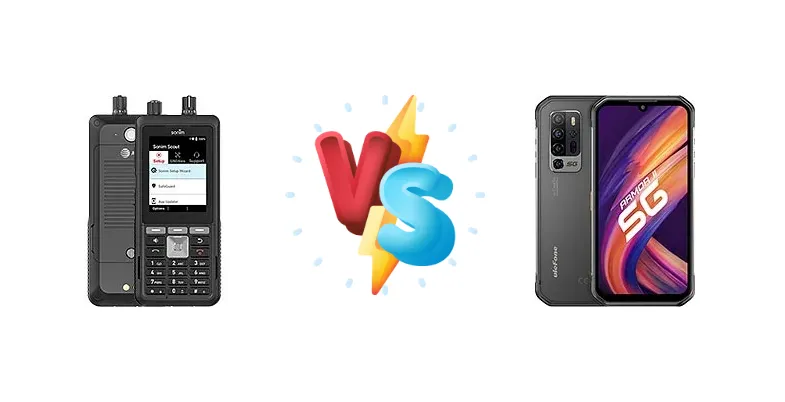
|
🏆 Quick Verdict
For users prioritizing consistent performance and long-term reliability in demanding environments, the Sonim XP5plus is the better choice. Its Snapdragon 662 offers a balanced experience, and Sonim’s reputation for build quality is unmatched. However, the Ulefone Armor 11 5G’s Dimensity 800 provides a significant performance boost and 5G connectivity for those who need it.
| PHONES | ||
|---|---|---|
| Phone Names | Sonim XP5plus | Ulefone Armor 11 5G |
| Network | ||
|---|---|---|
| 2G bands | GSM 850 / 900 / 1800 / 1900 | GSM 850 / 900 / 1800 / 1900 |
| 3G bands | HSDPA 850 / 1700(AWS) / 1900 / 2100 | HSDPA 850 / 900 / 1700(AWS) / 1900 / 2100 |
| 4G bands | 1, 2, 3, 4, 5, 7, 8, 12, 13, 14, 25, 26, 29, 30, 39, 40, 41, 66, 71 | 1, 2, 3, 4, 5, 7, 8, 12, 13, 17, 18, 19, 20, 25, 26, 28, 34, 38, 39, 40, 41, 66 |
| 5G bands | - | 1, 3, 5, 8, 20, 28, 38, 41, 77, 78, 79 SA/NSA |
| Speed | HSPA, LTE | HSPA, LTE, 5G |
| Technology | GSM / HSPA / LTE | GSM / CDMA / HSPA / EVDO / LTE / 5G |
| - | CDMA2000 1xEV-DO | |
| Launch | ||
|---|---|---|
| Announced | 2022, July 15 | 2021, February 18 |
| Status | Available. Released 2022, July 15 | Available. Released 2021, March 08 |
| Body | ||
|---|---|---|
| Build | - | Front glass, aluminum back with rubber, aluminum frame |
| Dimensions | 148.7 x 65.9 x 21 mm (5.85 x 2.59 x 0.83 in) | 163.8 x 81.6 x 14.2 mm (6.45 x 3.21 x 0.56 in) |
| SIM | Nano-SIM + Nano-SIM | Nano-SIM + Nano-SIM |
| Weight | 275 g (9.70 oz) | 295 g (10.41 oz) |
| IP68 dust/water resistant (up to 1.5m for 30 min) IPX9K water ingress protection MIL-STD-810H | IP68 dust/water resistant (up to 1.5m for 30 min) Drop-to-concrete resistance from up to 1.2m MIL-STD-810G compliant | |
| Display | ||
|---|---|---|
| Protection | Corning Gorilla Glass 3 | Oleophobic coating |
| Resolution | 240 x 320 pixels, 4:3 ratio (~143 ppi density) | 720 x 1560 pixels, 19.5:9 ratio (~282 ppi density) |
| Size | 2.8 inches, 24.3 cm2 (~24.8% screen-to-body ratio) | 6.1 inches, 91.3 cm2 (~68.3% screen-to-body ratio) |
| Type | TFT LCD | IPS LCD |
| Platform | ||
|---|---|---|
| CPU | Octa-core (4x2.0 GHz Kryo 260 Gold & 4x1.8 GHz Kryo 260 Silver) | Octa-core (4x2.0 GHz Cortex-A76 & 4x2.0 GHz Cortex-A55) |
| Chipset | Qualcomm SM6115 Snapdragon 662 (11 nm) | Mediatek Dimensity 800 (7 nm) |
| GPU | Adreno 610 | Mali-G57 MP4 |
| OS | Sonim OS (based on AOSP Android 11) | Android 10, planned upgrade to Android 11 |
| Memory | ||
|---|---|---|
| Card slot | microSDXC | No |
| Internal | 16GB 2GB RAM | 256GB 8GB RAM |
| - | UFS 2.1 | |
| Main Camera | ||
|---|---|---|
| Features | LED flash | Dual-LED dual-tone flash, HDR, panorama |
| Penta | - | 48 MP, f/1.8, 26mm (wide), 1/2.0", 0.8µm, PDAF 13 MP, f/2.4, 125˚ (ultrawide) 20 MP, f/1.8, (night vision), 1/2.78", 1.0µm 2 MP (macro) Auxiliary lens |
| Single | 8 MP | 16 MP, f/2.0 |
| Video | 1080p@30fps | 4K@30fps, 1080p@30fps |
| Selfie camera | ||
|---|---|---|
| Features | - | HDR, panorama |
| Single | - | 16 MP, f/2.0 |
| Video | - | 1080p@30fps |
| Sound | ||
|---|---|---|
| 3.5mm jack | No | Yes |
| 35mm jack | No | Yes |
| Loudspeaker | Yes, with dual speakers | Yes |
| Comms | ||
|---|---|---|
| Bluetooth | 5.0, A2DP, LE | 5.0, A2DP, LE |
| NFC | No | Yes |
| Positioning | GPS, GLONASS, GALILEO, BDS | GPS, GLONASS, GALILEO, BDS |
| Radio | FM radio | FM radio, RDS, recording |
| USB | USB Type-C | USB Type-C 2.0, OTG |
| WLAN | Wi-Fi 802.11 a/b/g/n/ac, dual-band | Wi-Fi 802.11 a/b/g/n/ac, Wi-Fi Direct |
| Features | ||
|---|---|---|
| Sensors | Accelerometer, barometer | Fingerprint (side-mounted), accelerometer, gyro, proximity, compass, baroceptor |
| Top-mount PTT control knobs (optional) | - | |
| Battery | ||
|---|---|---|
| Charging | - | 18W wired 10W wireless |
| Type | Li-Ion 3500 mAh, removable | Li-Po 5200 mAh |
| Misc | ||
|---|---|---|
| Colors | Black | Black |
| Price | About 300 EUR | About 480 EUR |
Sonim XP5plus
- Proven Snapdragon 662 efficiency
- Strong reputation for build quality and durability
- Potentially longer battery life due to efficient chipset
- Less powerful processor compared to the Dimensity 800
- Limited to 4G LTE connectivity
- Lacks wireless charging
Ulefone Armor 11 5G
- Faster MediaTek Dimensity 800 processor
- 5G connectivity for faster data speeds
- 18W wired and 10W wireless charging
- Dimensity 800 may be prone to thermal throttling
- Potentially shorter battery life due to higher power consumption
- Ulefone’s build quality reputation is less established than Sonim’s
Display Comparison
Neither device boasts a cutting-edge display. Details on panel type and resolution are missing, but the focus here is clearly on durability, not visual fidelity. The Ulefone Armor 11 5G’s inclusion of 10W wireless charging suggests a more modern feature set, hinting at a potentially more advanced display controller. However, without specific brightness or color accuracy data, it’s difficult to definitively say which offers a better viewing experience. Both will likely prioritize visibility in direct sunlight over color accuracy.
Camera Comparison
Camera details are sparse, but the focus on ruggedness suggests image quality isn’t a primary concern for either manufacturer. Without sensor size or aperture information, it’s difficult to make a meaningful comparison. The inclusion of a 2MP macro camera on the Ulefone is likely a marketing feature with limited real-world utility. Both phones will likely rely on software processing to enhance image quality, but the Dimensity 800’s image signal processor (ISP) in the Armor 11 5G *could* offer slightly better processing capabilities, assuming sufficient software optimization.
Performance
The core difference lies in the chipsets. The Ulefone Armor 11 5G’s MediaTek Dimensity 800 (7nm) represents a significant leap in processing power compared to the Sonim XP5plus’s Qualcomm Snapdragon 662 (11nm). The Dimensity 800’s Cortex-A76 cores offer substantially higher single-core performance, crucial for responsive app loading and smoother multitasking. However, the 7nm process node doesn’t automatically guarantee better efficiency; thermal management will be key. The Snapdragon 662, while less powerful, is known for its efficiency and stability, potentially leading to less throttling during sustained workloads. The Armor 11 5G’s 5G modem is a major advantage for users in areas with 5G coverage, while the XP5plus is limited to 4G LTE.
Battery Life
Battery capacity is not specified for either device. However, the Snapdragon 662 in the Sonim XP5plus is known for its power efficiency, suggesting potentially longer battery life despite a potentially smaller capacity. The Ulefone Armor 11 5G’s 18W wired and 10W wireless charging capabilities offer more convenient charging options, but the more powerful Dimensity 800 will likely consume more power, potentially offsetting the benefits of faster charging. Real-world battery life will depend heavily on usage patterns and network conditions (especially with 5G enabled on the Ulefone).
Buying Guide
Buy the Sonim XP5plus if you need a phone that can withstand extreme conditions and prioritize consistent, all-day performance over raw speed. This is ideal for construction workers, first responders, or anyone frequently working outdoors. Buy the Ulefone Armor 11 5G if you prioritize 5G connectivity, faster processing for demanding apps, and wireless charging, and are willing to potentially trade some battery life for that performance.