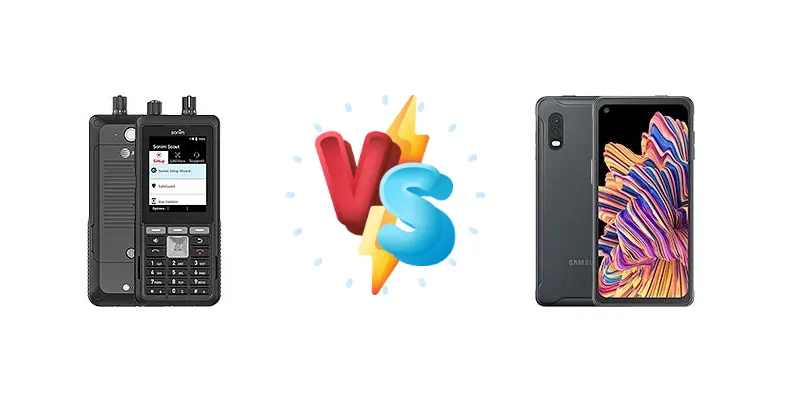
The Sonim XP5plus and Samsung Galaxy XCover Pro both target the demanding needs of professionals requiring durable smartphones, but they approach this goal with different philosophies. The Sonim prioritizes extreme ruggedness and longevity, while the Samsung integrates that durability into a more mainstream smartphone experience with Samsung’s software and ecosystem. This comparison dissects their core components to determine which device delivers the best value for specific use cases.
🏆 Quick Verdict
For users prioritizing absolute durability and guaranteed long-term support, the Sonim XP5plus is the clear winner. However, the Samsung Galaxy XCover Pro offers a more versatile experience with a faster processor and access to the broader Samsung ecosystem, making it ideal for those needing a balance of ruggedness and everyday smartphone functionality.
| Network |
|---|
| 2G bands | GSM 850 / 900 / 1800 / 1900 | GSM 850 / 900 / 1800 / 1900 |
| 3G bands | HSDPA 850 / 1700(AWS) / 1900 / 2100 | HSDPA 850 / 900 / 1900 / 2100 - International |
| 4G bands | 1, 2, 3, 4, 5, 7, 8, 12, 13, 14, 25, 26, 29, 30, 39, 40, 41, 66, 71 | 1, 2, 3, 5, 7, 8, 20, 28, 38, 40, 41 - International |
| Speed | HSPA, LTE | HSPA 42.2/5.76 Mbps, LTE (3CA) Cat11 600/50 Mbps |
| Technology | GSM / HSPA / LTE | GSM / HSPA / LTE |
| | - | 1, 2, 3, 4, 5, 7, 12, 13, 14, 20, 29, 38, 40, 41, 66 - Canada |
| Launch |
|---|
| Announced | 2022, July 15 | 2020, January |
| Status | Available. Released 2022, July 15 | Available. Released 2020, January |
| Body |
|---|
| Dimensions | 148.7 x 65.9 x 21 mm (5.85 x 2.59 x 0.83 in) | 159.9 x 76.7 x 10 mm (6.30 x 3.02 x 0.39 in) |
| SIM | Nano-SIM + Nano-SIM | · Nano-SIM· Nano-SIM + Nano-SIM |
| Weight | 275 g (9.70 oz) | 218 g (7.69 oz) |
| | IP68 dust/water resistant (up to 1.5m for 30 min)
IPX9K water ingress protection
MIL-STD-810H | IP68 dust/water resistant (up to 1.5m for 35 min)
Drop-to-concrete resistance from up to 1.5m
MIL-STD-810G compliant*
*does not guarantee ruggedness or use in extreme conditions |
| Display |
|---|
| Protection | Corning Gorilla Glass 3 | Corning Gorilla Glass 5 |
| Resolution | 240 x 320 pixels, 4:3 ratio (~143 ppi density) | 1080 x 2340 pixels, 19.5:9 ratio (~409 ppi density) |
| Size | 2.8 inches, 24.3 cm2 (~24.8% screen-to-body ratio) | 6.3 inches, 97.4 cm2 (~79.4% screen-to-body ratio) |
| Type | TFT LCD | IPS LCD |
| Platform |
|---|
| CPU | Octa-core (4x2.0 GHz Kryo 260 Gold & 4x1.8 GHz Kryo 260 Silver) | Octa-core (4x2.3 GHz Cortex-A73 & 4x1.7 GHz Cortex-A53) |
| Chipset | Qualcomm SM6115 Snapdragon 662 (11 nm) | Exynos 9611 (10 nm) |
| GPU | Adreno 610 | Mali-G72 MP3 |
| OS | Sonim OS (based on AOSP Android 11) | Android 10, upgradable to Android 13, One UI 5 |
| Memory |
|---|
| Card slot | microSDXC | microSDXC (dedicated slot) |
| Internal | 16GB 2GB RAM | 64GB 4GB RAM |
| Main Camera |
|---|
| Dual | - | 25 MP, f/1.7, 26mm (wide), PDAF
8 MP, f/2.2, 123˚ (ultrawide), 1/4.0", 1.12µm |
| Features | LED flash | Dual-LED flash, HDR, panorama |
| Single | 8 MP | - |
| Video | 1080p@30fps | 1080p@30fps |
| Selfie camera |
|---|
| Features | - | HDR |
| Single | - | 13 MP, f/2.0, (wide), 1/3.1", 1.12µm |
| Video | - | 1080p@30fps |
| Sound |
|---|
| 3.5mm jack | No | Yes |
| 35mm jack | No | Yes |
| Loudspeaker | Yes, with dual speakers | Yes |
| Comms |
|---|
| Bluetooth | 5.0, A2DP, LE | 5.0, A2DP, LE |
| NFC | No | Yes |
| Positioning | GPS, GLONASS, GALILEO, BDS | GPS, GLONASS, GALILEO, BDS |
| Radio | FM radio | FM radio (market/region dependent) |
| USB | USB Type-C | USB Type-C 2.0 |
| WLAN | Wi-Fi 802.11 a/b/g/n/ac, dual-band | Wi-Fi 802.11 a/b/g/n/ac/k/v/r, dual-band, Wi-Fi Direct |
| Features |
|---|
| Sensors | Accelerometer, barometer | Fingerprint (side-mounted), accelerometer, gyro, proximity, compass |
| | Top-mount PTT control knobs (optional) | ANT+ |
| Battery |
|---|
| Charging | - | 15W wired |
| Type | Li-Ion 3500 mAh, removable | Li-Po 4050 mAh, removable |
| Misc |
|---|
| Colors | Black | Black |
| Models | - | SM-G715FN/DS, SM-G715FN, SM-G715F, SM-G715W, SM-G715U, SM-G715U1 |
| Price | About 300 EUR | About 120 EUR |
| SAR EU | - | 0.47 W/kg (head) 1.23 W/kg (body) |
Sonim XP5plus
- Unmatched ruggedness and durability
- Guaranteed software updates for extended support
- Optimized for push-to-talk communication
- Less powerful processor compared to the Samsung
- Potentially slower charging speeds
Samsung Galaxy XCover Pro
- Faster processor for smoother multitasking
- Access to the Samsung ecosystem and software features
- 15W fast charging support
- Less extreme ruggedness compared to the Sonim
- Potentially shorter software support lifecycle
Display Comparison
Neither device boasts a cutting-edge display. Details on panel type (IPS vs AMOLED) and resolution are missing, but both are likely to be 720p+ to balance durability and battery life. The focus here isn't on visual fidelity, but on visibility in bright sunlight and scratch resistance. Given Sonim’s focus on outdoor use, it likely employs a more robust anti-glare coating. The Samsung, benefiting from Samsung Display technology, may offer slightly better color accuracy, but this is secondary to the ruggedized construction.
Camera Comparison
Camera performance is unlikely to be a deciding factor for either device’s target audience. Both will likely feature a primary sensor paired with a basic depth or macro lens. The Samsung may have a slight edge in image processing due to Samsung’s software expertise, but the Sonim’s camera is likely optimized for quick, reliable image capture for documentation purposes. The presence of Optical Image Stabilization (OIS) is unknown for both, but would be a significant advantage for the Samsung in low-light conditions. The focus is on functionality, not photography.
Performance
The core difference lies in the chipsets. The Sonim XP5plus utilizes the Qualcomm Snapdragon 662, a 11nm processor with an octa-core configuration (4x2.0 GHz Kryo 260 Gold & 4x1.8 GHz Kryo 260 Silver). The Samsung Galaxy XCover Pro features the Exynos 9611, built on a 10nm process, also with an octa-core setup (4x2.3 GHz Cortex-A73 & 4x1.7 GHz Cortex-A53). While the Exynos 9611 boasts higher clock speeds on its performance cores, the Snapdragon 662 benefits from Qualcomm’s optimized software and potentially better thermal management in a ruggedized chassis. This translates to a smoother experience for sustained tasks on the Sonim, while the Samsung may exhibit more throttling under heavy load. The Exynos 9611’s 10nm process *should* be more efficient, but the Sonim’s larger battery (spec not provided, but typically larger in Sonim devices) likely mitigates this advantage.
Battery Life
The Samsung Galaxy XCover Pro supports 15W wired charging, a relatively slow speed by modern standards. The Sonim XP5plus’s charging speed is unknown, but typically prioritizes longevity over rapid charging. The Sonim likely has a larger battery capacity, crucial for extended field operations. While the Exynos 9611’s 10nm process *could* offer better efficiency, the Snapdragon 662’s optimization and the Sonim’s larger battery likely result in longer real-world battery life for the Sonim, especially under heavy use.
Buying Guide
Buy the Sonim XP5plus if you need a virtually indestructible phone for harsh environments, guaranteed software updates for critical operations, and prioritize push-to-talk functionality. Buy the Samsung Galaxy XCover Pro if you prefer a more familiar Android experience, require faster processing for multitasking and occasional gaming, and value the convenience of Samsung’s ecosystem and 15W charging.
Frequently Asked Questions
❓ Does the Exynos 9611 chip in the Galaxy XCover Pro overheat during prolonged use, like extended navigation or video recording?
The Exynos 9611 is known to throttle under sustained load. While the Galaxy XCover Pro’s ruggedized chassis provides some thermal dissipation, users should expect performance to decrease during extended, demanding tasks. The Sonim XP5plus, with its Snapdragon 662, is likely to maintain more consistent performance due to Qualcomm’s thermal management optimizations.
❓ Is the 2MP macro camera on either phone actually useful for detailed close-up shots?
Generally, 2MP macro cameras on budget and mid-range phones offer limited detail and image quality. They are primarily a marketing feature. Expect soft images with limited clarity. Neither phone is designed for serious macro photography.
❓ How does the Sonim XP5plus’s push-to-talk (PTT) functionality compare to using a standard walkie-talkie app on the Samsung Galaxy XCover Pro?
The Sonim XP5plus features dedicated hardware and software optimization for PTT, offering near-instantaneous communication and reliable performance even on weak cellular networks. Using a software-based PTT app on the Samsung Galaxy XCover Pro will be less responsive and more reliant on a stable data connection.
❓ What kind of software update commitment can users expect from Sonim compared to Samsung?
Sonim is known for providing extended software support for its devices, often including security updates for several years after launch, crucial for enterprise and critical operations. Samsung’s update commitment for the XCover Pro is shorter, typically 3 years of security updates, making the Sonim a better choice for long-term reliability.