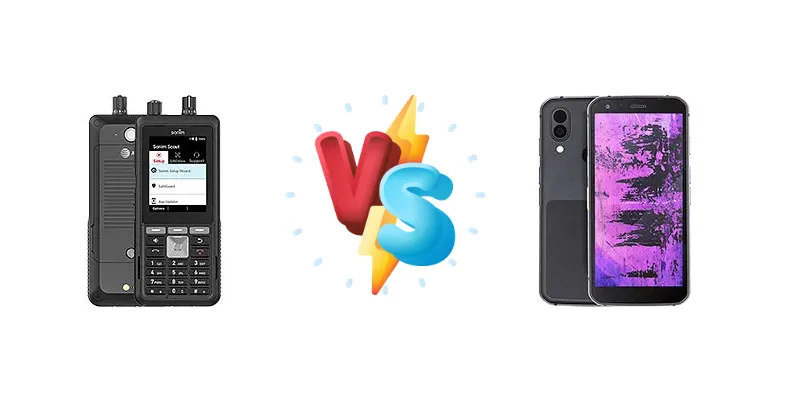
The Sonim XP5plus and Cat S62 Pro represent two of the leading brands in the rugged smartphone space. While both are built to withstand harsh conditions, they differ in their internal hardware and target user. This comparison dives deep into the specifications to determine which device offers the best balance of performance, durability, and value for demanding professionals and outdoor enthusiasts.
🏆 Quick Verdict
For most users prioritizing a slightly more modern chipset and potentially better long-term software support, the Sonim XP5plus emerges as the winner. Its Snapdragon 662, built on a smaller 11nm process, offers a marginal efficiency advantage over the Cat S62 Pro’s 14nm Snapdragon 660, translating to potentially better sustained performance.
| Network |
|---|
| 2G bands | GSM 850 / 900 / 1800 / 1900 | GSM 850 / 900 / 1800 / 1900 |
| 3G bands | HSDPA 850 / 1700(AWS) / 1900 / 2100 | HSDPA 850 / 900 / 1700(AWS) / 1900 / 2100 |
| 4G bands | 1, 2, 3, 4, 5, 7, 8, 12, 13, 14, 25, 26, 29, 30, 39, 40, 41, 66, 71 | 1, 2, 3, 4, 5, 7, 8, 20, 28, 38, 40 |
| Speed | HSPA, LTE | HSPA 42.2/5.76 Mbps, LTE (2CA) Cat13 400/150 Mbps |
| Technology | GSM / HSPA / LTE | GSM / HSPA / LTE |
| Launch |
|---|
| Announced | 2022, July 15 | 2020, June 28. Released 2020, August 17 |
| Status | Available. Released 2022, July 15 | Discontinued |
| Body |
|---|
| Build | - | Glass front (Gorilla Glass 6), plastic back, aluminum frame |
| Dimensions | 148.7 x 65.9 x 21 mm (5.85 x 2.59 x 0.83 in) | 158.5 x 76.7 x 11.9 mm (6.24 x 3.02 x 0.47 in) |
| SIM | Nano-SIM + Nano-SIM | · Nano-SIM· Nano-SIM + Nano-SIM |
| Weight | 275 g (9.70 oz) | 248 g (8.75 oz) |
| | IP68 dust/water resistant (up to 1.5m for 30 min)
IPX9K water ingress protection
MIL-STD-810H | IP68/IP69 dust/water resistant (up to 1.5m for 35 mins)
Drop-to-concrete resistance from up to 1.8m
MIL-STD-810H compliant |
| Display |
|---|
| Protection | Corning Gorilla Glass 3 | Corning Gorilla Glass 6 |
| Resolution | 240 x 320 pixels, 4:3 ratio (~143 ppi density) | 1080 x 2160 pixels, 18:9 ratio (~424 ppi density) |
| Size | 2.8 inches, 24.3 cm2 (~24.8% screen-to-body ratio) | 5.7 inches, 83.8 cm2 (~69.0% screen-to-body ratio) |
| Type | TFT LCD | IPS LCD |
| Platform |
|---|
| CPU | Octa-core (4x2.0 GHz Kryo 260 Gold & 4x1.8 GHz Kryo 260 Silver) | Octa-core (4x2.2 GHz Kryo 260 Gold & 4x1.8 GHz Kryo 260 Silver) |
| Chipset | Qualcomm SM6115 Snapdragon 662 (11 nm) | Qualcomm SDM660 Snapdragon 660 (14 nm) |
| GPU | Adreno 610 | Adreno 512 |
| OS | Sonim OS (based on AOSP Android 11) | Android 10 |
| Memory |
|---|
| Card slot | microSDXC | microSDXC (dedicated slot) |
| Internal | 16GB 2GB RAM | 128GB 6GB RAM |
| Main Camera |
|---|
| Dual | - | 12 MP, f/1.8, (wide), 1/2.55", 1.4µm, dual pixel PDAF
FLIR thermal camera (Lepton 3.5 module) |
| Features | LED flash | Thermal imaging, heat palettes, temp. spot meter, LED flash |
| Single | 8 MP | - |
| Video | 1080p@30fps | 1080p@30fps, gyro-EIS |
| Selfie camera |
|---|
| Single | - | 8 MP |
| Video | - | 1080p@30fps |
| Sound |
|---|
| 3.5mm jack | No | No |
| 35mm jack | No | No |
| Loudspeaker | Yes, with dual speakers | Yes |
| Comms |
|---|
| Bluetooth | 5.0, A2DP, LE | 5.0, A2DP, LE |
| NFC | No | Yes |
| Positioning | GPS, GLONASS, GALILEO, BDS | GPS, GLONASS, GALILEO, BDS |
| Radio | FM radio | FM radio |
| USB | USB Type-C | USB Type-C 2.0, OTG |
| WLAN | Wi-Fi 802.11 a/b/g/n/ac, dual-band | Wi-Fi 802.11 a/b/g/n/ac, dual-band, Wi-Fi Direct |
| Features |
|---|
| Sensors | Accelerometer, barometer | Fingerprint (rear-mounted), accelerometer, gyro, proximity, compass |
| | Top-mount PTT control knobs (optional) | - |
| Battery |
|---|
| Type | Li-Ion 3500 mAh, removable | Li-Ion 4000 mAh |
| Misc |
|---|
| Colors | Black | Black |
| Price | About 300 EUR | About 530 EUR |
Sonim XP5plus
- Newer Snapdragon 662 chipset for potentially better efficiency.
- Likely longer software support due to newer hardware.
- Potentially better sustained performance under load.
- Detailed specifications are limited.
- Price may be higher than the Cat S62 Pro.
Cat S62 Pro
- Potentially lower price point.
- Proven rugged design from a reputable brand.
- Still a capable processor for everyday tasks.
- Older Snapdragon 660 chipset.
- Potentially shorter software support lifecycle.
- Less efficient processor may lead to more throttling.
Display Comparison
Neither Sonim nor Cat provide detailed display specifications beyond basic resolution. However, given the focus on outdoor visibility, both likely employ IPS LCD panels. The lack of high refresh rates is expected in this segment, prioritizing battery life. The real-world difference in display quality will likely be minimal, with both aiming for adequate brightness for outdoor use. Bezels are expected to be substantial on both devices, reflecting the need for robust construction and drop protection.
Camera Comparison
Detailed camera specifications are unavailable. Given the target audience, image quality is likely secondary to durability. Both phones will likely feature a primary camera capable of capturing usable images in good lighting conditions. The absence of detailed specs suggests neither phone will excel in low-light photography. Any additional cameras (ultra-wide, macro) are likely to be of limited quality and primarily for marketing purposes. Focusing on the primary sensor’s megapixel count and aperture would be key to differentiating them, but that data is missing.
Performance
The core difference lies in the chipsets: the Sonim XP5plus utilizes the Qualcomm Snapdragon 662 (11nm) while the Cat S62 Pro features the Snapdragon 660 (14nm). While both are octa-core CPUs with the same Kryo 260 core configuration (4x2.0 GHz Gold & 4x1.8 GHz Silver), the 662’s smaller 11nm fabrication process offers a theoretical advantage in power efficiency and thermal management. This means the XP5plus *may* sustain peak performance for longer periods without significant throttling. The GPU performance will be similar, adequate for basic tasks and light gaming, but not suited for demanding titles. RAM configurations are not specified, but are likely similar, impacting multitasking capabilities.
Battery Life
Battery capacity is not specified for either device. However, rugged phones generally prioritize large batteries to ensure all-day operation in the field. Charging wattage is also unknown. The Snapdragon 662 in the XP5plus, being more efficient, *could* translate to slightly longer battery life under similar usage scenarios. Without specific battery capacity and charging speed data, it’s difficult to definitively declare a winner, but the XP5plus has a slight edge due to its chipset’s efficiency.
Buying Guide
Buy the Sonim XP5plus if you need a rugged phone with a newer chipset for potentially longer software updates and slightly improved efficiency. It’s ideal for field workers who rely on consistent performance throughout a long shift. Buy the Cat S62 Pro if you prioritize a potentially lower price point and are comfortable with a slightly older, but still capable, processor. It’s a solid choice for those needing a durable device without the absolute latest internals.
Frequently Asked Questions
❓ Will the Sonim XP5plus receive Android updates for several years, given its newer chipset?
While Sonim doesn't have a stellar track record for long-term software support, the Snapdragon 662's newer architecture *increases* the likelihood of receiving at least one major Android version update and several security patches compared to the Cat S62 Pro. However, don't expect the same level of support as flagship devices.
❓ Is the Snapdragon 660 in the Cat S62 Pro still capable of running modern apps and multitasking effectively?
Yes, the Snapdragon 660 remains a capable processor for everyday tasks like browsing, email, and social media. It can handle moderate multitasking, but may struggle with demanding applications or running numerous apps simultaneously. It's sufficient for users who prioritize durability over raw processing power.
❓ How does the 11nm process of the Snapdragon 662 impact real-world battery life compared to the 14nm Snapdragon 660?
The 11nm process is more efficient, meaning the Snapdragon 662 consumes less power for the same level of performance. This translates to potentially longer battery life, especially during sustained use like navigation or video streaming. The difference may not be dramatic, but it's a noticeable advantage for the Sonim XP5plus.