
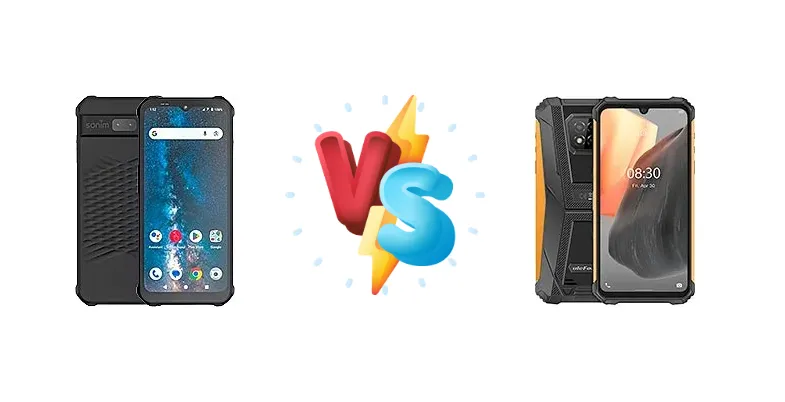
Sonim XP400 vs. Ulefone Armor 8 Pro: Which Rugged Phone Reigns Supreme?
| Phones Images | |||||
|---|---|---|---|---|---|
|
🏆 Quick Verdict
For the average user prioritizing long-term performance and efficiency, the Sonim XP400 is the clear winner. Its Snapdragon 4 Gen 2 (4nm) chipset provides a significant advantage in processing power and thermal management over the Ulefone Armor 8 Pro’s Helio P60 (12nm), translating to a smoother user experience and better longevity.
| PHONES | ||
|---|---|---|
| Phone Names | Sonim XP400 | Ulefone Armor 8 Pro |
| Network | ||
|---|---|---|
| 2G bands | GSM 850 / 900 / 1800 / 1900 | GSM 850 / 900 / 1800 / 1900 |
| 3G bands | HSDPA 850 / 900 / 1700(AWS) / 1900 / 2100 | HSDPA 850 / 900 / 1700(AWS) / 1900 / 2100 |
| 4G bands | 1, 3, 5, 7, 8, 20, 26, 28, 32, 38, 40, 41, 42, 68, 71 | 1, 2, 3, 4, 5, 7, 8, 12, 13, 17, 18, 19, 20, 25, 26, 28, 66 |
| 5G bands | 1, 3, 5, 7, 8, 20, 26, 28, 38, 40, 41, 71, 75, 77, 78 SA/NSA | - |
| Speed | HSPA, LTE, 5G | HSPA 42.2/11.5 Mbps, LTE Cat7 300/150 Mbps |
| Technology | GSM / HSPA / LTE / 5G | GSM / HSPA / LTE |
| Launch | ||
|---|---|---|
| Announced | 2025, January 22 | 2021, April 28 |
| Status | Available. Released 2025, January 22 | Available. Released 2021, April 28 |
| Body | ||
|---|---|---|
| Build | - | Front glass, aluminum back with rubber, aluminum frame |
| Dimensions | 170 x 78 x 10.2 mm (6.69 x 3.07 x 0.40 in) | 166 x 81.8 x 15 mm (6.54 x 3.22 x 0.59 in) |
| SIM | Nano-SIM + Nano-SIM | Nano-SIM + Nano-SIM |
| Weight | 230 g (8.11 oz) | 282 g (9.95 oz) |
| - | IP68 dust/water resistant (up to 1.5m for 30 min) Drop-to-concrete resistance from up to 1.2m MIL-STD-810G compliant | |
| Display | ||
|---|---|---|
| Protection | Corning Gorilla Glass Victus 2 | Scratch-resistant glass, oleophobic coating |
| Resolution | 720 x 1612 pixels, 20:9 ratio (~272 ppi density) | 720 x 1560 pixels, 19.5:9 ratio (~282 ppi density) |
| Size | 6.5 inches, 101.5 cm2 (~76.5% screen-to-body ratio) | 6.1 inches, 91.3 cm2 (~67.3% screen-to-body ratio) |
| Type | IPS LCD | IPS LCD |
| Platform | ||
|---|---|---|
| CPU | Octa-core (2x2.2 GHz Cortex-A78 & 6x1.95 GHz Cortex-A55) | Octa-core (4x2.0 GHz Cortex-A73 & 4x2.0 GHz Cortex-A53) |
| Chipset | Qualcomm SM4450 Snapdragon 4 Gen 2 (4 nm) | Mediatek MT6771 Helio P60 (12 nm) |
| GPU | Adreno 613 | Mali-G72 MP3 |
| OS | Android 14, up to 2 major Android upgrades | Android 11 |
| Memory | ||
|---|---|---|
| Card slot | microSDXC (uses shared SIM slot) | microSDXC (uses shared SIM slot) |
| Internal | 128GB 6GB RAM | 128GB 6GB RAM, 128GB 8GB RAM |
| Main Camera | ||
|---|---|---|
| Dual | 50 MP, (wide), PDAF 5 MP, (ultrawide) | - |
| Features | LED flash | LED flash, Panorama, HDR |
| Single | - | 8 MP, f/2.2 |
| Triple | - | 16 MP, f/2.2, (wide), PDAF 5 MP (macro) Auxiliary lens |
| Video | 1080p@30fps | 1080p@30fps |
| Selfie camera | ||
|---|---|---|
| Single | 8 MP, (wide) | 8 MP, f/2.2 |
| Video | 1080p@30fps | 1080p@30fps |
| Sound | ||
|---|---|---|
| 3.5mm jack | - | Yes |
| 35mm jack | No | Yes |
| Loudspeaker | Yes, with stereo speakers | Yes |
| Comms | ||
|---|---|---|
| Bluetooth | 5.1, A2DP, LE | 4.2, A2DP, LE |
| NFC | Yes | Yes |
| Positioning | GPS (L1+L5), GALILEO, GLONASS | GPS, GLONASS, GALILEO, BDS |
| Radio | FM radio | FM radio, RDS, recording |
| USB | USB Type-C 3.1 | USB Type-C 2.0, OTG |
| WLAN | Wi-Fi 802.11 a/b/g/n/ac, dual-band | Wi-Fi 802.11 a/b/g/n/ac, Wi-Fi Direct |
| Features | ||
|---|---|---|
| Sensors | Fingerprint (side-mounted), accelerometer, gyro, proximity, compass, barometer | Fingerprint (side-mounted), accelerometer, gyro, proximity, compass |
| Battery | ||
|---|---|---|
| Charging | - | 15W wired |
| Type | 5000 mAh | Li-Po 5580 mAh |
| Misc | ||
|---|---|---|
| Colors | Black | Black, Orange, Red |
| Price | € 249.90 | About 190 EUR |
Sonim XP400
- Modern and efficient Snapdragon 4 Gen 2 chipset
- Superior thermal management for sustained performance
- Potential for longer battery life due to chipset efficiency
- Price likely higher than the Ulefone Armor 8 Pro
- Specific display details are unknown
Ulefone Armor 8 Pro
- Lower upfront cost
- Rugged design for demanding environments
- Acceptable performance for basic tasks
- Outdated Helio P60 chipset
- Slow 15W charging
- Potential for performance throttling under load
Display Comparison
Neither device's display specifications are provided, so a direct comparison is limited. However, given Sonim's focus on outdoor visibility, it's reasonable to assume the XP400 prioritizes high brightness nits. The Ulefone Armor 8 Pro, being an older model, likely features a standard LCD panel. The absence of details like refresh rate or resolution suggests both are geared towards functionality over visual fidelity, prioritizing durability and battery conservation over cutting-edge display technology.
Camera Comparison
Without specific camera sensor details, a detailed comparison is difficult. However, the rugged phone market often prioritizes durability over camera quality. It’s likely both devices feature modest camera setups. The absence of information suggests neither phone is positioned as a photography powerhouse. Any differences would likely be in image processing algorithms rather than raw sensor capabilities.
Performance
The core difference lies in the chipsets. The Sonim XP400’s Qualcomm SM4450 Snapdragon 4 Gen 2 (4nm) is a significant leap forward. The 4nm fabrication process inherently offers better power efficiency and thermal performance compared to the Ulefone Armor 8 Pro’s Mediatek MT6771 Helio P60 (12nm). The Snapdragon 4 Gen 2’s CPU configuration – 2x2.2 GHz Cortex-A78 & 6x1.95 GHz Cortex-A55 – provides a more modern and capable architecture than the Helio P60’s 4x2.0 GHz Cortex-A73 & 4x2.0 GHz Cortex-A53. This translates to faster app loading times, smoother multitasking, and improved responsiveness for the Sonim XP400. The older Helio P60 will likely struggle with demanding applications and may exhibit more noticeable throttling under sustained load.
Battery Life
Battery capacity isn't specified for either device. However, the Ulefone Armor 8 Pro’s 15W wired charging is a clear disadvantage. The Sonim XP400, while potentially having a similar battery capacity, benefits from the Snapdragon 4 Gen 2’s superior power efficiency. This means the XP400 will likely achieve longer battery life on a single charge and potentially support faster charging technologies (though not specified). The slower charging speed of the Armor 8 Pro will require more downtime to reach a full charge.
Buying Guide
Buy the Sonim XP400 if you need a rugged phone for demanding work environments, frequent outdoor use, or value future-proofing with a modern chipset. Its superior processing power and efficiency will handle multitasking and software updates more effectively. Buy the Ulefone Armor 8 Pro if you prioritize a lower upfront cost and are willing to compromise on performance and long-term software support. It’s a viable option for basic communication and light usage in rugged conditions.