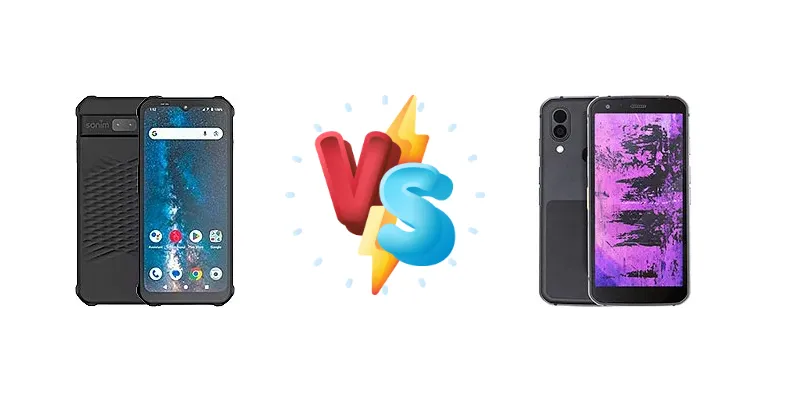
The rugged smartphone market caters to a specific need: durability. Both the Sonim XP400 and Cat S62 Pro aim to deliver that, but they approach it with different internal philosophies. The XP400 leverages a newer, more efficient chipset, while the S62 Pro relies on a tried-and-true, albeit older, platform. This comparison dissects these differences to determine which phone best suits your needs.
🏆 Quick Verdict
For most users, the Sonim XP400 emerges as the superior choice. Its Qualcomm Snapdragon 4 Gen 2 (4nm) chipset provides a noticeable performance uplift and improved power efficiency compared to the Cat S62 Pro’s Snapdragon 660 (14nm). While both are rugged, the XP400 offers a more future-proofed experience.
| Network |
|---|
| 2G bands | GSM 850 / 900 / 1800 / 1900 | GSM 850 / 900 / 1800 / 1900 |
| 3G bands | HSDPA 850 / 900 / 1700(AWS) / 1900 / 2100 | HSDPA 850 / 900 / 1700(AWS) / 1900 / 2100 |
| 4G bands | 1, 3, 5, 7, 8, 20, 26, 28, 32, 38, 40, 41, 42, 68, 71 | 1, 2, 3, 4, 5, 7, 8, 20, 28, 38, 40 |
| 5G bands | 1, 3, 5, 7, 8, 20, 26, 28, 38, 40, 41, 71, 75, 77, 78 SA/NSA | - |
| Speed | HSPA, LTE, 5G | HSPA 42.2/5.76 Mbps, LTE (2CA) Cat13 400/150 Mbps |
| Technology | GSM / HSPA / LTE / 5G | GSM / HSPA / LTE |
| Launch |
|---|
| Announced | 2025, January 22 | 2020, June 28. Released 2020, August 17 |
| Status | Available. Released 2025, January 22 | Discontinued |
| Body |
|---|
| Build | - | Glass front (Gorilla Glass 6), plastic back, aluminum frame |
| Dimensions | 170 x 78 x 10.2 mm (6.69 x 3.07 x 0.40 in) | 158.5 x 76.7 x 11.9 mm (6.24 x 3.02 x 0.47 in) |
| SIM | Nano-SIM + Nano-SIM | · Nano-SIM· Nano-SIM + Nano-SIM |
| Weight | 230 g (8.11 oz) | 248 g (8.75 oz) |
| | - | IP68/IP69 dust/water resistant (up to 1.5m for 35 mins)
Drop-to-concrete resistance from up to 1.8m
MIL-STD-810H compliant |
| Display |
|---|
| Protection | Corning Gorilla Glass Victus 2 | Corning Gorilla Glass 6 |
| Resolution | 720 x 1612 pixels, 20:9 ratio (~272 ppi density) | 1080 x 2160 pixels, 18:9 ratio (~424 ppi density) |
| Size | 6.5 inches, 101.5 cm2 (~76.5% screen-to-body ratio) | 5.7 inches, 83.8 cm2 (~69.0% screen-to-body ratio) |
| Type | IPS LCD | IPS LCD |
| Platform |
|---|
| CPU | Octa-core (2x2.2 GHz Cortex-A78 & 6x1.95 GHz Cortex-A55) | Octa-core (4x2.2 GHz Kryo 260 Gold & 4x1.8 GHz Kryo 260 Silver) |
| Chipset | Qualcomm SM4450 Snapdragon 4 Gen 2 (4 nm) | Qualcomm SDM660 Snapdragon 660 (14 nm) |
| GPU | Adreno 613 | Adreno 512 |
| OS | Android 14, up to 2 major Android upgrades | Android 10 |
| Memory |
|---|
| Card slot | microSDXC (uses shared SIM slot) | microSDXC (dedicated slot) |
| Internal | 128GB 6GB RAM | 128GB 6GB RAM |
| Main Camera |
|---|
| Dual | 50 MP, (wide), PDAF
5 MP, (ultrawide) | 12 MP, f/1.8, (wide), 1/2.55", 1.4µm, dual pixel PDAF
FLIR thermal camera (Lepton 3.5 module) |
| Features | LED flash | Thermal imaging, heat palettes, temp. spot meter, LED flash |
| Video | 1080p@30fps | 1080p@30fps, gyro-EIS |
| Selfie camera |
|---|
| Single | 8 MP, (wide) | 8 MP |
| Video | 1080p@30fps | 1080p@30fps |
| Sound |
|---|
| 3.5mm jack | - | No |
| 35mm jack | No | No |
| Loudspeaker | Yes, with stereo speakers | Yes |
| Comms |
|---|
| Bluetooth | 5.1, A2DP, LE | 5.0, A2DP, LE |
| NFC | Yes | Yes |
| Positioning | GPS (L1+L5), GALILEO, GLONASS | GPS, GLONASS, GALILEO, BDS |
| Radio | FM radio | FM radio |
| USB | USB Type-C 3.1 | USB Type-C 2.0, OTG |
| WLAN | Wi-Fi 802.11 a/b/g/n/ac, dual-band | Wi-Fi 802.11 a/b/g/n/ac, dual-band, Wi-Fi Direct |
| Features |
|---|
| Sensors | Fingerprint (side-mounted), accelerometer, gyro, proximity, compass, barometer | Fingerprint (rear-mounted), accelerometer, gyro, proximity, compass |
| Battery |
|---|
| Type | 5000 mAh | Li-Ion 4000 mAh |
| Misc |
|---|
| Colors | Black | Black |
| Price | € 249.90 | About 530 EUR |
Sonim XP400
- More efficient Snapdragon 4 Gen 2 chipset
- Likely longer software support
- Improved thermal management
- Rugged phone pricing can be high
- Detailed camera specs are unknown
Cat S62 Pro
- Potentially lower price point
- Proven Snapdragon 660 platform
- Rugged design for demanding environments
- Older, less efficient chipset
- Potential for throttling under load
- Shorter software support lifecycle
Display Comparison
Neither Sonim nor Cat provide detailed display specifications beyond basic resolution. However, the focus on outdoor visibility is paramount for rugged phones. We can infer that both likely utilize IPS LCD panels for wide viewing angles. The S62 Pro's older design may result in larger bezels. Without specific brightness data, it's difficult to declare a clear winner, but newer panel technology often translates to better efficiency and color accuracy, potentially favoring the XP400.
Camera Comparison
Detailed camera specs are unavailable for both devices. However, rugged phones typically prioritize practicality over photographic excellence. We can assume both feature capable main sensors for documentation purposes. The absence of detailed information makes a direct comparison difficult. The S62 Pro's age suggests its image processing may be less refined than what the XP400 can achieve, even with similar hardware. The focus should be on reliable image capture in challenging conditions, rather than artistic quality.
Performance
The core difference lies in the chipsets. The Sonim XP400’s Snapdragon 4 Gen 2 (4nm) is a significant leap forward from the Cat S62 Pro’s Snapdragon 660 (14nm). The 4nm process node delivers substantially better power efficiency, reducing heat and extending battery life. The XP400’s CPU, with its Cortex-A78 cores, offers a performance advantage over the S62 Pro’s Kryo 260 Gold cores in multi-threaded tasks. While both are octa-core, the architectural improvements in the newer chipset translate to a smoother user experience, especially when multitasking or running demanding applications. The XP400 will likely exhibit less throttling under sustained load.
Battery Life
Battery capacity is not specified for either device. However, the XP400’s more efficient Snapdragon 4 Gen 2 chipset will undoubtedly translate to longer battery life, even with a similarly sized battery to the S62 Pro. The 4nm process reduces power consumption at every step. Charging wattage is also unknown, but the XP400’s efficiency will likely result in faster overall charging times, even if peak wattage is comparable.
Buying Guide
Buy the Sonim XP400 if you need a rugged phone that can handle demanding tasks, benefits from longer software support due to the newer chipset, and prioritizes battery life. Buy the Cat S62 Pro if you prefer a device with a potentially lower price point and are primarily focused on basic communication and light usage, accepting the limitations of an older processor.
Frequently Asked Questions
❓ Will the Sonim XP400 run demanding apps like mapping software or industrial tools smoothly?
The Snapdragon 4 Gen 2 chipset in the XP400 is significantly more capable than the Snapdragon 660 in the S62 Pro. The Cortex-A78 cores and the 4nm process node will provide a smoother experience when running resource-intensive applications, reducing lag and improving responsiveness.
❓ How does the older Snapdragon 660 in the Cat S62 Pro handle prolonged use of GPS or data-heavy tasks?
The Snapdragon 660, being a 14nm chip, is prone to thermal throttling under sustained load. Prolonged GPS use or data-heavy tasks may result in reduced performance and increased heat generation. The XP400’s 4nm chipset will manage heat more effectively, maintaining performance for longer durations.
❓ Is the software update support significantly different between these two devices?
Yes. The Cat S62 Pro, being an older device, is likely nearing the end of its software update lifecycle. The Sonim XP400, with its newer chipset, will receive longer software support, including security patches and potentially Android version upgrades, ensuring a more secure and future-proofed experience.