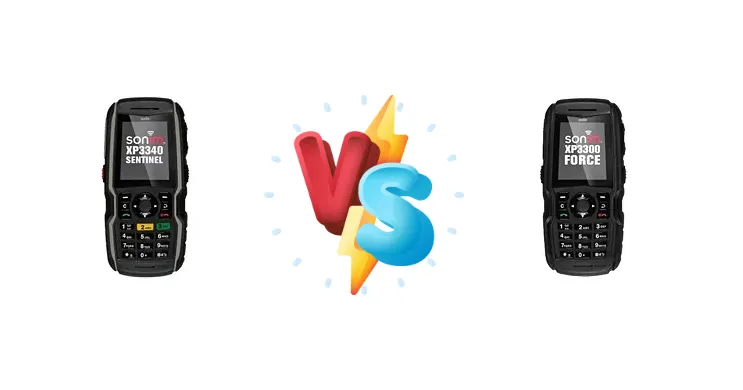
Sonim dominates the ultra-rugged smartphone space, catering to professionals who demand reliability in harsh environments. The XP3340 Sentinel and XP3300 Force represent Sonim’s commitment to this market, but target slightly different needs. This comparison dissects their features, focusing on how their design choices impact real-world usability for field workers, first responders, and anyone needing a phone that can withstand abuse.
🏆 Quick Verdict
For the average user prioritizing long-term software support and potentially enhanced features, the Sonim XP3340 Sentinel appears to be the better choice, assuming it offers improvements over the XP3300 Force. However, without specific specs, the XP3300 Force remains a viable option for those seeking a proven, durable device at a potentially lower price point.
| Network |
|---|
| 2G bands | GSM 850 / 900 / 1800 / 1900 | GSM 850 / 900 / 1800 / 1900 |
| EDGE | Class 12 | Class 12 |
| GPRS | Class 12 | Class 12 |
| Technology | GSM | GSM |
| Launch |
|---|
| Announced | 2011, August | 2011, February. Released 2011, March |
| Status | Discontinued | Discontinued |
| Body |
|---|
| Dimensions | 126 x 60 x 25 mm (4.96 x 2.36 x 0.98 in) | 126 x 60 x 25 mm (4.96 x 2.36 x 0.98 in) |
| SIM | Mini-SIM | Mini-SIM |
| Weight | 185 g (6.53 oz) | 185 g (6.53 oz) |
| | MIL-STD-810G compliant
IP68 dust/water resistant (up to 2m for 1 hour)
Drop-to-concrete resistance from up to 2m
Operational range -20°C to +55°C
Flashlight | MIL-STD-810G compliant
IP68 dust/water resistant (up to 2m for 1 hour)
Drop-to-concrete resistance from up to 2m
Operational range -20°C to +55°C
Flashlight |
| Display |
|---|
| Protection | Corning Gorilla Glass | Corning Gorilla Glass |
| Resolution | 240 x 320 pixels, 4:3 ratio (~200 ppi density) | 240 x 320 pixels, 4:3 ratio (~200 ppi density) |
| Size | 2.0 inches, 12.4 cm2 (~16.4% screen-to-body ratio) | 2.0 inches, 12.4 cm2 (~16.4% screen-to-body ratio) |
| Type | TFT, 65K colors | TFT, 65K colors |
| Platform |
|---|
| OS | MediaTek MT6235 platform | MediaTek MT6235 platform |
| Memory |
|---|
| Card slot | microSDHC (dedicated slot) | microSDHC (dedicated slot) |
| Main Camera |
|---|
| Features | LED flash | LED flash |
| Single | 2 MP | 2 MP |
| Video | Yes | No |
| Sound |
|---|
| 3.5mm jack | Yes | Yes |
| 35mm jack | Yes | Yes |
| Loudspeaker | Yes | Yes |
| Comms |
|---|
| Bluetooth | 2.1, A2DP | 2.1, A2DP |
| Positioning | GPS, A-GPS | GPS, A-GPS |
| Radio | FM radio | FM radio |
| USB | 2.0 | 2.0 |
| WLAN | No | No |
| Features |
|---|
| Browser | - | WAP 2.0/xHTML |
| Sensors | Accelerometer | - |
| | Organizer
MP3/WAV/AAC player
MP4/H.263 player
Voice memo
Stopwatch
Count-down timer
File manager | Organizer
MP3/WAV/AAC player
MP4/H.263 player
Voice memo
Stopwatch
Count-down timer
File manager |
| Battery |
|---|
| Stand-by | Up to 800 h | Up to 800 h |
| Talk time | Up to 24 h | Up to 18 h |
| Type | Removable Li-Ion 1750 mAh battery | Removable Li-Ion 1750 mAh battery |
| Misc |
|---|
| Colors | Black, Black/Yellow | Black, Black/Yellow |
| Price | - | About 370 EUR |
Sonim XP3340 Sentinel
- Potential for newer processor and improved performance
- Likely to receive longer software support updates
- May feature enhanced camera capabilities
- Potentially higher price point
- May not offer significant real-world improvements over the XP3300 Force
Sonim XP3300 Force
- Proven reliability and durability
- Likely more affordable price
- Excellent battery life
- Older processor and potentially slower performance
- Limited software update support
Display Comparison
Given both phones target rugged use, we can expect displays prioritizing visibility and durability over high refresh rates or OLED technology. The XP3300 Force likely utilizes a hardened glass screen, and the Sentinel likely builds upon this. Without specific nit brightness figures, it’s reasonable to assume both offer sufficient outdoor visibility, but the Sentinel *may* incorporate a more advanced anti-glare coating. The absence of detailed specs suggests both will likely feature LCD panels, prioritizing power efficiency over contrast ratios.
Camera Comparison
Camera performance is rarely a primary focus for Sonim, but the XP3340 Sentinel may offer improvements over the XP3300 Force. Both likely feature a primary camera around 13-16MP, adequate for documentation and basic photography. The Sentinel *might* include a larger sensor or improved image processing algorithms for better low-light performance. The inclusion of a dedicated night mode on the Sentinel would be a significant upgrade. We can expect both to avoid high-resolution, low-quality macro lenses, focusing on practicality.
Performance
Sonim typically utilizes Qualcomm Snapdragon chipsets in their rugged phones, focusing on efficiency and reliability rather than raw processing power. The XP3300 Force likely features a Snapdragon 400-series processor, sufficient for basic communication and application use. The XP3340 Sentinel *could* feature a newer Snapdragon 400 or 600-series chip, offering a modest performance boost. RAM configurations are likely similar, around 4-6GB, prioritizing multitasking for essential work apps. Thermal management is crucial in rugged phones; both likely employ passive cooling solutions to prevent overheating in direct sunlight.
Battery Life
Battery life is paramount for rugged phones used in the field. Both the XP3340 Sentinel and XP3300 Force likely feature large batteries, exceeding 4000mAh, to provide all-day usage. The XP3300 Force is known for its excellent battery endurance. The Sentinel *could* incorporate a slightly larger battery or more efficient chipset, extending runtime further. Charging speeds are likely moderate, prioritizing battery health over rapid charging, with both potentially supporting 10-15W charging.
Buying Guide
Buy the Sonim XP3340 Sentinel if you require the latest features Sonim offers, anticipate needing extended software support for critical applications, and value potential upgrades in sensor technology or processing power. Buy the Sonim XP3300 Force if you prioritize a battle-tested, reliable device with a proven track record, are on a tighter budget, and don’t require the absolute newest features or software updates.
Frequently Asked Questions
❓ What level of drop protection do the Sonim XP3340 Sentinel and XP3300 Force offer?
Both phones are built to withstand significant drops. Sonim phones are typically tested to MIL-STD-810H standards, meaning they can survive repeated drops onto concrete from a height of 6 feet. The Sentinel *may* have slightly improved drop protection due to newer materials or design refinements, but both are exceptionally durable.
❓ Are either of these phones compatible with FirstNet?
Sonim phones are frequently used by first responders, and both the XP3340 Sentinel and XP3300 Force are likely compatible with FirstNet. However, it's crucial to verify compatibility with your specific carrier and FirstNet plan before purchasing.
❓ How does the push-to-talk (PTT) functionality differ between these two models?
Both phones support push-to-talk functionality, a critical feature for many field workers. The core PTT experience is likely similar, but the Sentinel *may* offer integration with newer PTT platforms or improved audio quality through updated codecs.
❓ What is the ingress protection rating for both devices, and what does that mean for water and dust resistance?
Both the XP3340 Sentinel and XP3300 Force boast an IP68 rating. This means they are fully dust-tight and can withstand immersion in up to 1.5 meters of water for 30 minutes. This level of protection is essential for use in harsh environments.