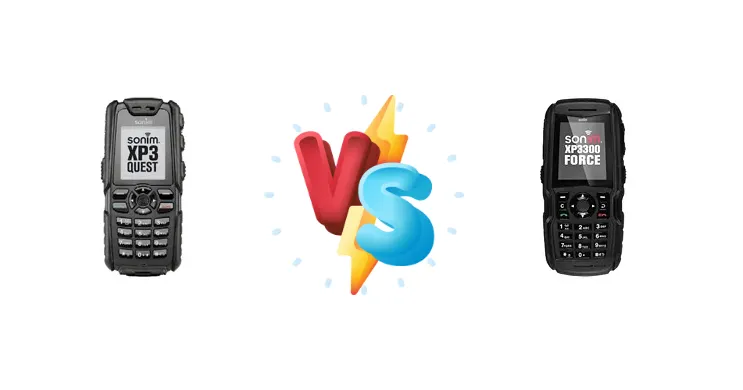
Sonim caters to a niche but vital market: users needing extreme durability. The XP3.20 Quest Pro and XP3300 Force both promise that, but target slightly different needs. The XP3.20 Quest Pro, given its 'Pro' designation, likely focuses on enhanced features and potentially connectivity, while the XP3300 Force appears to be a more streamlined, core-functionality rugged device. This comparison will dissect their likely differences, focusing on how those translate to real-world usability for demanding professions.
🏆 Quick Verdict
For the average user prioritizing core rugged functionality and long-term reliability, the Sonim XP3300 Force is likely the better choice. Its focus on essential features, combined with Sonim’s established build quality, offers a dependable tool without the potential complexities of the Quest Pro’s added features, which remain undefined.
| Network |
|---|
| 2G bands | GSM 900 / 1800 / 1900 | GSM 850 / 900 / 1800 / 1900 |
| EDGE | Yes | Class 12 |
| GPRS | Class 10 | Class 12 |
| Technology | GSM | GSM |
| | GSM 850 / 1800 / 1900 | - |
| Launch |
|---|
| Announced | 2010, January. Released 2010, Q2 | 2011, February. Released 2011, March |
| Status | Discontinued | Discontinued |
| Body |
|---|
| Dimensions | 119 x 56 x 25 mm (4.69 x 2.20 x 0.98 in) | 126 x 60 x 25 mm (4.96 x 2.36 x 0.98 in) |
| SIM | Mini-SIM | Mini-SIM |
| Weight | 170 g (6.00 oz) | 185 g (6.53 oz) |
| | IP67 dust/water resistant (up to 1m for 30 mins)
MIL-STD-810F compliant
Drop-to-concrete resistance from up to 2m
Operational range -20°C to +55°C
Flashlight | MIL-STD-810G compliant
IP68 dust/water resistant (up to 2m for 1 hour)
Drop-to-concrete resistance from up to 2m
Operational range -20°C to +55°C
Flashlight |
| Display |
|---|
| Protection | Corning Gorilla Glass | Corning Gorilla Glass |
| Resolution | 176 x 220 pixels (~159 ppi density) | 240 x 320 pixels, 4:3 ratio (~200 ppi density) |
| Size | 1.77 inches, 9.9 cm2 (~14.8% screen-to-body ratio) | 2.0 inches, 12.4 cm2 (~16.4% screen-to-body ratio) |
| Type | TFT, 65K colors | TFT, 65K colors |
| Platform |
|---|
| OS | - | MediaTek MT6235 platform |
| Memory |
|---|
| Call records | Yes | - |
| Card slot | microSD (dedicated slot) | microSDHC (dedicated slot) |
| Phonebook | Yes, up to 1000 entries | - |
| Main Camera |
|---|
| Features | LED flash | LED flash |
| Single | 2 MP | 2 MP |
| Video | - | No |
| Sound |
|---|
| 3.5mm jack | No | Yes |
| 35mm jack | No | Yes |
| Loudspeaker | Yes | Yes |
| | 20mm water resistant speaker
2.5 mm audio jack | - |
| Comms |
|---|
| Bluetooth | 2.0 | 2.1, A2DP |
| Positioning | GPS, A-GPS; navigation software | GPS, A-GPS |
| Radio | FM radio | FM radio |
| USB | miniUSB | 2.0 |
| WLAN | No | No |
| Features |
|---|
| Browser | WAP 2.0/xHTML | WAP 2.0/xHTML |
| Games | Yes | - |
| Java | Yes | - |
| Messaging | SMS(1000) | - |
| | Organizer
Voice memo
Stopwatch | Organizer
MP3/WAV/AAC player
MP4/H.263 player
Voice memo
Stopwatch
Count-down timer
File manager |
| Battery |
|---|
| Stand-by | Up to 1500 h | Up to 800 h |
| Talk time | Up to 18 h | Up to 18 h |
| Type | Removable Li-Ion 1850 mAh battery | Removable Li-Ion 1750 mAh battery |
| Misc |
|---|
| Colors | Black | Black, Black/Yellow |
| Price | - | About 370 EUR |
Sonim XP3.20 Quest Pro
- Potentially enhanced connectivity features (satellite, advanced PTT)
- Likely higher resolution display
- May offer faster processing speeds
- Potentially higher price point
- Increased complexity could lead to more potential failure points
- May have shorter battery life due to advanced features
Sonim XP3300 Force
- Exceptional durability and reliability
- Long battery life focused on core functionality
- Likely more affordable price
- Potentially lower resolution display
- Less powerful processor
- Fewer advanced features
Display Comparison
Without specific display specs, we can infer differences based on the 'Pro' designation. The XP3.20 Quest Pro likely features a larger display with a higher resolution, potentially incorporating features like Gorilla Glass Victus for improved scratch resistance. The XP3300 Force, prioritizing cost-effectiveness, likely uses a more basic, though still ruggedized, display. Given Sonim’s focus on usability in bright sunlight, both models likely employ high-nit displays, but the Quest Pro may offer superior color accuracy and viewing angles. The XP3.20 may also include features like glove mode for enhanced touch sensitivity.
Camera Comparison
Camera performance is unlikely to be a primary focus for either device. Both will likely feature a main camera capable of capturing usable images in good lighting conditions. The XP3.20 Quest Pro may include a higher-resolution sensor and potentially additional features like image stabilization. However, the emphasis will be on durability and reliability of the camera module itself, rather than image quality. Expect both to prioritize functional image capture for documentation purposes over artistic photography. The inclusion of a dedicated PTT button on both models suggests a focus on voice communication over image capture.
Performance
Considering Sonim’s target market, neither device will prioritize bleeding-edge processing power. The XP3.20 Quest Pro, however, likely utilizes a more recent chipset to handle potential advanced features like satellite connectivity or enhanced software. The XP3300 Force probably employs a proven, efficient processor optimized for battery life and reliable operation of core functions. RAM capacity is also likely higher on the Quest Pro to support multitasking. Thermal management will be crucial for both, with Sonim likely employing passive cooling solutions to maintain performance under stress.
Battery Life
Battery life is critical for users in remote locations. The XP3300 Force, with its likely focus on core functionality, may prioritize a larger battery capacity to maximize uptime. The XP3.20 Quest Pro, with potentially more power-hungry features, may employ a slightly smaller battery but compensate with optimized power management and potentially faster charging capabilities. Both devices will likely support extended battery life through software optimizations and potentially user-replaceable battery options, a hallmark of Sonim’s design philosophy. 0-100% charge times will likely be similar, prioritizing safety and longevity over speed.
Buying Guide
Buy the Sonim XP3.20 Quest Pro if you require advanced connectivity options like potentially integrated satellite communication or enhanced PTT capabilities, and are willing to pay a premium for those features. Buy the Sonim XP3300 Force if you prioritize a no-nonsense, incredibly durable phone for voice communication, basic data tasks, and reliable operation in harsh environments where simplicity and longevity are paramount.
Frequently Asked Questions
❓ What level of water and dust resistance can I expect from the Sonim XP3.20 Quest Pro and XP3300 Force?
Both Sonim phones are built to withstand extremely harsh conditions. They likely meet or exceed IP68 and MIL-STD-810H standards, meaning they are fully dust-tight and can survive submersion in water for extended periods. The XP3300 Force, being a more basic model, may have slightly tighter tolerances for extreme conditions, but both are designed for reliable operation in demanding environments.
❓ Are the batteries on either the XP3.20 Quest Pro or XP3300 Force user-replaceable in the field?
Sonim is known for offering user-replaceable batteries on many of their models. While not confirmed for these specific devices, it's highly probable that the XP3300 Force, prioritizing uptime, will feature a user-replaceable battery. The XP3.20 Quest Pro may or may not, depending on design constraints related to its advanced features. This is a crucial consideration for users working in remote locations without access to charging infrastructure.
❓ Does the Sonim XP3.20 Quest Pro offer any satellite communication capabilities?
The 'Quest Pro' designation hints at potential advanced connectivity. It's possible the XP3.20 Quest Pro integrates satellite communication capabilities for use in areas with no cellular coverage. This would be a significant differentiator, allowing for voice and potentially data communication in truly remote locations. However, this feature remains unconfirmed and would likely come with a subscription cost.