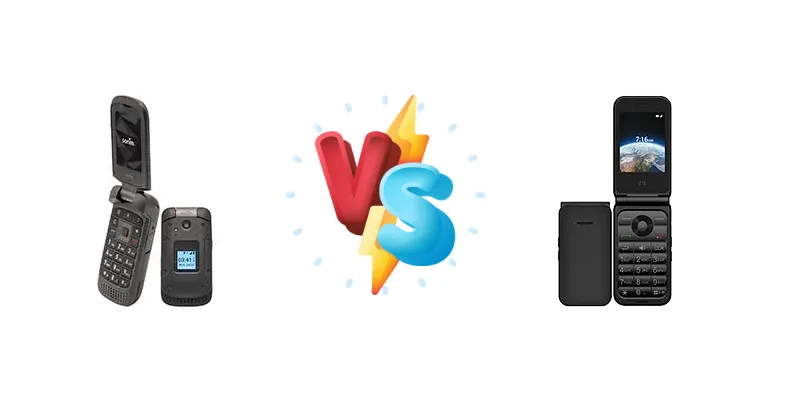
Rugged phones are built to withstand the toughest conditions, appealing to outdoor enthusiasts, construction workers, and anyone needing a durable device. Today, we're pitting two contenders against each other: the Sonim XP3, known for its extreme durability, and the ZTE Cymbal U, offering a balance of features and affordability. Let's dive into a detailed comparison.
🏆 Quick Verdict
The ZTE Cymbal U edges out the Sonim XP3 thanks to its slightly faster processor and more modern chipset. While the XP3 boasts superior ruggedness, the Cymbal U provides a better overall user experience for the price, making it the more compelling choice for most users.
| Network |
|---|
| 2G bands | GSM 850 / 900 / 1800 / 1900 | GSM 850 / 1900 |
| 3G bands | HSDPA 800 / 850 / 900 / 1700(AWS) / 2100 | HSDPA 850 / 1700(AWS) / 1900 |
| 4G bands | 1, 2, 3, 4, 5, 8, 12, 13, 14, 25, 26, 38, 41, 66 | 2, 4, 5, 12, 41, 66, 71 |
| Speed | HSPA, LTE | HSPA, LTE Cat4 150/50 Mbps |
| Technology | GSM / CDMA / HSPA / EVDO / LTE | GSM / HSPA / LTE |
| | CDMA2000 1xEV-DO | - |
| Launch |
|---|
| Announced | 2019, March. Released 2019, March | 2021, January |
| Status | Discontinued | Available. Released 2021, January |
| Body |
|---|
| Dimensions | 112 x 58 x 27 mm (4.41 x 2.28 x 1.06 in) | 109.2 x 55.9 x 19.5 mm (4.30 x 2.20 x 0.77 in) |
| SIM | Nano-SIM | Nano-SIM |
| Weight | 195 g (6.88 oz) | - |
| | IP68 dust/water resistant (up to 1.5m for 30 min)
MIL-STD-810G | - |
| Display |
|---|
| Resolution | 240 x 320 pixels, 4:3 ratio (~154 ppi density) | 240 x 320 pixels, 4:3 ratio (~143 ppi density) |
| Size | 2.6 inches, 20.9 cm2 (~32.2% screen-to-body ratio) | 2.8 inches, 24.3 cm2 (~39.8% screen-to-body ratio) |
| Type | TFT LCD | TFT LCD |
| | Cover display:
TN LCD, 1.08 inches, 96 x 96 pixels | Cover display:
TFT LCD, 1.70 inches |
| Platform |
|---|
| CPU | Quad-core 1.1 GHz Cortex-A7 | Quad-core 1.3 GHz Cortex-A53 |
| Chipset | Qualcomm MSM8909 Snapdragon 210 (28 nm) | Qualcomm QM215 Snapdragon 215 (28 nm) |
| GPU | Adreno 304 | Adreno 308 |
| OS | Sonim OS (based on AOSP Android 8.1) | Proprietary |
| Memory |
|---|
| Card slot | microSDXC (dedicated slot) | microSDHC (dedicated slot) |
| Internal | 8GB 1GB RAM | 8GB 1GB RAM |
| Main Camera |
|---|
| Features | LED flash | - |
| Single | 5 MP | 2 MP |
| Video | - | 720p@30fps |
| Sound |
|---|
| 3.5mm jack | Yes | Yes |
| 35mm jack | Yes | Yes |
| Loudspeaker | Yes | Yes |
| Comms |
|---|
| Bluetooth | 4.2, A2DP, LE | 4.2, A2DP |
| NFC | No | No |
| Positioning | GPS, GLONASS, GALILEO | GPS |
| Radio | FM Radio | FM Radio |
| USB | USB Type-C | microUSB 2.0 |
| WLAN | Wi-Fi 802.11 a/b/g/n/r, dual-band | Wi-Fi 802.11 b/g/n, hotspot |
| Features |
|---|
| Sensors | Barometer | - |
| Battery |
|---|
| Type | Li-Ion 1500 mAh, removable | Li-Ion 1600 mAh, removable |
| Misc |
|---|
| Colors | Black | Black |
| Price | About 190 EUR | About 70 EUR |
Sonim XP3
- Exceptional durability and ruggedness
- Large battery capacity (likely)
- Loudspeaker for clear communication in noisy environments
- Push-to-Talk functionality
- Outdated processor and chipset
- Slow performance
- Basic display
- Likely low-resolution camera
ZTE Cymbal U
- More modern processor and chipset
- Better performance
- Potentially better battery efficiency
- More affordable
- Less rugged than the Sonim XP3
- Basic display
- Likely low-resolution camera
- Smaller battery capacity (potentially)
Display Comparison
Both phones feature relatively basic displays, likely LCD panels with standard resolutions. The Sonim XP3's display is likely smaller, prioritizing durability over screen real estate. The ZTE Cymbal U may offer slightly better color accuracy and brightness due to its newer chipset, but both are functional for outdoor visibility.
Camera Comparison
Camera quality on both devices is likely to be basic. Expect low-resolution sensors and limited features. The ZTE Cymbal U's newer chipset *might* offer slightly improved image processing, but don't expect stellar photo quality from either phone. Both are primarily for capturing essential moments, not high-quality photography.
Performance
The ZTE Cymbal U holds a clear advantage here. Its Cortex-A53 cores are significantly more efficient and powerful than the XP3's Cortex-A7 cores. The Snapdragon 215 chipset is also a more modern design, offering better overall performance and potentially smoother multitasking. The XP3 will feel noticeably slower.
Battery Life
The Sonim XP3 is known for its large battery capacity, often exceeding 4000mAh. The ZTE Cymbal U likely has a smaller battery, but the efficiency of the Snapdragon 215 could result in comparable or even slightly better real-world battery life, despite the smaller capacity.
Buying Guide
The Sonim XP3 is ideal for those prioritizing absolute durability and ruggedness above all else – construction workers, first responders, or anyone facing harsh environments. The ZTE Cymbal U is a better fit for users who want a rugged phone with decent performance and battery life at a more accessible price point.
Frequently Asked Questions
❓ Is the Sonim XP3 waterproof?
Yes, the Sonim XP3 is IP68 rated, meaning it's dustproof and waterproof up to a certain depth and duration.
❓ Can the ZTE Cymbal U handle drops?
The ZTE Cymbal U is designed to be rugged, but it's not as robust as the Sonim XP3. It can likely withstand minor drops, but extreme conditions are better suited for the XP3.