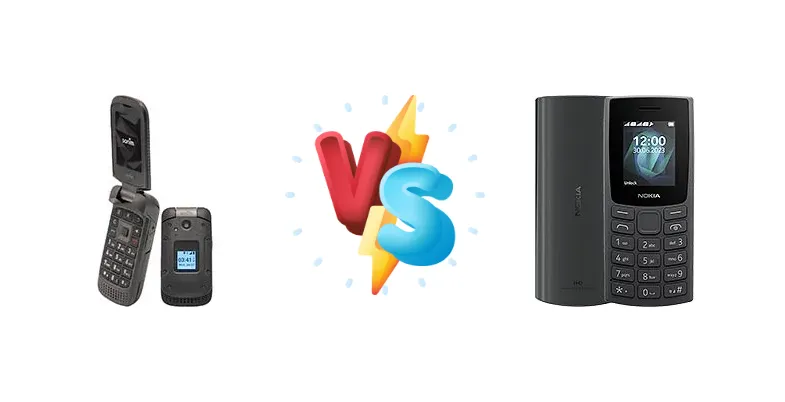
The mobile landscape is diverse, ranging from flagship smartphones to ultra-affordable feature phones. We're pitting the Sonim XP3, a device built for harsh environments, against the Nokia 105 4G 2nd Edition, a no-frills phone focused on providing basic 4G connectivity. This comparison isn't about raw power, but about understanding where each phone excels and who benefits most from its design.
🏆 Quick Verdict
For users needing a virtually indestructible phone for demanding work or outdoor activities, the Sonim XP3 is the clear winner. Its Qualcomm Snapdragon 210 chipset, while not powerful, provides a functional smartphone-like experience. The Nokia 105 4G 2nd Edition is best suited for those needing a simple, reliable secondary phone for calls and texts with 4G access.
| Network |
|---|
| 2G bands | GSM 850 / 900 / 1800 / 1900 | GSM 900 / 1800 |
| 3G bands | HSDPA 800 / 850 / 900 / 1700(AWS) / 2100 | HSDPA 850 / 900 / 1700(AWS) / 1900 / 2100 |
| 4G bands | 1, 2, 3, 4, 5, 8, 12, 13, 14, 25, 26, 38, 41, 66 | LTE |
| Speed | HSPA, LTE | HSPA, LTE |
| Technology | GSM / CDMA / HSPA / EVDO / LTE | GSM / HSPA / LTE |
| | CDMA2000 1xEV-DO | - |
| Launch |
|---|
| Announced | 2019, March. Released 2019, March | 2024, December |
| Status | Discontinued | Available. Released 2024, December |
| Body |
|---|
| Dimensions | 112 x 58 x 27 mm (4.41 x 2.28 x 1.06 in) | 121.5 x 50 x 14.4 mm (4.78 x 1.97 x 0.57 in) |
| SIM | Nano-SIM | · Nano-SIM· Nano-SIM + Nano-SIM |
| Weight | 195 g (6.88 oz) | 93 g (3.28 oz) |
| | IP68 dust/water resistant (up to 1.5m for 30 min)
MIL-STD-810G | - |
| Display |
|---|
| Resolution | 240 x 320 pixels, 4:3 ratio (~154 ppi density) | 120 x 160 pixels, 4:3 ratio (~111 ppi density) |
| Size | 2.6 inches, 20.9 cm2 (~32.2% screen-to-body ratio) | 1.8 inches, 10.0 cm2 (~16.5% screen-to-body ratio) |
| Type | TFT LCD | IPS LCD |
| | Cover display:
TN LCD, 1.08 inches, 96 x 96 pixels | - |
| Platform |
|---|
| CPU | Quad-core 1.1 GHz Cortex-A7 | - |
| Chipset | Qualcomm MSM8909 Snapdragon 210 (28 nm) | - |
| GPU | Adreno 304 | - |
| OS | Sonim OS (based on AOSP Android 8.1) | - |
| Memory |
|---|
| Call records | - | Yes |
| Card slot | microSDXC (dedicated slot) | microSDHC |
| Internal | 8GB 1GB RAM | 48MB 128MB RAM |
| Phonebook | - | Yes |
| Main Camera |
|---|
| Features | LED flash | - |
| Single | 5 MP | - |
| Sound |
|---|
| 3.5mm jack | Yes | - |
| 35mm jack | Yes | Yes |
| Loudspeaker | Yes | Yes |
| Comms |
|---|
| Bluetooth | 4.2, A2DP, LE | 5.0, A2DP |
| NFC | No | No |
| Positioning | GPS, GLONASS, GALILEO | No |
| Radio | FM Radio | Wireless FM radio |
| USB | USB Type-C | USB Type-C |
| WLAN | Wi-Fi 802.11 a/b/g/n/r, dual-band | No |
| Features |
|---|
| Games | - | Yes |
| Java | - | No |
| Messaging | - | SMS |
| Sensors | Barometer | - |
| Battery |
|---|
| Type | Li-Ion 1500 mAh, removable | Li-Ion 1450 mAh, removable |
| Misc |
|---|
| Colors | Black | Charcoal |
| Price | About 190 EUR | About 50 EUR |
Sonim XP3
- Extremely durable and ruggedized design
- Functional smartphone-like experience with Snapdragon 210
- 4G connectivity for data access
- Relatively short battery life compared to basic feature phones
- Higher price point than basic feature phones
Nokia 105 4G 2nd Edition
- Exceptional standby time
- Very affordable price
- Simple and easy to use
- Limited functionality beyond calls and texts
- Basic display and user interface
Display Comparison
The Nokia 105 4G 2nd Edition's display specifications are not available, but based on its market segment, it likely features a basic color LCD with a low resolution. The Sonim XP3, while not boasting a high-end display, benefits from a more robust construction designed to protect it from damage. The XP3's screen is likely optimized for visibility in bright sunlight, a crucial feature for outdoor use, whereas the Nokia 105 4G 2nd Edition prioritizes power efficiency over display quality.
Camera Comparison
Neither device is marketed for its camera capabilities. The Nokia 105 4G 2nd Edition's camera specifications are unavailable, but it likely features a very basic camera suitable for simple snapshots. The Sonim XP3's camera details are also limited, but its focus is on durability rather than image quality. Both phones are intended for communication, not photography, and users should not expect high-quality images from either.
Performance
The Sonim XP3's Qualcomm MSM8909 Snapdragon 210 (28nm) chipset, a quad-core 1.1 GHz Cortex-A7 processor, provides a noticeable performance advantage over the Nokia 105 4G 2nd Edition, which lacks detailed specifications. While the Snapdragon 210 isn't a powerhouse, it allows for basic app usage and web browsing. The 28nm manufacturing process, while older, is known for its relatively good power efficiency. The Nokia 105 4G 2nd Edition likely relies on a simpler chipset designed solely for voice calls and SMS, making direct performance comparisons difficult but clearly favoring the Sonim XP3 for any task beyond basic communication.
Battery Life
The Nokia 105 4G 2nd Edition is known for its exceptional standby time, a key benefit of its minimalist design and lack of power-hungry features. While the Sonim XP3's battery capacity is not specified, its Snapdragon 210 chipset and more active display will likely result in shorter battery life. However, the XP3's larger size allows for a potentially larger battery, and its focus on durability means it's designed to withstand the rigors of field use, where access to charging may be limited. The Nokia 105 4G 2nd Edition excels in standby duration, while the Sonim XP3 aims for a balance between functionality and reasonable battery life.
Buying Guide
Buy the Sonim XP3 if you need a phone that can withstand drops, dust, water, and extreme temperatures – ideal for construction workers, first responders, or outdoor enthusiasts. Buy the Nokia 105 4G 2nd Edition if you prefer a minimalist device for essential communication, perhaps as a backup phone, or for users who prioritize simplicity and long standby time over advanced features.
Frequently Asked Questions
❓ Is the Sonim XP3 truly waterproof? What IP rating does it have?
The Sonim XP3 is designed to be highly water-resistant, but specific IP ratings vary by model and region. It's generally rated to withstand submersion in water for a period, but it's crucial to check the specific rating for your model to understand its limitations. It's built to handle rain, splashes, and accidental drops in water, unlike the Nokia 105 4G 2nd Edition which offers minimal water resistance.
❓ Can I use WhatsApp or Facebook on the Sonim XP3?
Yes, the Sonim XP3, powered by the Snapdragon 210 and running a version of Android, supports basic Android applications like WhatsApp and Facebook. However, performance will be limited due to the processor and RAM. The Nokia 105 4G 2nd Edition does not support these applications due to its feature phone operating system.
❓ What kind of SIM card does the Nokia 105 4G 2nd Edition use?
The Nokia 105 4G 2nd Edition uses a Micro-SIM card. This is a standard size for many older and budget-friendly phones, but it's important to ensure you have the correct SIM card size before purchasing.