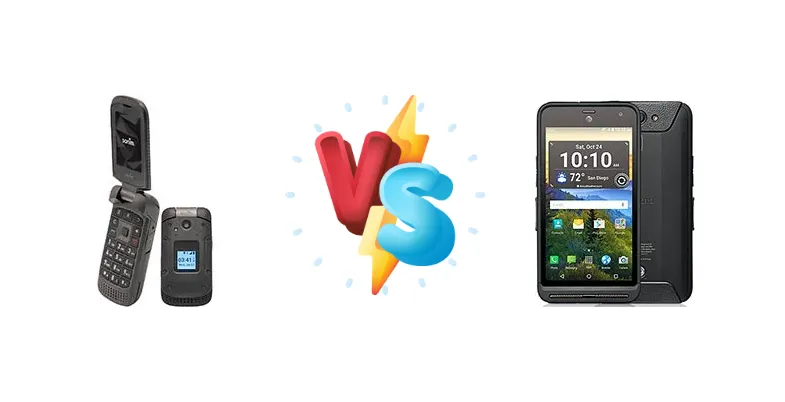
Need a phone that can withstand drops, dust, and water? The Sonim XP3 and Kyocera DuraForce XD are both built for the toughest environments. But which one offers the best combination of durability, performance, and features? Let's dive into a detailed comparison.
🏆 Quick Verdict
The Kyocera DuraForce XD edges out the Sonim XP3 thanks to its faster processor, slightly better performance, and faster charging. Both are incredibly durable, but the XD’s improved speed makes it a more practical daily driver for demanding users.
| Network |
|---|
| 2G bands | GSM 850 / 900 / 1800 / 1900 | GSM 850 / 900 / 1800 / 1900 |
| 3G bands | HSDPA 800 / 850 / 900 / 1700(AWS) / 2100 | HSDPA 850 / 900 / 1900 / 2100 - AT&T, T-Mobile |
| 4G bands | 1, 2, 3, 4, 5, 8, 12, 13, 14, 25, 26, 38, 41, 66 | 1, 2, 3, 4, 5, 7, 17, 20, 29 - AT&T |
| Speed | HSPA, LTE | HSPA, LTE |
| Technology | GSM / CDMA / HSPA / EVDO / LTE | GSM / HSPA / LTE |
| | CDMA2000 1xEV-DO | 1, 2, 3, 4, 5, 7, 12, 20, 29 - T-Mobile |
| Launch |
|---|
| Announced | 2019, March. Released 2019, March | 2015, October. Released 2015, November |
| Status | Discontinued | Discontinued |
| Body |
|---|
| Dimensions | 112 x 58 x 27 mm (4.41 x 2.28 x 1.06 in) | 166.8 x 86.4 x 13.9 mm (6.57 x 3.40 x 0.55 in) |
| SIM | Nano-SIM | Nano-SIM |
| Weight | 195 g (6.88 oz) | 307 g (10.83 oz) |
| | IP68 dust/water resistant (up to 1.5m for 30 min)
MIL-STD-810G | IP68 dust/water resistant (up to 1.5m for 30 mins)
MIL-STD-810G compliant |
| Display |
|---|
| Protection | - | Yes |
| Resolution | 240 x 320 pixels, 4:3 ratio (~154 ppi density) | 720 x 1280 pixels, 16:9 ratio (~258 ppi density) |
| Size | 2.6 inches, 20.9 cm2 (~32.2% screen-to-body ratio) | 5.7 inches, 89.6 cm2 (~62.1% screen-to-body ratio) |
| Type | TFT LCD | IPS LCD |
| | Cover display:
TN LCD, 1.08 inches, 96 x 96 pixels | - |
| Platform |
|---|
| CPU | Quad-core 1.1 GHz Cortex-A7 | Quad-core 1.6 GHz Cortex-A7 |
| Chipset | Qualcomm MSM8909 Snapdragon 210 (28 nm) | Qualcomm MSM8928 Snapdragon 400 (28 nm) |
| GPU | Adreno 304 | Adreno 305 |
| OS | Sonim OS (based on AOSP Android 8.1) | Android 5.1 (Lollipop) |
| Memory |
|---|
| Card slot | microSDXC (dedicated slot) | microSDXC (dedicated slot) |
| Internal | 8GB 1GB RAM | 16GB 2GB RAM |
| | - | eMMC 4.5 |
| Main Camera |
|---|
| Features | LED flash | LED flash, HDR, panorama |
| Single | 5 MP | 8 MP, AF |
| Video | - | 1080p@30fps |
| Sound |
|---|
| 3.5mm jack | Yes | Yes |
| 35mm jack | Yes | Yes |
| Loudspeaker | Yes | Yes |
| Comms |
|---|
| Bluetooth | 4.2, A2DP, LE | 4.1, A2DP, EDR, LE |
| NFC | No | Yes |
| Positioning | GPS, GLONASS, GALILEO | GPS |
| Radio | FM Radio | No |
| USB | USB Type-C | microUSB 2.0 |
| WLAN | Wi-Fi 802.11 a/b/g/n/r, dual-band | Wi-Fi 802.11 a/b/g/n/ac//r/k, dual-band, Wi-Fi Direct, hotspot |
| Features |
|---|
| Sensors | Barometer | Accelerometer, gyro, proximity, compass, barometer |
| Battery |
|---|
| Charging | - | 10W wired |
| Stand-by | - | Up to 816 h (3G) |
| Talk time | - | Up to 23 h (3G) |
| Type | Li-Ion 1500 mAh, removable | Li-Ion 3700 mAh, removable |
| Misc |
|---|
| Colors | Black | Black |
| Price | About 190 EUR | - |
Sonim XP3
- Exceptional durability and ruggedness
- Loudspeaker for noisy environments
- Simple and reliable interface
- Long battery life (4000 mAh)
- Slow processor and performance
- Basic camera quality
- Slower charging
- Outdated design
Kyocera DuraForce XD
- Faster processor and performance (Snapdragon 400)
- Slightly larger display
- Faster charging (10W)
- Good durability and ruggedness
- Smaller battery capacity (3200 mAh)
- Basic camera quality
- Design is somewhat dated
- Can be more expensive
Display Comparison
Both phones feature displays around 3.5-4 inches, typically with a resolution around 480x854. While both are functional, neither offers exceptional visual quality. The Kyocera's slightly larger screen (4.0") might offer a marginal advantage for viewing content, but the Sonim's display is known for its good visibility in direct sunlight.
Camera Comparison
Camera quality on both phones is basic, typical of rugged devices. Both likely feature 8MP rear cameras. Image quality is acceptable for quick snapshots but don't expect high-resolution photos or impressive low-light performance. The XD might have a slight edge due to the more powerful processor assisting image processing.
Performance
This is where the DuraForce XD shines. Its Snapdragon 400 chipset and 1.6 GHz quad-core Cortex-A7 CPU significantly outperform the XP3's Snapdragon 210 and 1.1 GHz quad-core Cortex-A7. Expect smoother app loading, faster multitasking, and a more responsive user experience on the XD.
Battery Life
Both phones offer substantial battery life, designed to last through a full workday. The XP3 typically has a 4000 mAh battery, while the DuraForce XD has a 3200 mAh battery. Despite the smaller capacity, the XD's more efficient processor may result in comparable battery life in real-world usage. The DuraForce XD's 10W wired charging is a notable advantage over the XP3's likely slower charging speed.
Buying Guide
The Sonim XP3 is ideal for users prioritizing extreme durability and a simple, reliable interface. The Kyocera DuraForce XD is better suited for those needing a bit more processing power for apps and multitasking, alongside robust ruggedness.
Frequently Asked Questions
❓ Are these phones waterproof?
Yes, both the Sonim XP3 and Kyocera DuraForce XD are IP68 rated, meaning they are dustproof and waterproof up to a certain depth for a specified time (typically 1.5 meters for 30 minutes).
❓ Can I use these phones with gloves on?
Yes, both phones are designed to be used with gloves. They typically feature larger buttons and capacitive touchscreens that are responsive to gloved hands.