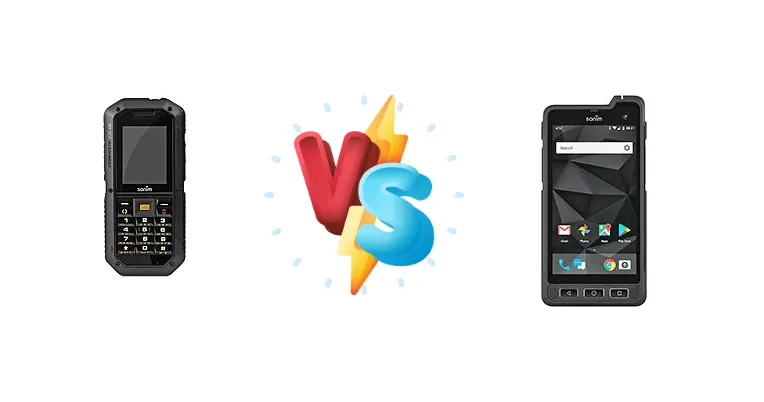
Sonim caters to a specific niche: users demanding extreme durability and reliability. The XP2.10 Spirit and XP8 represent different points within that spectrum. The XP8, with its Snapdragon 630, offers a step up in processing power, while the XP2.10 Spirit likely focuses on core ruggedness and cost-effectiveness, given the lack of detailed specifications. This comparison aims to dissect where each phone excels and who will benefit most from their respective strengths.
🏆 Quick Verdict
For the average user prioritizing a balance of performance and ruggedness, the Sonim XP8 is the better choice. Its Snapdragon 630 chipset provides a noticeable performance boost for demanding tasks, and 18W Quick Charge 4 support offers faster refueling. However, users on a strict budget or needing the absolute simplest, most durable device may find the XP2.10 Spirit sufficient.
| Network |
|---|
| 2G bands | GSM 900 / 1800 / 1900 | GSM 850 / 900 / 1800 / 1900 |
| 3G bands | HSDPA 2100 | HSDPA 850 / 900 / 1700(AWS) / 1900 / 2100 |
| 4G bands | - | 1, 2, 3, 4, 5, 7, 8, 12, 13, 14, 20, 25, 26, 28, 29, 30, 38, 40, 41, 66 |
| Speed | HSPA 7.2/0.384 Mbps | HSPA 42.2/5.76 Mbps, LTE (3CA) Cat12 600/150 Mbps |
| Technology | GSM / HSPA | GSM / CDMA / HSPA / EVDO / LTE |
| | GSM 850 / 1800 / 1900 | CDMA2000 1xEV-DO |
| Launch |
|---|
| Announced | 2010, February. Released 2010, March | 2018, April. Released 2018, May |
| Status | Discontinued | Discontinued |
| Body |
|---|
| Dimensions | 130.7 x 59.7 x 21.7 mm (5.15 x 2.35 x 0.85 in) | 152 x 79.5 x 18 mm (5.98 x 3.13 x 0.71 in) |
| SIM | Mini-SIM | Nano-SIM + Nano-SIM |
| Weight | 180 g (6.35 oz) | 335 g (11.82 oz) |
| | IP67 dust/water resistant (up to 1m for 30 mins)
MIL-STD-810D compliant
Drop-to-concrete resistance from up to 2m
Operational range -20°C to +55°C
Flashlight | IP69 dust proof and water resistant over 1 meter and 30 minutes
MIL-STD-810G |
| Display |
|---|
| Protection | Corning Gorilla Glass | Corning Gorilla Glass 3 |
| Resolution | 240 x 320 pixels, 4:3 ratio (~200 ppi density) | 1080 x 1920 pixels, 16:9 ratio (~441 ppi density) |
| Size | 2.0 inches, 12.4 cm2 (~15.9% screen-to-body ratio) | 5.0 inches, 68.9 cm2 (~57.0% screen-to-body ratio) |
| Type | TFT, 256K colors | IPS LCD |
| Platform |
|---|
| CPU | - | Octa-core 2.2 GHz Cortex-A53 |
| Chipset | - | Qualcomm SDM630 Snapdragon 630 (14 nm) |
| GPU | - | Adreno 508 |
| OS | - | Android 7.0 (Nougat) |
| Memory |
|---|
| Call records | Yes | - |
| Card slot | microSDHC (dedicated slot) | microSDXC |
| Internal | 40MB | 64GB 4GB RAM |
| Phonebook | Yes, up to 1000 entries | - |
| Main Camera |
|---|
| Features | LED flash | LED flash, HDR, panorama |
| Single | 3.15 MP | 12 MP, PDAF |
| Video | Yes | 1080p@30fps |
| Selfie camera |
|---|
| Single | - | 8 MP |
| Video | - | 1080p@30fps |
| | No | - |
| Sound |
|---|
| 3.5mm jack | No | No |
| 35mm jack | No | No |
| Loudspeaker | Yes | Yes |
| | Water resistant speaker (GORE-TEX cover)
2.5 mm audio jack | - |
| Comms |
|---|
| Bluetooth | 1.2, A2DP | 5.0, A2DP, EDR, LE |
| NFC | - | Yes |
| Positioning | No | GPS, GLONASS |
| Radio | Stereo FM radio | FM radio |
| USB | microUSB 2.0 | USB Type-C 2.0, magnetic connector |
| WLAN | No | Wi-Fi 802.11 a/b/g/n/ac, dual-band, Wi-Fi Direct |
| Features |
|---|
| Browser | WAP 2.0/xHTML, HTML (Opera Mini) | - |
| Games | Yes | - |
| Java | Yes, MIDP 2.0 | - |
| Messaging | SMS, MMS, Email | - |
| Sensors | - | Accelerometer, gyro, proximity, compass, barometer |
| | Organizer
MP3/WAV/eAAC+ player
MP4/H.264 player
Nimbuzz IM
Voice memo
Stopwatch
Predictive text input | - |
| Battery |
|---|
| Charging | - | 18W wired, QC4 |
| Music play | - | Up to 70 h |
| Stand-by | Up to 428 h | Up to 720 h |
| Talk time | Up to 8 h | Up to 30 h |
| Type | Removable Li-Ion 1300 mAh battery | Li-Ion 4900 mAh, removable |
| Misc |
|---|
| Colors | Black | Black |
| Models | - | XP8800 |
| Price | - | About 700 EUR |
Sonim XP2.10 Spirit
- Likely more affordable price point
- Potentially simpler user interface
- Extreme durability focused design
- Significantly lower processing power
- Slower charging speeds
- Limited multitasking capabilities
Sonim XP8
- Faster Snapdragon 630 processor
- 18W Quick Charge 4 support
- Improved image processing capabilities
- Higher price point
- Potentially more complex software
- May be slightly heavier due to more features
Display Comparison
Without specific display details for the XP2.10 Spirit, a direct comparison is limited. The XP8’s display, while not specified in resolution, benefits from the Snapdragon 630’s image signal processor for potentially better color reproduction. Given Sonim’s focus, both likely utilize hardened glass and prioritize visibility in direct sunlight over high refresh rates or OLED technology. The XP8’s chipset allows for more sophisticated display calibration, potentially leading to a more accurate color profile.
Camera Comparison
Due to the lack of camera specifications for the XP2.10 Spirit, a detailed comparison is impossible. The XP8, while not a camera-focused device, benefits from the Snapdragon 630’s image signal processor. This allows for improved image processing, potentially resulting in better dynamic range and noise reduction. It’s reasonable to assume both phones prioritize durability over camera quality, so users shouldn’t expect flagship-level photography. The XP8’s ISP will likely offer more features and better image quality in various lighting conditions.
Performance
The Sonim XP8’s Qualcomm Snapdragon 630 (14nm) is the clear performance leader. Its octa-core 2.2 GHz Cortex-A53 CPU provides a significant advantage over the XP2.10 Spirit, which likely utilizes a less powerful, and potentially older, chipset. The 14nm process node of the SD630 also contributes to better thermal efficiency, reducing the likelihood of throttling during sustained workloads. This translates to smoother multitasking, faster app loading times, and a more responsive user experience for XP8 users. The XP2.10 Spirit will likely be adequate for voice calls and basic apps, but will struggle with more demanding tasks.
Battery Life
Battery capacity for both devices is unknown. However, the XP8’s 18W wired charging with Quick Charge 4 (QC4) support provides a significant advantage. QC4 allows for faster and more efficient charging compared to standard charging protocols. While the XP2.10 Spirit may have a comparable battery size, its slower charging speed will result in longer downtime. The Snapdragon 630’s power efficiency also contributes to potentially longer battery life on the XP8, even with similar capacity.
Buying Guide
Buy the Sonim XP2.10 Spirit if you need a no-frills, incredibly durable phone primarily for voice communication and basic tasks in harsh environments, and cost is a major concern. Buy the Sonim XP8 if you prefer a rugged phone capable of handling more demanding applications like field data collection, remote diagnostics, or occasional multimedia consumption, and value faster charging and a smoother user experience.
Frequently Asked Questions
❓ Is the Snapdragon 630 in the XP8 powerful enough for running specialized field service apps?
Yes, the Snapdragon 630 is capable of running most field service applications. While not a flagship processor, its octa-core architecture and 2.2 GHz clock speed provide sufficient power for tasks like data entry, GPS navigation, and basic reporting. However, extremely demanding apps with complex graphics may experience some slowdown.
❓ How does the XP2.10 Spirit hold up in extremely cold temperatures compared to the XP8?
Both Sonim phones are designed to operate in a wide temperature range. However, the XP2.10 Spirit, potentially lacking the power management features of the Snapdragon 630, might experience slightly reduced battery performance in extreme cold. The XP8’s chipset is designed to optimize power delivery even in low temperatures, potentially extending battery life.
❓ Does the XP8 support VoLTE and Wi-Fi calling on all carriers?
Support for VoLTE and Wi-Fi calling varies by carrier. While the Snapdragon 630 modem supports these technologies, compatibility depends on the specific carrier’s network and certification. It’s crucial to check with your carrier to ensure compatibility before purchasing the XP8.