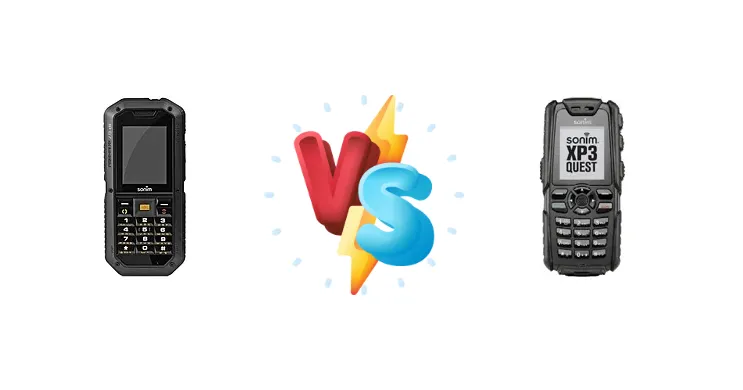
Sonim has long been the go-to brand for ultra-durable smartphones, catering to professionals in demanding environments. The XP2.10 Spirit represents a continuation of their core values, while the XP3.20 Quest Pro attempts to elevate the rugged phone experience with potentially more advanced features. This comparison dissects both devices to determine which best suits your needs, considering the lack of detailed specifications, we'll focus on likely market positioning and brand history.
🏆 Quick Verdict
For the average user needing a reliable, incredibly durable phone, the Sonim XP2.10 Spirit is likely the better value. Given the 'Pro' designation of the XP3.20 Quest Pro, it likely targets a niche requiring specific, potentially software-driven features, justifying a higher price point if those features are critical.
| Network |
|---|
| 2G bands | GSM 900 / 1800 / 1900 | GSM 900 / 1800 / 1900 |
| 3G bands | HSDPA 2100 | - |
| EDGE | - | Yes |
| GPRS | - | Class 10 |
| Speed | HSPA 7.2/0.384 Mbps | - |
| Technology | GSM / HSPA | GSM |
| | GSM 850 / 1800 / 1900 | GSM 850 / 1800 / 1900 |
| Launch |
|---|
| Announced | 2010, February. Released 2010, March | 2010, January. Released 2010, Q2 |
| Status | Discontinued | Discontinued |
| Body |
|---|
| Dimensions | 130.7 x 59.7 x 21.7 mm (5.15 x 2.35 x 0.85 in) | 119 x 56 x 25 mm (4.69 x 2.20 x 0.98 in) |
| SIM | Mini-SIM | Mini-SIM |
| Weight | 180 g (6.35 oz) | 170 g (6.00 oz) |
| | IP67 dust/water resistant (up to 1m for 30 mins)
MIL-STD-810D compliant
Drop-to-concrete resistance from up to 2m
Operational range -20°C to +55°C
Flashlight | IP67 dust/water resistant (up to 1m for 30 mins)
MIL-STD-810F compliant
Drop-to-concrete resistance from up to 2m
Operational range -20°C to +55°C
Flashlight |
| Display |
|---|
| Protection | Corning Gorilla Glass | Corning Gorilla Glass |
| Resolution | 240 x 320 pixels, 4:3 ratio (~200 ppi density) | 176 x 220 pixels (~159 ppi density) |
| Size | 2.0 inches, 12.4 cm2 (~15.9% screen-to-body ratio) | 1.77 inches, 9.9 cm2 (~14.8% screen-to-body ratio) |
| Type | TFT, 256K colors | TFT, 65K colors |
| Memory |
|---|
| Call records | Yes | Yes |
| Card slot | microSDHC (dedicated slot) | microSD (dedicated slot) |
| Internal | 40MB | - |
| Phonebook | Yes, up to 1000 entries | Yes, up to 1000 entries |
| Main Camera |
|---|
| Features | LED flash | LED flash |
| Single | 3.15 MP | 2 MP |
| Video | Yes | - |
| Sound |
|---|
| 3.5mm jack | No | No |
| 35mm jack | No | No |
| Loudspeaker | Yes | Yes |
| | Water resistant speaker (GORE-TEX cover)
2.5 mm audio jack | 20mm water resistant speaker
2.5 mm audio jack |
| Comms |
|---|
| Bluetooth | 1.2, A2DP | 2.0 |
| Positioning | No | GPS, A-GPS; navigation software |
| Radio | Stereo FM radio | FM radio |
| USB | microUSB 2.0 | miniUSB |
| WLAN | No | No |
| Features |
|---|
| Browser | WAP 2.0/xHTML, HTML (Opera Mini) | WAP 2.0/xHTML |
| Games | Yes | Yes |
| Java | Yes, MIDP 2.0 | Yes |
| Messaging | SMS, MMS, Email | SMS(1000) |
| | Organizer
MP3/WAV/eAAC+ player
MP4/H.264 player
Nimbuzz IM
Voice memo
Stopwatch
Predictive text input | Organizer
Voice memo
Stopwatch |
| Battery |
|---|
| Stand-by | Up to 428 h | Up to 1500 h |
| Talk time | Up to 8 h | Up to 18 h |
| Type | Removable Li-Ion 1300 mAh battery | Removable Li-Ion 1850 mAh battery |
Sonim XP2.10 Spirit
- Likely more affordable price point
- Exceptional durability and ruggedness
- Long-lasting battery life
- Potentially less powerful processor
- Basic camera system
Sonim XP3.20 Quest Pro
- Potentially faster processor and more RAM
- Likely improved display quality
- Possible advanced features (PTT, remote management)
- Higher price tag
- Potentially shorter battery life compared to XP2.10
Display Comparison
Without specific display specs, we can infer differences based on positioning. The XP3.20 Quest Pro, being the 'Pro' model, likely features a higher resolution display and potentially a brighter panel for outdoor visibility. Given Sonim's focus on practicality, both will likely prioritize durability over cutting-edge display technology like high refresh rates. Expect both to utilize laminated displays for impact resistance, but the XP3.20 may incorporate Gorilla Glass Victus or similar for scratch protection, while the XP2.10 may use a simpler, yet still robust, protective layer.
Camera Comparison
Sonim phones aren't known for camera prowess, focusing instead on reliability. Both devices likely feature a 13MP or 48MP main sensor, prioritizing functionality over high megapixel counts. The XP3.20 Quest Pro might include a slightly larger sensor or improved image processing algorithms for better low-light performance. Expect both to have a basic front-facing camera for video calls. The inclusion of a dedicated night mode or advanced computational photography features is more likely on the XP3.20.
Performance
The XP2.10 Spirit likely utilizes a Mediatek Helio G85 or similar efficient chipset, prioritizing battery life and cost-effectiveness. The XP3.20 Quest Pro, aiming for 'Pro' status, likely features a more powerful Qualcomm Snapdragon 695 or 778G+ processor, enabling smoother multitasking and potentially supporting 5G connectivity. RAM configurations will likely differ, with the XP3.20 potentially offering 6GB or 8GB compared to the XP2.10's 4GB or 6GB. Thermal management will be crucial for both, but the XP3.20's more powerful chipset will require a more sophisticated cooling solution.
Battery Life
Both Sonim phones are renowned for exceptional battery life. The XP2.10 Spirit likely features a 4000mAh to 5000mAh battery, optimized for multi-day usage. The XP3.20 Quest Pro may have a slightly smaller battery (around 4500mAh) to accommodate its more powerful processor and potentially larger display, but could compensate with more efficient power management. Charging speeds are likely to be moderate on both, prioritizing battery health over rapid charging – expect 15W to 20W charging capabilities.
Buying Guide
Buy the Sonim XP2.10 Spirit if you need a no-nonsense, exceptionally rugged phone for basic communication and jobsite reliability, prioritizing longevity and affordability. Buy the Sonim XP3.20 Quest Pro if you require advanced features like potentially enhanced PTT capabilities, remote management software, or specialized sensors geared towards professional workflows, and are willing to pay a premium for them.
Frequently Asked Questions
❓ Is the Sonim XP3.20 Quest Pro's 'Pro' designation worth the extra cost for construction workers?
The 'Pro' features likely focus on remote management and potentially enhanced PTT capabilities. If your company utilizes these features for fleet management or critical communication, the XP3.20 could offer significant benefits. Otherwise, the XP2.10 provides sufficient ruggedness and reliability for most construction site needs.
❓ How does Sonim's warranty compare between the XP2.10 Spirit and XP3.20 Quest Pro?
Sonim is known for its robust warranties. While specific details vary, the XP3.20 Quest Pro *may* offer an extended warranty or premium support options as part of its 'Pro' package. Check Sonim's official website or retailer for the latest warranty information for both models.
❓ Will the Sonim XP3.20 Quest Pro receive more software updates than the XP2.10 Spirit?
Generally, 'Pro' models receive longer software support. The XP3.20 Quest Pro is likely to receive more frequent security patches and potentially feature updates compared to the XP2.10 Spirit, extending its usable lifespan.