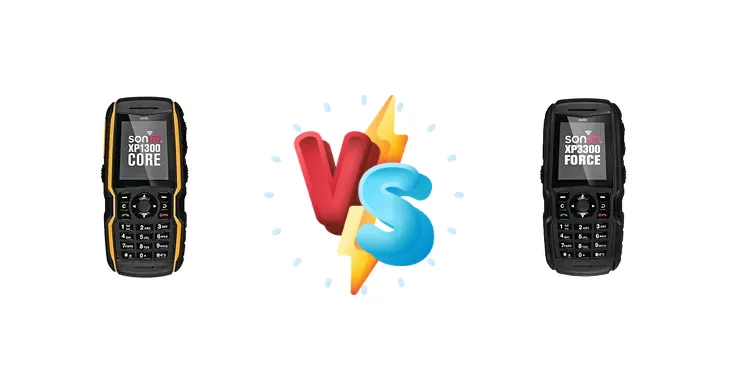
Sonim specializes in ultra-durable smartphones designed for demanding work environments. The XP1300 Core and XP3300 Force represent different tiers within their rugged lineup, catering to varying needs and budgets. This comparison dissects their features, focusing on how each model delivers on Sonim’s core promise of reliability in harsh conditions, despite the limited publicly available specifications.
🏆 Quick Verdict
For the average user needing a dependable, work-focused phone, the Sonim XP3300 Force likely offers a more robust feature set and potentially better long-term durability, given Sonim’s tendency to iterate upwards in their 'Force' line. However, the XP1300 Core may represent a more cost-effective entry point for basic rugged communication.
| Network |
|---|
| 2G bands | GSM 850 / 900 / 1800 / 1900 | GSM 850 / 900 / 1800 / 1900 |
| EDGE | Class 10 | Class 12 |
| GPRS | Class 10 | Class 12 |
| Technology | GSM | GSM |
| Launch |
|---|
| Announced | 2010, October. Released 2010, November | 2011, February. Released 2011, March |
| Status | Discontinued | Discontinued |
| Body |
|---|
| Dimensions | 126 x 60 x 25 mm (4.96 x 2.36 x 0.98 in) | 126 x 60 x 25 mm (4.96 x 2.36 x 0.98 in) |
| SIM | Mini-SIM | Mini-SIM |
| Weight | 185 g (6.53 oz) | 185 g (6.53 oz) |
| | MIL-STD-810F compliant
IP68 dust/water resistant (up to 1.5m for 30 mins)
Drop-to-concrete resistance from up to 2m
Operational range -20°C to +55°C
Flashlight | MIL-STD-810G compliant
IP68 dust/water resistant (up to 2m for 1 hour)
Drop-to-concrete resistance from up to 2m
Operational range -20°C to +55°C
Flashlight |
| Display |
|---|
| Protection | Corning Gorilla Glass | Corning Gorilla Glass |
| Resolution | 240 x 320 pixels, 4:3 ratio (~200 ppi density) | 240 x 320 pixels, 4:3 ratio (~200 ppi density) |
| Size | 2.0 inches, 12.4 cm2 (~16.4% screen-to-body ratio) | 2.0 inches, 12.4 cm2 (~16.4% screen-to-body ratio) |
| Type | TFT, 65K colors | TFT, 65K colors |
| Platform |
|---|
| OS | MediaTek MT6235 platform | MediaTek MT6235 platform |
| Memory |
|---|
| Card slot | microSDHC (dedicated slot) | microSDHC (dedicated slot) |
| Main Camera |
|---|
| Features | - | LED flash |
| Single | - | 2 MP |
| Video | - | No |
| Sound |
|---|
| 3.5mm jack | Yes | Yes |
| 35mm jack | Yes | Yes |
| Loudspeaker | Yes | Yes |
| Comms |
|---|
| Bluetooth | 2.1, A2DP | 2.1, A2DP |
| Positioning | No | GPS, A-GPS |
| Radio | FM radio | FM radio |
| USB | 2.0 | 2.0 |
| WLAN | No | No |
| Features |
|---|
| Browser | WAP 2.0/xHTML (Opera Mini) | WAP 2.0/xHTML |
| | Organizer
MP3/WAV/AAC player
MP4/H.263 player
Voice memo
Stopwatch
Count-down timer
File manager | Organizer
MP3/WAV/AAC player
MP4/H.263 player
Voice memo
Stopwatch
Count-down timer
File manager |
| Battery |
|---|
| Stand-by | Up to 800 h | Up to 800 h |
| Talk time | Up to 18 h | Up to 18 h |
| Type | Removable Li-Ion 1750 mAh battery | Removable Li-Ion 1750 mAh battery |
| Misc |
|---|
| Colors | Black, Black/Yellow | Black, Black/Yellow |
| Price | About 290 EUR | About 370 EUR |
Sonim XP1300 Core
- Likely more affordable price point
- Durable construction meeting Sonim standards
- Long battery life for essential communication
- Potentially older processor and less RAM
- Likely lower camera resolution
- Fewer advanced features compared to the Force
Sonim XP3300 Force
- Potentially more powerful processor and RAM
- Enhanced durability and build quality
- Likely better camera performance and features
- Higher price point
- May be slightly larger and heavier
- Advanced features may not be needed by all users
Display Comparison
Given both phones target industrial users, we anticipate both displays prioritize visibility in direct sunlight. Without specific nit ratings, we can infer the XP3300 Force, being the higher-tier model, likely benefits from a brighter panel and potentially a more scratch-resistant glass covering. Sonim typically uses reinforced glass, but the Force model may employ a newer generation. Bezels are likely substantial on both to contribute to shock absorption, and color accuracy is likely secondary to readability in harsh conditions.
Camera Comparison
Sonim’s cameras are generally functional rather than flagship-level. The XP3300 Force likely features a higher-resolution main sensor than the XP1300 Core, enabling clearer photos for documentation purposes. Optical Image Stabilization (OIS) is a feature more likely to be found on the Force model, reducing blur in challenging lighting conditions. While both phones may include a secondary camera, the image quality will likely be limited, and the primary focus remains on capturing usable images for work-related tasks, not photography.
Performance
Without chipset details, we can speculate that the XP3300 Force utilizes a more recent and powerful processor than the XP1300 Core. Sonim often uses Qualcomm Snapdragon chipsets in their devices. A newer Snapdragon generation in the Force model would translate to faster application loading times, smoother multitasking, and improved performance with demanding industrial software. RAM capacity is also likely higher in the Force model, further enhancing multitasking capabilities. Thermal management is crucial in rugged phones; the Force model may incorporate a more sophisticated heat dissipation system.
Battery Life
Both phones prioritize long battery life, essential for users in the field. The XP3300 Force may have a slightly larger battery capacity, but more importantly, it could support faster charging speeds. Sonim’s software likely includes power-saving modes to extend battery life further. Real-world battery performance will depend heavily on network conditions and usage patterns, but the Force model’s potential for faster charging provides a significant advantage for users who need to quickly replenish power during breaks.
Buying Guide
Buy the Sonim XP1300 Core if you need a basic, highly durable phone primarily for voice communication and essential tasks in challenging environments, prioritizing affordability. Buy the Sonim XP3300 Force if you require advanced features like enhanced connectivity options (potentially including satellite communication, based on Sonim’s broader portfolio), more robust physical construction, and a platform for running specialized industrial applications, justifying a higher investment.
Frequently Asked Questions
❓ What level of water and dust resistance can I expect from the Sonim XP1300 Core and XP3300 Force?
Both phones are built to withstand extremely harsh conditions. Sonim devices typically meet or exceed IP68 and MIL-STD-810H standards, meaning they are fully dust-tight and can survive submersion in water for extended periods. The XP3300 Force may offer slightly improved resistance due to potentially enhanced sealing and construction.
❓ Are these phones compatible with FirstNet, and what other network features do they support?
Sonim phones are frequently used with FirstNet, the dedicated communications network for first responders. Both the XP1300 Core and XP3300 Force likely support FirstNet, as well as standard LTE and potentially 5G networks. They also typically include features like push-to-talk (PTT) over LTE, dedicated side buttons for PTT, and programmable keys for quick access to frequently used functions.
❓ Can I run specialized industrial applications on these Sonim phones?
The XP3300 Force, with its potentially more powerful processor and greater RAM capacity, is better suited for running demanding industrial applications. While the XP1300 Core can handle basic tasks, it may struggle with resource-intensive software. Consider the specific requirements of your applications when choosing between the two models.
❓ What kind of warranty and support does Sonim offer for these devices?
Sonim typically offers a standard warranty, but also provides extended warranty options and dedicated support services for enterprise customers. Their support is geared towards addressing the unique needs of users in demanding work environments, including repair services and software updates.