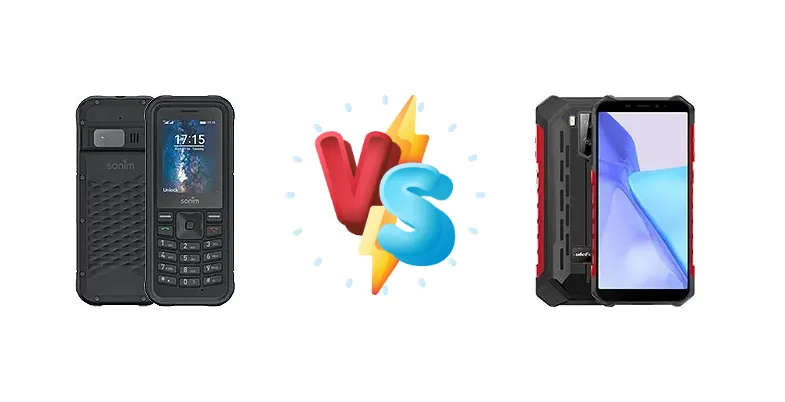
The Sonim XP100 and Ulefone Armor X9 Pro both target the rugged smartphone market, but cater to slightly different priorities. The Sonim, historically focused on extreme durability for professional use, enters with a basic Unisoc chipset. The Ulefone, a more consumer-focused brand, aims for a balance of toughness and affordability with a Mediatek Helio A25. This comparison dissects their core differences to determine which phone delivers the best value for demanding users.
🏆 Quick Verdict
For the average user needing a durable phone, the Ulefone Armor X9 Pro is the better choice. Its Mediatek Helio A25 chipset, built on a 12nm process, provides a significantly more responsive experience than the Sonim XP100’s Unisoc T127, making it better suited for everyday tasks and light multitasking. While the Sonim prioritizes extreme ruggedness, the performance gap is too large to ignore.
| Network |
|---|
| 2G bands | GSM 850 / 900 / 1800 / 1900 | GSM 850 / 900 / 1800 / 1900 |
| 3G bands | HSDPA 850 / 900 / 1900 / 2100 | HSDPA 850 / 900 / 1700(AWS) / 1900 / 2100 |
| 4G bands | 1, 3, 7, 8, 20, 28, 38, 40, 41 | 1, 2, 3, 4, 5, 7, 8, 12, 17, 19, 20, 28 |
| Speed | HSPA, LTE | HSPA 21/5.76 Mbps, LTE Cat6 300/150 Mbps |
| Technology | GSM / HSPA / LTE | GSM / HSPA / LTE |
| Launch |
|---|
| Announced | 2024, October 24 | 2021, September 07 |
| Status | Available. Released 2024, October 24 | Available. Released 2021, September 07 |
| Body |
|---|
| Dimensions | 145 x 62 x 16.2 mm (5.71 x 2.44 x 0.64 in) | 158 x 77.5 x 13.9 mm (6.22 x 3.05 x 0.55 in) |
| SIM | Nano-SIM + Nano-SIM | Nano-SIM + Nano-SIM |
| Weight | 165 g (5.82 oz) | 235 g (8.29 oz) |
| | - | IP68/IP69K dust/water resistant (up to 1.5m for 30 min)
Drop-to-concrete resistance from up to 1.2m
MIL-STD-810G compliant |
| Display |
|---|
| Protection | Corning Gorilla Glass | - |
| Resolution | 240 x 320 pixels, 4:3 ratio (~167 ppi density) | 720 x 1440 pixels, 18:9 ratio (~293 ppi density) |
| Size | 2.4 inches, 17.8 cm2 (~19.8% screen-to-body ratio) | 5.5 inches, 78.1 cm2 (~63.8% screen-to-body ratio) |
| Type | TFT LCD | IPS LCD |
| Platform |
|---|
| CPU | 1.0 GHz | Octa-core (4x1.8 GHz Cortex-A53 & 4x1.5 GHz Cortex-A53) |
| Chipset | Unisoc T127 | Mediatek MT6762D Helio A25 (12 nm) |
| GPU | - | PowerVR GE8320 |
| OS | - | Android 11 |
| Memory |
|---|
| Call records | Yes | - |
| Card slot | microSDXC | microSDXC (uses shared SIM slot) |
| Internal | 128MB 64MB RAM | 64GB 4GB RAM |
| Phonebook | Yes | - |
| | - | eMMC 5.1 |
| Main Camera |
|---|
| Dual | - | 13 MP, f/2.2, (wide), AF
Auxiliary lens |
| Features | - | Dual-LED flash, HDR, panorama |
| Single | 2 MP | 5 MP |
| Video | Yes | 1080p@30fps |
| Selfie camera |
|---|
| Features | - | HDR |
| Single | - | 5 MP |
| Video | - | 1080p@30fps |
| Sound |
|---|
| 3.5mm jack | - | Yes |
| 35mm jack | Yes | Yes |
| Loudspeaker | Yes | Yes |
| Comms |
|---|
| Bluetooth | 5.0, A2DP, LE | 5.0, A2DP, LE |
| NFC | No | Yes |
| Positioning | No | GPS, GLONASS, GALILEO, BDS |
| Radio | FM radio | FM radio, RDS, recording |
| USB | USB Type-C 2.0 | microUSB 2.0, OTG |
| WLAN | No | Wi-Fi 802.11 a/b/g/n/ac, Wi-Fi Direct |
| Features |
|---|
| Games | Downloadable | - |
| Java | No | - |
| Messaging | SMS(threaded view), MMS, Email, Push Email, IM | - |
| Sensors | No | Accelerometer, proximity, compass |
| Battery |
|---|
| Charging | - | 10W wired |
| Type | Li-Ion 1800 mAh, removable | Li-Po 5000 mAh |
| Misc |
|---|
| Colors | Black | Red, Black, Green |
| Price | - | About 160 EUR |
Sonim XP100
- Potentially higher level of ruggedization (Sonim's core competency)
- Simple, streamlined software experience (likely)
- Focus on essential communication features
- Extremely limited processing power with Unisoc T127
- Likely slow app loading times and lag
- Poor multitasking capabilities
Ulefone Armor X9 Pro
- Significantly faster performance with Mediatek Helio A25
- Octa-core CPU enables smoother multitasking
- 10W wired charging for faster replenishment
- Ruggedization may not be as extreme as the Sonim XP100
- 2MP macro camera is likely of limited use
- Software experience may be less refined than Sonim
Display Comparison
Neither device boasts a standout display. Given the context data, we can assume both utilize LCD panels, common in this price bracket. The lack of specified resolution or refresh rate suggests both are basic. However, the Ulefone benefits from the more modern Helio A25 chipset potentially supporting a slightly higher resolution display. Bezels are likely substantial on both, prioritizing screen protection over aesthetics. Color accuracy is unlikely to be a strong point on either device.
Camera Comparison
Camera performance is likely similar in real-world results, given the focus on ruggedness over photography. Without sensor size or aperture data, it’s difficult to make definitive claims. However, the Ulefone’s more powerful chipset allows for potentially better image processing. The inclusion of a 2MP macro camera on the Ulefone is largely a marketing gimmick; its limited resolution offers minimal practical benefit. Both phones likely rely heavily on software processing to enhance image quality, and results will be heavily dependent on lighting conditions.
Performance
The performance disparity is the most significant difference. The Ulefone Armor X9 Pro’s Mediatek Helio A25, fabricated on a 12nm process, features an octa-core CPU (4x1.8 GHz Cortex-A53 & 4x1.5 GHz Cortex-A53). This contrasts sharply with the Sonim XP100’s Unisoc T127, a single-core 1.0 GHz processor. The Helio A25’s multi-core architecture and higher clock speeds translate to a demonstrably faster and more responsive user experience, particularly when multitasking or running demanding applications. The Unisoc T127 will struggle with anything beyond basic phone functions. While neither phone is a gaming powerhouse, the Ulefone will handle casual games far better.
Battery Life
Battery life will depend heavily on usage patterns. While the mAh capacity isn’t specified for either device, the Ulefone Armor X9 Pro’s 10W wired charging is a notable advantage. The Sonim XP100’s charging speed is unknown, but likely slower. The more efficient Helio A25 chipset in the Ulefone will also contribute to longer battery life under moderate use. The Ulefone’s faster charging will reduce downtime, a crucial factor for users relying on their phone throughout the day.
Buying Guide
Buy the Sonim XP100 if you absolutely require a phone certified to withstand the harshest conditions and prioritize longevity over speed – think construction sites or emergency services. Buy the Ulefone Armor X9 Pro if you need a rugged phone for outdoor adventures, occasional drops, and general durability, while still wanting a reasonably smooth user experience and the ability to run modern apps without significant lag.
Frequently Asked Questions
❓ Will the Helio A25 in the Ulefone Armor X9 Pro overheat during prolonged use, like GPS navigation or video recording?
The Mediatek Helio A25 is a relatively efficient chipset. While it may warm up during extended use, it's unlikely to experience significant overheating or throttling due to its 12nm fabrication process and moderate power consumption. The Ulefone’s rugged design also likely incorporates heat dissipation features.
❓ Is the Sonim XP100 a good choice for running specialized work apps, like those used in logistics or field service?
The Sonim XP100’s Unisoc T127 processor is likely insufficient for running demanding work applications smoothly. The limited processing power and RAM will result in slow loading times and potential crashes. Users requiring specialized apps should strongly consider the Ulefone Armor X9 Pro or a more powerful rugged smartphone.
❓ How does the build quality of the Sonim XP100 compare to the Ulefone Armor X9 Pro in terms of drop resistance?
Sonim is renowned for its exceptionally rugged devices, often exceeding industry standards for drop and shock resistance. While the Ulefone Armor X9 Pro is also a rugged phone, it likely doesn't match the Sonim's level of extreme durability. If surviving truly harsh conditions is paramount, the Sonim is the safer bet.