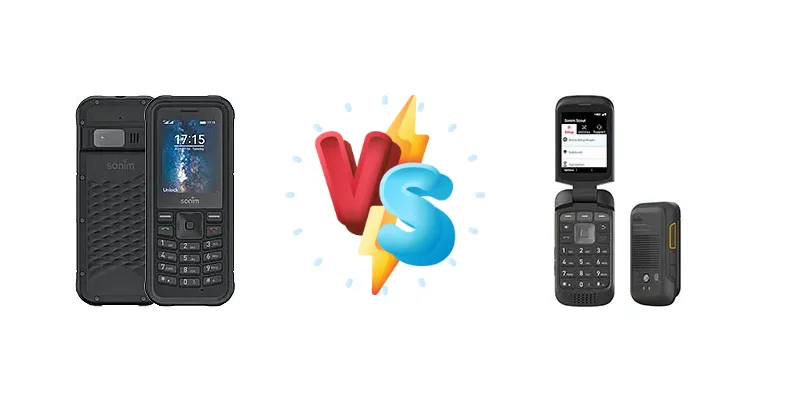
Sonim caters to a niche market: users demanding extreme durability. The XP100 and XP3plus both offer that, but diverge significantly in internal hardware. The XP100 represents a budget-focused entry point, while the XP3plus aims for a more balanced experience with a significantly more powerful chipset. This comparison dissects those differences to determine which Sonim best suits your needs.
🏆 Quick Verdict
For the average user needing a reliable, rugged phone for demanding work environments, the Sonim XP3plus is the clear winner. Its Qualcomm Snapdragon 662 chipset delivers substantially better performance than the XP100’s Unisoc T127, enabling smoother multitasking and faster app loading times. While the XP100 offers a lower price, the XP3plus’s performance uplift justifies the cost for most users.
| Network |
|---|
| 2G bands | GSM 850 / 900 / 1800 / 1900 | GSM 850 / 900 / 1800 / 1900 |
| 3G bands | HSDPA 850 / 900 / 1900 / 2100 | HSDPA 850 / 1700(AWS) / 1900 / 2100 |
| 4G bands | 1, 3, 7, 8, 20, 28, 38, 40, 41 | 1, 2, 3, 4, 5, 7, 12, 13, 14, 25, 26, 30, 39, 40, 41, 66, 71 |
| Speed | HSPA, LTE | HSPA, LTE |
| Technology | GSM / HSPA / LTE | GSM / HSPA / LTE |
| Launch |
|---|
| Announced | 2024, October 24 | 2021, September |
| Status | Available. Released 2024, October 24 | Available. Released 2021, September |
| Body |
|---|
| Dimensions | 145 x 62 x 16.2 mm (5.71 x 2.44 x 0.64 in) | 116 x 60 x 28 mm (4.57 x 2.36 x 1.10 in) |
| SIM | Nano-SIM + Nano-SIM | Nano-SIM |
| Weight | 165 g (5.82 oz) | 220 g (7.76 oz) |
| | - | IP68 dust/water resistant (up to 1.5m for 30 min)
MIL-STD-810H |
| Display |
|---|
| Protection | Corning Gorilla Glass | - |
| Resolution | 240 x 320 pixels, 4:3 ratio (~167 ppi density) | 240 x 320 pixels, 4:3 ratio (~143 ppi density) |
| Size | 2.4 inches, 17.8 cm2 (~19.8% screen-to-body ratio) | 2.8 inches, 24.3 cm2 (~34.9% screen-to-body ratio) |
| Type | TFT LCD | TFT LCD |
| | - | Cover display:
IPS LCD, 1.3 inches, 240 x 240 pixels |
| Platform |
|---|
| CPU | 1.0 GHz | Octa-core (4x2.0 GHz Kryo 260 Gold & 4x1.8 GHz Kryo 260 Silver) |
| Chipset | Unisoc T127 | Qualcomm SM6115 Snapdragon 662 (11 nm) |
| GPU | - | Adreno 610 |
| OS | - | Sonim OS (based on AOSP Android 11) |
| Memory |
|---|
| Call records | Yes | - |
| Card slot | microSDXC | microSDXC (dedicated slot) |
| Internal | 128MB 64MB RAM | 16GB 2GB RAM |
| Phonebook | Yes | - |
| Main Camera |
|---|
| Features | - | LED flash |
| Single | 2 MP | 8 MP |
| Video | Yes | - |
| Sound |
|---|
| 3.5mm jack | - | Yes |
| 35mm jack | Yes | Yes |
| Loudspeaker | Yes | Yes |
| Comms |
|---|
| Bluetooth | 5.0, A2DP, LE | 5.0, A2DP, LE |
| NFC | No | No |
| Positioning | No | GPS, GLONASS, GALILEO |
| Radio | FM radio | FM Radio |
| USB | USB Type-C 2.0 | USB Type-C |
| WLAN | No | Wi-Fi 802.11 a/b/g/n/ac, dual-band |
| Features |
|---|
| Games | Downloadable | - |
| Java | No | - |
| Messaging | SMS(threaded view), MMS, Email, Push Email, IM | - |
| Sensors | No | Accelerometer, barometer |
| Battery |
|---|
| Type | Li-Ion 1800 mAh, removable | Li-Ion 2300 mAh, removable |
| Misc |
|---|
| Colors | Black | Black |
| Price | - | About 240 EUR |
Sonim XP100
- Lowest price point in the Sonim lineup
- Extremely durable build quality
- Simple and easy-to-use interface
- Significantly slower performance
- Limited multitasking capabilities
- Inferior camera performance
Sonim XP3plus
- Much faster and more responsive performance
- Improved camera quality
- Better multitasking and app support
- Higher price than the XP100
- Still a relatively basic smartphone experience compared to mainstream devices
- May not offer a substantial camera upgrade for casual users
Display Comparison
Neither Sonim provides detailed display specifications beyond basic resolution. However, the XP3plus benefits from the more advanced Qualcomm chipset’s image signal processor, potentially leading to slightly better color reproduction and image processing. Given both phones target durability, expect similar levels of scratch resistance and outdoor visibility. The XP3plus’s more powerful GPU could also contribute to smoother scrolling and animations, enhancing the overall user experience.
Camera Comparison
Detailed camera specs are limited, but the XP3plus’s Snapdragon 662 includes a more capable image signal processor (ISP). This allows for faster image processing, better noise reduction, and improved dynamic range compared to the XP100. While both likely feature similar primary sensor resolutions, the XP3plus will deliver superior image quality, especially in challenging lighting conditions. The ISP also enables features like improved autofocus and potentially better video stabilization.
Performance
The performance disparity is the most significant difference. The Sonim XP100’s Unisoc T127, with its single 1.0 GHz core, is geared towards basic tasks. In contrast, the XP3plus boasts a Qualcomm Snapdragon 662 with an octa-core configuration (4x2.0 GHz Kryo 260 Gold & 4x1.8 GHz Kryo 260 Silver) built on an 11nm process. This translates to a dramatically faster and more responsive experience on the XP3plus, particularly when multitasking or running demanding applications. The Snapdragon 662’s architecture allows for efficient task switching and smoother operation of push-to-talk (PTT) applications, crucial for many Sonim users. The 11nm process also contributes to better thermal efficiency, reducing the likelihood of throttling under sustained load.
Battery Life
Battery capacity isn’t specified for either device, but Sonim prioritizes long battery life in both models. The XP3plus’s more efficient Snapdragon 662 chipset, despite its higher performance, is likely to offer comparable or even better battery life than the XP100 due to its optimized power management. Charging wattage is also unspecified, but the XP3plus’s more modern chipset may support faster charging protocols, reducing 0-100% charge times.
Buying Guide
Buy the Sonim XP100 if you prioritize absolute lowest cost and only need basic functionality like calls, texts, and limited app usage in a rugged package. It’s ideal for users with minimal smartphone requirements who need a durable device for essential communication. Buy the Sonim XP3plus if you require a more responsive and capable smartphone experience for tasks like running multiple work apps, using push-to-talk features, or occasional media consumption, all while maintaining Sonim’s signature ruggedness.
Frequently Asked Questions
❓ Will the Sonim XP3plus handle multiple work apps simultaneously without significant lag?
Yes, the Snapdragon 662 in the XP3plus is significantly more capable of handling multitasking than the Unisoc T127 in the XP100. You can expect a smoother experience running multiple apps like email, messaging, and work-specific tools concurrently.
❓ Is the performance difference between the XP100 and XP3plus noticeable for basic phone calls and texting?
For basic tasks like calls and texts, the performance difference is minimal. However, the XP3plus will feel snappier and more responsive even during these simple operations, and the difference becomes substantial when launching apps or switching between them.
❓ Does the XP3plus support VoLTE and Wi-Fi calling for improved call quality?
While not explicitly stated, the Snapdragon 662 chipset generally supports VoLTE and Wi-Fi calling. However, compatibility depends on your carrier, so it’s best to confirm with your provider before purchasing.
❓ How does the XP100's processor affect the responsiveness of push-to-talk (PTT) applications?
The XP100's Unisoc T127 processor may result in slower response times when initiating or receiving PTT communications. The XP3plus, with its Snapdragon 662, offers a much more fluid and reliable PTT experience due to its superior processing power.