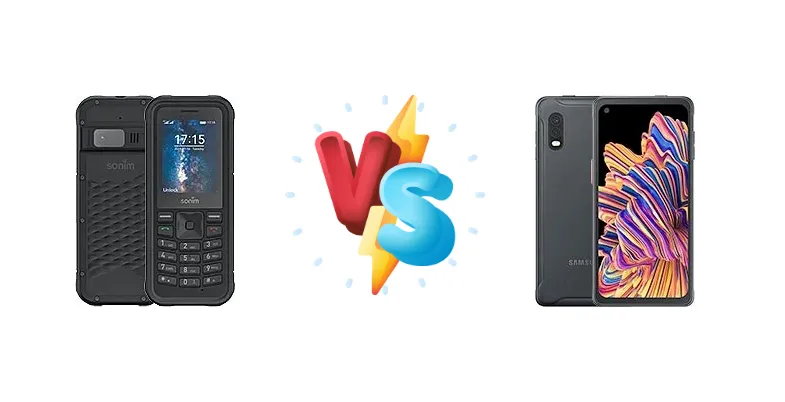
The Sonim XP100 and Samsung Galaxy XCover Pro both target a niche: users needing a phone built to withstand harsh conditions. However, their approaches differ significantly. The Sonim prioritizes extreme durability and longevity, while the Samsung aims for a balance of ruggedness, modern features, and a more palatable price point. This comparison dissects these differences to determine which phone best suits your needs.
🏆 Quick Verdict
For most users needing a durable phone, the Samsung Galaxy XCover Pro is the better choice. Its Exynos 9611 chipset delivers significantly superior performance for multitasking and demanding applications, while 15W charging offers a quicker top-up. The Sonim XP100 remains a viable option for those prioritizing absolute drop-proof resilience above all else.
| Network |
|---|
| 2G bands | GSM 850 / 900 / 1800 / 1900 | GSM 850 / 900 / 1800 / 1900 |
| 3G bands | HSDPA 850 / 900 / 1900 / 2100 | HSDPA 850 / 900 / 1900 / 2100 - International |
| 4G bands | 1, 3, 7, 8, 20, 28, 38, 40, 41 | 1, 2, 3, 5, 7, 8, 20, 28, 38, 40, 41 - International |
| Speed | HSPA, LTE | HSPA 42.2/5.76 Mbps, LTE (3CA) Cat11 600/50 Mbps |
| Technology | GSM / HSPA / LTE | GSM / HSPA / LTE |
| | - | 1, 2, 3, 4, 5, 7, 12, 13, 14, 20, 29, 38, 40, 41, 66 - Canada |
| Launch |
|---|
| Announced | 2024, October 24 | 2020, January |
| Status | Available. Released 2024, October 24 | Available. Released 2020, January |
| Body |
|---|
| Dimensions | 145 x 62 x 16.2 mm (5.71 x 2.44 x 0.64 in) | 159.9 x 76.7 x 10 mm (6.30 x 3.02 x 0.39 in) |
| SIM | Nano-SIM + Nano-SIM | · Nano-SIM· Nano-SIM + Nano-SIM |
| Weight | 165 g (5.82 oz) | 218 g (7.69 oz) |
| | - | IP68 dust/water resistant (up to 1.5m for 35 min)
Drop-to-concrete resistance from up to 1.5m
MIL-STD-810G compliant*
*does not guarantee ruggedness or use in extreme conditions |
| Display |
|---|
| Protection | Corning Gorilla Glass | Corning Gorilla Glass 5 |
| Resolution | 240 x 320 pixels, 4:3 ratio (~167 ppi density) | 1080 x 2340 pixels, 19.5:9 ratio (~409 ppi density) |
| Size | 2.4 inches, 17.8 cm2 (~19.8% screen-to-body ratio) | 6.3 inches, 97.4 cm2 (~79.4% screen-to-body ratio) |
| Type | TFT LCD | IPS LCD |
| Platform |
|---|
| CPU | 1.0 GHz | Octa-core (4x2.3 GHz Cortex-A73 & 4x1.7 GHz Cortex-A53) |
| Chipset | Unisoc T127 | Exynos 9611 (10 nm) |
| GPU | - | Mali-G72 MP3 |
| OS | - | Android 10, upgradable to Android 13, One UI 5 |
| Memory |
|---|
| Call records | Yes | - |
| Card slot | microSDXC | microSDXC (dedicated slot) |
| Internal | 128MB 64MB RAM | 64GB 4GB RAM |
| Phonebook | Yes | - |
| Main Camera |
|---|
| Dual | - | 25 MP, f/1.7, 26mm (wide), PDAF
8 MP, f/2.2, 123˚ (ultrawide), 1/4.0", 1.12µm |
| Features | - | Dual-LED flash, HDR, panorama |
| Single | 2 MP | - |
| Video | Yes | 1080p@30fps |
| Selfie camera |
|---|
| Features | - | HDR |
| Single | - | 13 MP, f/2.0, (wide), 1/3.1", 1.12µm |
| Video | - | 1080p@30fps |
| Sound |
|---|
| 3.5mm jack | - | Yes |
| 35mm jack | Yes | Yes |
| Loudspeaker | Yes | Yes |
| Comms |
|---|
| Bluetooth | 5.0, A2DP, LE | 5.0, A2DP, LE |
| NFC | No | Yes |
| Positioning | No | GPS, GLONASS, GALILEO, BDS |
| Radio | FM radio | FM radio (market/region dependent) |
| USB | USB Type-C 2.0 | USB Type-C 2.0 |
| WLAN | No | Wi-Fi 802.11 a/b/g/n/ac/k/v/r, dual-band, Wi-Fi Direct |
| Features |
|---|
| Games | Downloadable | - |
| Java | No | - |
| Messaging | SMS(threaded view), MMS, Email, Push Email, IM | - |
| Sensors | No | Fingerprint (side-mounted), accelerometer, gyro, proximity, compass |
| | - | ANT+ |
| Battery |
|---|
| Charging | - | 15W wired |
| Type | Li-Ion 1800 mAh, removable | Li-Po 4050 mAh, removable |
| Misc |
|---|
| Colors | Black | Black |
| Models | - | SM-G715FN/DS, SM-G715FN, SM-G715F, SM-G715W, SM-G715U, SM-G715U1 |
| Price | - | About 120 EUR |
| SAR EU | - | 0.47 W/kg (head) 1.23 W/kg (body) |
Sonim XP100
- Exceptional drop and shock resistance
- Potentially longer standby time due to basic chipset
- Designed for extreme environments
- Extremely limited processing power
- Slow app loading and multitasking
- Likely outdated software support
Samsung Galaxy XCover Pro
- Significantly faster performance with Exynos 9611
- 15W fast charging for quicker top-ups
- More versatile for everyday tasks
- Less extreme drop resistance compared to Sonim
- May require more careful handling in harsh conditions
- Potentially shorter battery life under heavy load
Display Comparison
Neither device boasts a cutting-edge display. Details on the XP100's panel are scarce, but given its price point, it likely utilizes a basic LCD. The XCover Pro’s display specifications are also not readily available, but Samsung’s history suggests a decent quality LCD. The key difference isn’t likely in resolution or color accuracy, but in durability; both are likely reinforced with Gorilla Glass or similar, but Sonim’s focus on drop resistance suggests a potentially more robust implementation. Bezels are expected to be substantial on both, prioritizing protection over maximizing screen real estate.
Camera Comparison
Camera performance is unlikely to be a deciding factor for either phone’s target audience. Details on the XP100’s camera are limited, but it’s likely a basic sensor for documentation purposes. The XCover Pro’s camera specifications are also not readily available, but Samsung typically equips its XCover series with functional, if not exceptional, cameras. The focus should be on capturing clear images for work-related documentation, rather than artistic photography. Expect adequate performance in good lighting conditions, but struggles in low light.
Performance
The performance gap is substantial. The Sonim XP100’s Unisoc T127, with its single 1.0 GHz core, is designed for basic functionality. It will struggle with multitasking, demanding apps, or even smooth web browsing. Conversely, the Samsung Galaxy XCover Pro’s Exynos 9611, built on a 10nm process, features an octa-core configuration (4x2.3 GHz Cortex-A73 & 4x1.7 GHz Cortex-A53). This translates to a significantly faster and more responsive experience, capable of handling multiple apps simultaneously and running more complex software. The Exynos’s architecture allows for more efficient task allocation, benefiting users who rely on navigation, communication, and data logging apps in the field.
Battery Life
Battery capacity details for the Sonim XP100 are unavailable, but Sonim typically prioritizes long standby times through efficient power management. The Galaxy XCover Pro supports 15W wired charging, a significant advantage over the XP100, which likely relies on slower charging speeds. While the XCover Pro’s battery capacity is not specified, the more efficient Exynos chipset and faster charging capabilities provide a practical benefit for users who need to quickly replenish their battery during breaks or between tasks.
Buying Guide
Buy the Sonim XP100 if you require a phone that can survive almost any physical abuse, prioritizing longevity and minimal downtime over app performance. This is ideal for construction workers, first responders, or anyone in consistently hazardous environments. Buy the Samsung Galaxy XCover Pro if you need a rugged phone that can also handle everyday tasks smoothly, offering a more modern user experience with faster processing and quicker charging, making it suitable for field service technicians, delivery drivers, or outdoor enthusiasts.
Frequently Asked Questions
❓ Does the Exynos 9611 in the Galaxy XCover Pro tend to overheat during prolonged use, like GPS navigation or video recording?
The Exynos 9611 is a relatively efficient chipset, and the XCover Pro’s rugged design likely incorporates thermal management features. While it may warm up during extended use, it’s unlikely to experience significant throttling or overheating under typical field work conditions. The 10nm process node contributes to better thermal efficiency compared to older, larger process technologies.
❓ How does the Sonim XP100’s audio performance hold up in noisy environments, such as construction sites?
Sonim phones are renowned for their loud and clear audio, specifically designed for high-noise environments. The XP100 likely features enhanced speakers and noise cancellation technology to ensure clear communication even in challenging conditions. This is a key strength for users working in loud industrial settings.
❓ Is the software on the Samsung Galaxy XCover Pro regularly updated with security patches?
Samsung provides regular security updates for its XCover series, though the frequency may not match flagship devices. Expect to receive critical security patches for several years after the phone’s release, ensuring your data remains protected. However, major Android version updates may be limited.
❓ Can the Sonim XP100 be easily repaired in the field if it sustains damage?
Sonim designs its phones with repairability in mind, and offers a robust warranty and repair program. While field repairs may not be possible without specialized tools, the phone is built to withstand significant abuse, reducing the likelihood of catastrophic failure. Sonim also offers extended warranty options for added peace of mind.