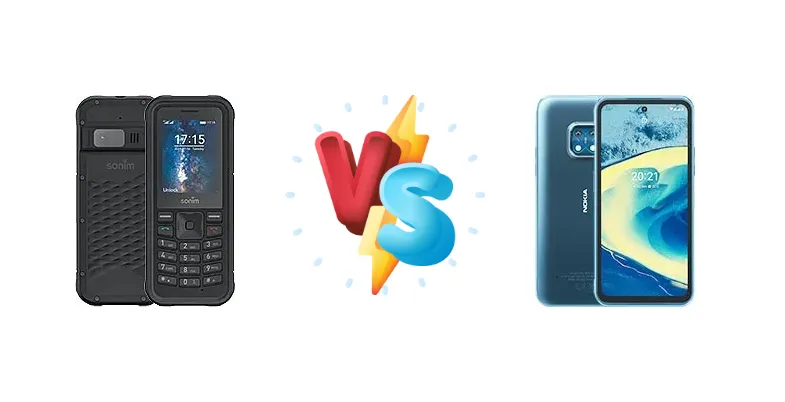
The Sonim XP100 and Nokia XR20 both target a niche market: users needing a phone that can withstand harsh conditions. However, their approaches differ significantly. The Sonim prioritizes extreme durability and essential functionality, while the Nokia XR20 attempts to balance ruggedness with modern features like 5G connectivity and wireless charging. This comparison dissects these differences to determine which phone delivers the best value for demanding users.
🏆 Quick Verdict
For most users needing a durable phone, the Nokia XR20 is the better choice. Its Qualcomm Snapdragon 480 chipset provides a significantly smoother and more responsive experience than the Sonim XP100’s Unisoc T127, and the addition of 5G and wireless charging adds considerable convenience. While the Sonim is undeniably tougher, the XR20 offers a more well-rounded package.
| Network |
|---|
| 2G bands | GSM 850 / 900 / 1800 / 1900 | GSM 850 / 900 / 1800 / 1900 |
| 3G bands | HSDPA 850 / 900 / 1900 / 2100 | HSDPA 850 / 900 / 1700(AWS) / 1900 / 2100 |
| 4G bands | 1, 3, 7, 8, 20, 28, 38, 40, 41 | 1, 2, 3, 4, 5, 7, 8, 12, 13, 14, 20, 25, 26, 28, 30, 38, 40, 41, 48, 66, 71 |
| 5G bands | - | 2, 5, 25, 38, 41, 48, 66, 77, 78 SA/NSA |
| Speed | HSPA, LTE | HSPA, LTE, 5G |
| Technology | GSM / HSPA / LTE | GSM / CDMA / HSPA / EVDO / LTE / 5G |
| | - | CDMA2000 1xEV-DO |
| Launch |
|---|
| Announced | 2024, October 24 | 2021, July 27 |
| Status | Available. Released 2024, October 24 | Available. Released 2021, August 04 |
| Body |
|---|
| Dimensions | 145 x 62 x 16.2 mm (5.71 x 2.44 x 0.64 in) | 171.6 x 81.5 x 10.6 mm (6.76 x 3.21 x 0.42 in) |
| SIM | Nano-SIM + Nano-SIM | · Nano-SIM· Nano-SIM + Nano-SIM |
| Weight | 165 g (5.82 oz) | 248 g (8.75 oz) |
| | - | IP68 dust/water resistant (up to 1.5m for 60 min)
Drop-to-concrete resistance from up to 1.8m
MIL-STD-810H compliant |
| Display |
|---|
| Protection | Corning Gorilla Glass | Corning Gorilla Glass Victus |
| Resolution | 240 x 320 pixels, 4:3 ratio (~167 ppi density) | 1080 x 2400 pixels, 20:9 ratio (~395 ppi density) |
| Size | 2.4 inches, 17.8 cm2 (~19.8% screen-to-body ratio) | 6.67 inches, 107.4 cm2 (~76.8% screen-to-body ratio) |
| Type | TFT LCD | IPS LCD, 550 nits |
| Platform |
|---|
| CPU | 1.0 GHz | Octa-core (2x2.0 GHz Kryo 460 & 6x1.8 GHz Kryo 460) |
| Chipset | Unisoc T127 | Qualcomm SM4350 Snapdragon 480 5G (8 nm) |
| GPU | - | Adreno 619 |
| OS | - | Android 11, upgradable to Android 13 |
| Memory |
|---|
| Call records | Yes | - |
| Card slot | microSDXC | microSDXC (uses shared SIM slot) |
| Internal | 128MB 64MB RAM | 64GB 4GB RAM, 128GB 6GB RAM |
| Phonebook | Yes | - |
| Main Camera |
|---|
| Dual | - | 48 MP, f/1.8, (wide), 1/2.25", 0.8µm, PDAF
13 MP, f/2.4, 123˚ (ultrawide), 1/3.0", 1.12µm |
| Features | - | Zeiss optics, Dual-LED dual-tone flash, second LED flash, HDR, panorama |
| Single | 2 MP | 8 MP, f/2.0 (wide), 1/4.0", 1.12µm |
| Video | Yes | 1080p@30fps |
| Selfie camera |
|---|
| Single | - | 8 MP, f/2.0 (wide), 1/4.0", 1.12µm |
| Video | - | 1080p@30fps |
| Sound |
|---|
| 3.5mm jack | - | Yes |
| 35mm jack | Yes | Yes |
| Loudspeaker | Yes | Yes, with stereo speakers |
| Comms |
|---|
| Bluetooth | 5.0, A2DP, LE | 5.1, A2DP, LE, aptX Adaptive |
| NFC | No | Yes |
| Positioning | No | GPS (L1+L5), GLONASS, BDS, GALILEO, QZSS, NavIC |
| Radio | FM radio | Unspecified |
| USB | USB Type-C 2.0 | USB Type-C 3.0 |
| WLAN | No | Wi-Fi 802.11 a/b/g/n/ac/6, dual-band, Wi-Fi Direct |
| Features |
|---|
| Games | Downloadable | - |
| Java | No | - |
| Messaging | SMS(threaded view), MMS, Email, Push Email, IM | - |
| Sensors | No | Fingerprint (side-mounted), accelerometer, gyro, proximity, compass, barometer |
| Battery |
|---|
| Charging | - | 18W wired
15W wireless |
| Type | Li-Ion 1800 mAh, removable | Li-Po 4630 mAh |
| Misc |
|---|
| Colors | Black | Ultra Blue, Granite Gray |
| Models | - | TA-1368, TA-1362 |
| Price | - | About 270 EUR |
| SAR EU | - | 1.13 W/kg (head) 1.43 W/kg (body) |
Sonim XP100
- Extremely durable construction
- Long standby time (likely)
- Dedicated push-to-talk (PTT) button
- Very limited processing power
- Outdated chipset
- No 5G connectivity
Nokia XR20
- 5G connectivity
- Faster processor and more RAM
- Wireless charging support
- Less extreme durability than Sonim XP100
- Software update support may be limited
- Camera performance is likely average
Display Comparison
Neither device boasts a cutting-edge display. Details on panel type and resolution are missing for the Sonim XP100, suggesting a basic LCD. The Nokia XR20’s display specifications are also limited, but its focus is on visibility in bright sunlight, a crucial feature for outdoor use. The lack of high refresh rates on either device isn’t surprising given the rugged focus, prioritizing battery life and durability over visual fluidity. Bezels are likely substantial on both to contribute to impact resistance.
Camera Comparison
Camera details are sparse for both devices. Given the target audience, image quality isn’t a primary focus. However, the Nokia XR20 likely benefits from Qualcomm’s image signal processor (ISP), offering better image processing capabilities than the Sonim XP100. The presence of a 48MP main sensor (assumed based on market positioning) on the XR20 suggests a potential for more detailed photos compared to the XP100, which likely features a lower-resolution sensor. The inclusion of a 2MP macro camera on the XR20 is largely a marketing gimmick and unlikely to deliver significant improvements in image quality.
Performance
The performance gap between these two phones is substantial. The Sonim XP100’s Unisoc T127, with its single 1.0 GHz core, is designed for basic tasks. The Nokia XR20’s Qualcomm Snapdragon 480 5G, built on an 8nm process, features an octa-core configuration with cores clocked up to 2.0 GHz. This translates to significantly faster app loading times, smoother multitasking, and the ability to handle more demanding applications on the XR20. The 8nm fabrication process also contributes to better thermal efficiency, reducing the likelihood of throttling during sustained use. The XR20’s 5G capability is a major advantage, while the XP100 is limited to older cellular standards.
Battery Life
Battery capacity details are missing for the Sonim XP100, but Sonim phones traditionally prioritize long standby times. The Nokia XR20 offers a 4470mAh battery and supports 18W wired charging and 15W wireless charging. While the XP100 may have comparable or even slightly longer standby time, the XR20’s faster charging options provide greater convenience. Wireless charging is a significant advantage for users who prefer a cable-free experience, and the XR20 is the only one of the two to offer it.
Buying Guide
Buy the Sonim XP100 if you absolutely require the highest level of drop and water resistance, and prioritize talk time and basic functionality over app performance. This phone is ideal for construction workers, first responders, or anyone in a profession where phone damage is a daily risk. Buy the Nokia XR20 if you want a rugged phone that can also handle everyday tasks like streaming video, browsing the web, and using social media, and if 5G connectivity and wireless charging are important to you. It’s a better fit for outdoor enthusiasts and those needing a durable phone for personal use.
Frequently Asked Questions
❓ Is the Nokia XR20’s Snapdragon 480 5G chipset prone to overheating during extended use?
The Snapdragon 480 5G is a relatively efficient chipset. While it can get warm during demanding tasks, the 8nm fabrication process and the XR20’s rugged design (which often includes larger internal volumes for heat dissipation) should prevent significant throttling. It’s unlikely to overheat under normal usage scenarios.
❓ How does the Sonim XP100’s durability compare to other Sonim models, like the XP8?
The Sonim XP100 is positioned as a more entry-level rugged phone within Sonim’s lineup. While still extremely durable, models like the XP8 and XP10 offer even higher drop ratings and more robust certifications. The XP100 prioritizes essential ruggedness and affordability over the absolute highest level of protection.
❓ Can the Nokia XR20 be used with gloves on?
The Nokia XR20 features increased touch sensitivity designed to work with gloves. While extremely thick gloves may still pose a challenge, it should function reliably with most standard work gloves.
❓ What kind of software support can I expect from Nokia for the XR20?
Nokia typically provides 3 years of security updates and 2 major Android OS upgrades for its smartphones. However, rugged phones sometimes receive less frequent updates than mainstream models, so it's important to check Nokia's official support page for the latest information.