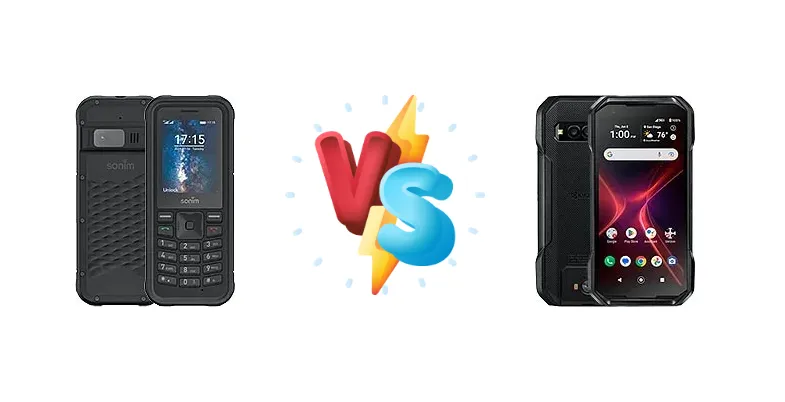
The rugged smartphone market caters to a specific need: durability. However, performance expectations vary. The Sonim XP100 prioritizes essential communication and longevity, while the Kyocera DuraForce Pro 3 aims for a more modern smartphone experience within a ruggedized frame. This comparison dissects the core differences between these two devices, focusing on how their internal hardware impacts real-world usability.
🏆 Quick Verdict
For the average user needing a reliable, no-frills rugged phone, the Sonim XP100 offers acceptable performance at a likely lower price point. However, the Kyocera DuraForce Pro 3 is the clear winner for those demanding significantly faster processing speeds, wireless charging, and a more responsive user experience, justifying its higher cost.
| Network |
|---|
| 2G bands | GSM 850 / 900 / 1800 / 1900 | GSM 850 / 900 / 1800 / 1900 |
| 3G bands | HSDPA 850 / 900 / 1900 / 2100 | HSDPA 850 / 900 / 1900 / 2100 |
| 4G bands | 1, 3, 7, 8, 20, 28, 38, 40, 41 | 1, 2, 3, 4, 5, 7, 8, 12, 13, 46, 48, 66 |
| 5G bands | - | 2, 5, 48, 66, 77, 78, 260, 261 SA/NSA/Sub6/mmWave |
| Speed | HSPA, LTE | HSPA, LTE, 5G |
| Technology | GSM / HSPA / LTE | GSM / HSPA / LTE / 5G |
| Launch |
|---|
| Announced | 2024, October 24 | 2023, July |
| Status | Available. Released 2024, October 24 | Available. Released 2023, September |
| Body |
|---|
| Dimensions | 145 x 62 x 16.2 mm (5.71 x 2.44 x 0.64 in) | 154 x 75 x 14.5 mm (6.06 x 2.95 x 0.57 in) |
| SIM | Nano-SIM + Nano-SIM | Nano SIM + eSIM |
| Weight | 165 g (5.82 oz) | 237 g (8.36 oz) |
| Display |
|---|
| Protection | Corning Gorilla Glass | Shatter-Resistant Glass |
| Resolution | 240 x 320 pixels, 4:3 ratio (~167 ppi density) | 1080 x 2160 pixels, 18:9 ratio (~449 ppi density) |
| Size | 2.4 inches, 17.8 cm2 (~19.8% screen-to-body ratio) | 5.38 inches, 74.7 cm2 (~64.7% screen-to-body ratio) |
| Type | TFT LCD | OLED |
| Platform |
|---|
| CPU | 1.0 GHz | Octa-core (1x2.4 GHz Cortex-A710 & 3x2.36 GHz Cortex-A710 & 4x1.8 GHz Cortex-A510) |
| Chipset | Unisoc T127 | Qualcomm SM7450-AB Snapdragon 7 Gen 1 (4 nm) |
| GPU | - | Adreno 644 |
| OS | - | Android 13, upgradable to Android 14 |
| Memory |
|---|
| Call records | Yes | - |
| Card slot | microSDXC | microSDXC (dedicated slot) |
| Internal | 128MB 64MB RAM | 128GB 6GB RAM |
| Phonebook | Yes | - |
| Main Camera |
|---|
| Features | - | Dual-LED flash, HDR, panorama |
| Single | 2 MP | - |
| Triple | - | 64 MP, f/1.8, (wide), PDAF
16 MP, f/2.0, 117˚ (ultrawide)
2 MP (macro) |
| Video | Yes | 4K@24fps, 1080p@30/60fps |
| Selfie camera |
|---|
| Single | - | 8 MP, f/1.8, (wide) |
| Video | - | 1080p@30fps |
| Sound |
|---|
| 35mm jack | Yes | Unspecified |
| Loudspeaker | Yes | Yes, with stereo speakers |
| Comms |
|---|
| Bluetooth | 5.0, A2DP, LE | 5.2, A2DP, LE |
| NFC | No | Yes |
| Positioning | No | GPS (L1+L5) |
| Radio | FM radio | No |
| USB | USB Type-C 2.0 | USB Type-C 3.2 |
| WLAN | No | Wi-Fi 802.11 a/b/g/n/ac/6e/mc/d/e/i/k/r/v, tri-band, Wi-Fi Direct |
| Features |
|---|
| Games | Downloadable | - |
| Java | No | - |
| Messaging | SMS(threaded view), MMS, Email, Push Email, IM | - |
| Sensors | No | Fingerprint (side-mounted); unspecified sensors |
| Battery |
|---|
| Charging | - | Wired
8W wireless (Qi) |
| Type | Li-Ion 1800 mAh, removable | Li-Ion 4270 mAh, removable |
| Misc |
|---|
| Colors | Black | Black |
| Price | - | About 450 EUR |
Sonim XP100
- Exceptional durability and ruggedness
- Likely longer battery life due to low-power processor
- Potentially lower price point
- Significantly slower performance
- Limited multitasking capabilities
- Basic camera system
Kyocera DuraForce Pro 3
- Powerful Snapdragon 7 Gen 1 processor
- Wireless charging (Qi)
- Smoother user experience and faster app loading
- Potentially shorter battery life
- Higher price point
- May be slightly bulkier due to advanced features
Display Comparison
Neither device's display specifications are provided, but given the Sonim's focus on essential functionality, it likely features a lower-resolution panel optimized for readability in direct sunlight. The Kyocera, positioned as a more premium offering, likely boasts a higher resolution and potentially a higher peak brightness. The absence of details like refresh rate or panel technology (IPS, AMOLED) suggests both prioritize durability and power efficiency over visual fidelity. Bezels are likely substantial on both to contribute to shock absorption.
Camera Comparison
Without specific camera details, it's reasonable to assume the Sonim XP100 features a basic camera setup geared towards documentation rather than photography. The Kyocera DuraForce Pro 3, benefiting from its more powerful processor and likely a more sophisticated image signal processor (ISP), is expected to offer superior image quality, faster processing, and potentially features like optical image stabilization (OIS). The Snapdragon 7 Gen 1's ISP capabilities would allow for better low-light performance and more advanced image processing algorithms. We can expect the Kyocera to have a larger main sensor and wider aperture.
Performance
The performance disparity is stark. The Sonim XP100's Unisoc T127, with its single 1.0 GHz core, is designed for basic tasks like calls, texts, and light app usage. In contrast, the Kyocera DuraForce Pro 3's Qualcomm Snapdragon 7 Gen 1 (4nm) is a modern, octa-core processor built on a significantly more efficient manufacturing process. The Snapdragon's architecture – featuring Cortex-A710 cores – delivers substantially higher CPU and GPU performance, enabling smoother multitasking, faster app loading times, and the ability to run more demanding applications. The 4nm process node also translates to better thermal management, reducing the likelihood of performance throttling under sustained load. The Kyocera will handle complex work applications and streaming services with ease, while the Sonim will struggle.
Battery Life
Battery capacity isn't specified for either device. However, the Sonim XP100, with its less power-hungry processor, is likely to achieve longer battery life on a single charge. The Kyocera DuraForce Pro 3, despite potentially having a larger battery, will consume more power due to its more powerful processor and features like wireless charging. The Kyocera's 8W wireless charging (Qi) provides convenient topping up, while the Sonim likely relies solely on wired charging. The efficiency of the Snapdragon 7 Gen 1's 4nm process will partially offset its higher power draw, but the Sonim will likely still have a significant advantage in longevity.
Buying Guide
Buy the Sonim XP100 if you need a highly durable, basic smartphone primarily for voice communication and essential tasks in harsh environments, and prioritize long-term battery life over app performance. Buy the Kyocera DuraForce Pro 3 if you prefer a rugged phone that can handle demanding applications, multitasking, and offers modern conveniences like wireless charging, and you require a smoother, more responsive user interface.
Frequently Asked Questions
❓ Is the Kyocera DuraForce Pro 3's Snapdragon 7 Gen 1 powerful enough for running specialized field service apps?
Yes, the Snapdragon 7 Gen 1 is a capable processor that should handle most field service applications without issue. Its octa-core architecture and modern GPU provide sufficient processing power for data collection, mapping, and reporting tasks commonly used in field service environments. The 4nm process also helps prevent overheating during prolonged use.
❓ How does the Sonim XP100's audio quality perform in noisy environments, like construction sites?
Sonim phones are specifically engineered for clear communication in loud environments. While specific audio specs aren't available, Sonim typically employs noise-canceling technology and powerful speakers to ensure voice calls are audible even amidst significant background noise. This is a core feature for users in industrial settings.
❓ Does the Kyocera DuraForce Pro 3 support over-the-air (OTA) software updates for security patches and feature enhancements?
Kyocera generally provides OTA updates for its smartphones, including security patches and software enhancements. However, the frequency and duration of support can vary. It's advisable to check Kyocera's official website for the specific update policy for the DuraForce Pro 3 model.
❓ What type of glove compatibility does the Sonim XP100 offer for use on worksites?
Sonim phones are designed with glove compatibility in mind. The XP100 likely features a touchscreen that can be operated while wearing common work gloves, though sensitivity may vary depending on the glove material and thickness. Sonim often includes a glove mode setting to enhance responsiveness.