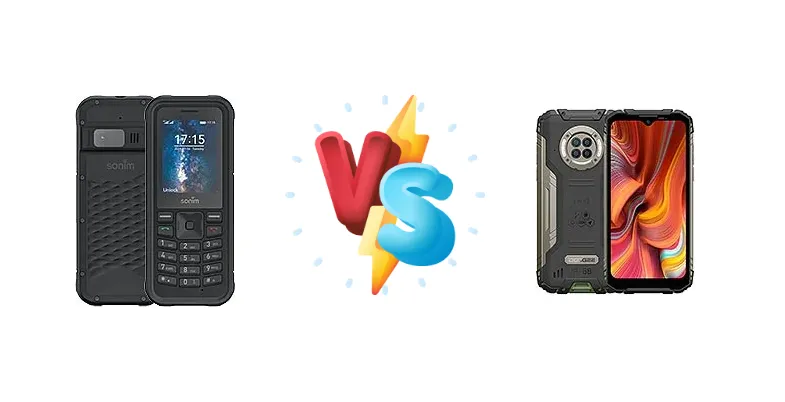
The rugged smartphone market caters to a specific need: durability. However, within this niche, priorities diverge. The Sonim XP100 focuses on essential communication and robust build quality, while the Doogee S96 Pro aims to deliver a more versatile experience, including gaming capabilities, at a competitive price. This comparison dissects their core differences to determine which device best suits your requirements.
🏆 Quick Verdict
For users prioritizing absolute reliability and basic functionality in harsh environments, the Sonim XP100 is a solid choice. However, the Doogee S96 Pro emerges as the winner for the average user, offering significantly superior processing power with the MediaTek Helio G90, faster charging, and a more modern user experience, all while maintaining rugged credentials.
| Network |
|---|
| 2G bands | GSM 850 / 900 / 1800 / 1900 | GSM 850 / 900 / 1800 / 1900 |
| 3G bands | HSDPA 850 / 900 / 1900 / 2100 | HSDPA 800 / 850 / 900 / 1700(AWS) / 1900 / 2100 |
| 4G bands | 1, 3, 7, 8, 20, 28, 38, 40, 41 | 1, 2, 3, 4, 5, 7, 8, 12, 13, 17, 18, 19, 20, 25, 26, 28, 38, 40, 66 |
| Speed | HSPA, LTE | HSPA, LTE |
| Technology | GSM / HSPA / LTE | GSM / CDMA / HSPA / LTE |
| Launch |
|---|
| Announced | 2024, October 24 | 2020, October 26. Released 2020, November |
| Status | Available. Released 2024, October 24 | Discontinued |
| Body |
|---|
| Dimensions | 145 x 62 x 16.2 mm (5.71 x 2.44 x 0.64 in) | 167 x 81.4 x 15.5 mm (6.57 x 3.20 x 0.61 in) |
| SIM | Nano-SIM + Nano-SIM | Nano-SIM + Nano-SIM |
| Weight | 165 g (5.82 oz) | 310 g (10.93 oz) |
| Display |
|---|
| Protection | Corning Gorilla Glass | Corning Gorilla Glass |
| Resolution | 240 x 320 pixels, 4:3 ratio (~167 ppi density) | 720 x 1520 pixels, 19:9 ratio (~270 ppi density) |
| Size | 2.4 inches, 17.8 cm2 (~19.8% screen-to-body ratio) | 6.22 inches, 96.6 cm2 (~71.0% screen-to-body ratio) |
| Type | TFT LCD | IPS LCD |
| Platform |
|---|
| CPU | 1.0 GHz | Octa-core (2x2.0 GHz Cortex-A76 & 6x2.0 GHz Cortex-A55) |
| Chipset | Unisoc T127 | Mediatek MT6785 Helio G90 (12 nm) |
| GPU | - | Mali-G76 MC4 |
| OS | - | Android 10 |
| Memory |
|---|
| Call records | Yes | - |
| Card slot | microSDXC | microSDXC (dedicated slot) |
| Internal | 128MB 64MB RAM | 128GB 8GB RAM |
| Phonebook | Yes | - |
| Main Camera |
|---|
| Features | - | Quad-LED flash, HDR, panorama |
| Quad | - | 48 MP, f/1.8, (wide), PDAF
8 MP, f/2.2, 130˚, (ultrawide)
20 MP, f/2.8, (night vision), 4 infrared night vision lights
2 MP (macro) |
| Single | 2 MP | - |
| Video | Yes | 1080p |
| Selfie camera |
|---|
| Single | - | 16 MP, f/2.0, (wide) |
| Video | - | 1080p |
| Sound |
|---|
| 35mm jack | Yes | Yes |
| Loudspeaker | Yes | Yes |
| Comms |
|---|
| Bluetooth | 5.0, A2DP, LE | 5.0, A2DP, LE |
| NFC | No | Yes |
| Positioning | No | GPS, GLONASS, BDS, GALILEO |
| Radio | FM radio | FM radio |
| USB | USB Type-C 2.0 | USB Type-C 2.0, OTG |
| WLAN | No | Wi-Fi 802.11 a/b/g/n/ac, dual-band |
| Features |
|---|
| Games | Downloadable | - |
| Java | No | - |
| Messaging | SMS(threaded view), MMS, Email, Push Email, IM | - |
| Sensors | No | Fingerprint (side-mounted), accelerometer, gyro, proximity, compass |
| Battery |
|---|
| Charging | - | 24W wired
10W wireless |
| Type | Li-Ion 1800 mAh, removable | 6350 mAh |
| Misc |
|---|
| Colors | Black | Black, Orange, Green |
| Price | - | About 280 EUR |
Sonim XP100
- Extremely durable and rugged build quality
- Simple and easy-to-use interface
- Long-lasting battery life (likely due to low power consumption)
- Significantly underpowered processor
- Limited features and functionality
- Outdated chipset
Doogee S96 Pro
- Powerful MediaTek Helio G90 processor
- Fast 24W wired and 10W wireless charging
- More versatile feature set for gaming and multimedia
- May not be as exceptionally durable as the Sonim XP100
- Potentially shorter battery life under heavy load
- More complex software experience
Display Comparison
Neither device's display specifications are provided, so a direct comparison is limited. However, given Sonim's focus on practicality, the XP100 likely features a standard LCD panel optimized for visibility in direct sunlight. The Doogee S96 Pro, positioned as a more feature-rich device, may incorporate a higher-resolution display with improved color accuracy. The absence of details like refresh rate or peak brightness suggests both prioritize durability over cutting-edge display technology.
Camera Comparison
Without detailed camera specifications, a precise comparison is difficult. However, the Doogee S96 Pro's positioning suggests a more capable camera system. While both likely feature a rear camera setup to accommodate rugged use, the Helio G90's integrated image signal processor (ISP) offers superior image processing capabilities. The Sonim XP100 likely prioritizes a functional camera for documentation, while the Doogee S96 Pro aims for more versatile photography.
Performance
The performance gap between these two devices is substantial. The Sonim XP100 utilizes the Unisoc T127 chipset with a single-core 1.0 GHz CPU, designed for basic tasks like calls, texts, and simple apps. In contrast, the Doogee S96 Pro boasts the MediaTek Helio G90, an octa-core processor (2x2.0 GHz Cortex-A76 & 6x2.0 GHz Cortex-A55) built on a 12nm process. This translates to a dramatically faster and more responsive experience on the Doogee, capable of handling demanding games and multitasking with ease. The Helio G90's architecture, featuring Cortex-A76 cores, provides a significant performance uplift compared to the Unisoc T127's simpler design.
Battery Life
Battery capacity isn't specified for either device. However, the Doogee S96 Pro's inclusion of 24W wired and 10W wireless charging is a significant advantage. The Sonim XP100 likely relies on slower charging speeds. The faster charging on the Doogee allows for quicker top-ups, crucial for users who rely heavily on their phone throughout the day. While a larger mAh rating is always beneficial, the Doogee's charging capabilities provide a tangible real-world advantage.
Buying Guide
Buy the Sonim XP100 if you need a virtually indestructible phone for essential communication in extreme conditions, prioritizing longevity and simplicity over advanced features. This is ideal for construction workers, first responders, or those frequently exposed to harsh elements. Buy the Doogee S96 Pro if you prefer a rugged phone that can also handle demanding tasks like gaming, streaming, and photography, offering a more balanced feature set and a significantly faster processor for everyday use.
Frequently Asked Questions
❓ Is the MediaTek Helio G90 in the Doogee S96 Pro prone to overheating during extended gaming sessions?
While the Helio G90 is a capable processor, it can generate heat under sustained load. However, the Doogee S96 Pro's rugged design likely incorporates heat dissipation features to mitigate throttling. User reports suggest moderate temperature increases during gaming, but not to the point of significant performance degradation.
❓ How does the Unisoc T127 in the Sonim XP100 handle basic productivity apps like email and web browsing?
The Unisoc T127 is sufficient for basic tasks like email, web browsing, and messaging. However, expect slower loading times and occasional lag when multitasking or using more demanding web pages. It's designed for essential communication, not intensive productivity.
❓ Does the Doogee S96 Pro support VoLTE and Wi-Fi calling, and are these features reliable?
The Doogee S96 Pro generally supports VoLTE and Wi-Fi calling, but compatibility can vary depending on your carrier and region. It's crucial to check with your mobile provider to ensure these features are fully supported for optimal call quality and network performance.
❓ What type of water and dust resistance certifications do the Sonim XP100 and Doogee S96 Pro have?
While specific certifications aren't provided, both phones are marketed as rugged devices. Sonim is renowned for its MIL-STD-810H certification, indicating high levels of shock, drop, and environmental resistance. The Doogee S96 Pro likely holds an IP68 or IP69K rating, offering protection against dust and water immersion.