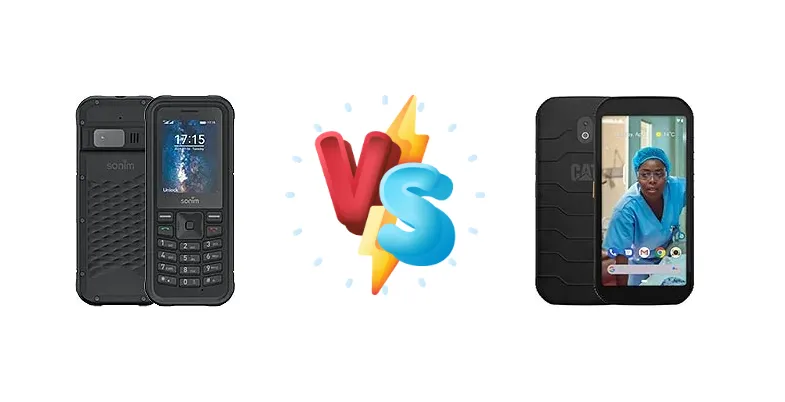
The Sonim XP100 and Cat S42 H+ both target the demanding user needing a phone that can withstand harsh conditions. However, their approaches to achieving this ruggedness differ significantly, particularly in the underlying hardware. This comparison dives deep into the specifications to determine which device delivers the best balance of durability and usability for field workers, outdoor enthusiasts, and anyone prone to accidental drops.
🏆 Quick Verdict
For the average user prioritizing basic functionality and affordability in a rugged package, the Cat S42 H+ emerges as the better choice. Its Mediatek Helio A20 chipset, clocked at 1.8 GHz, provides a noticeable performance advantage over the Sonim XP100’s Unisoc T127, making everyday tasks smoother and more responsive.
| Network |
|---|
| 2G bands | GSM 850 / 900 / 1800 / 1900 | GSM 850 / 900 / 1800 / 1900 - SIM 1 & SIM 2 |
| 3G bands | HSDPA 850 / 900 / 1900 / 2100 | HSDPA 850 / 900 / 1700(AWS) / 1900 / 2100 |
| 4G bands | 1, 3, 7, 8, 20, 28, 38, 40, 41 | 1, 2, 3, 4, 5, 7, 12, 13, 14, 17, 25, 26, 41, 66, 71 |
| Speed | HSPA, LTE | HSPA 42.2/5.76 Mbps, LTE-A (2CA) Cat6 300/50 Mbps |
| Technology | GSM / HSPA / LTE | GSM / HSPA / LTE |
| Launch |
|---|
| Announced | 2024, October 24 | 2021, April 20 |
| Status | Available. Released 2024, October 24 | Available. Released 2021, April 20 |
| Body |
|---|
| Dimensions | 145 x 62 x 16.2 mm (5.71 x 2.44 x 0.64 in) | 161.3 x 77.2 x 12.7 mm (6.35 x 3.04 x 0.5 in) |
| SIM | Nano-SIM + Nano-SIM | Dual SIM (Nano-SIM, dual stand-by) |
| Weight | 165 g (5.82 oz) | 220 g (7.76 oz) |
| Display |
|---|
| Protection | Corning Gorilla Glass | Corning Gorilla Glass 5 |
| Resolution | 240 x 320 pixels, 4:3 ratio (~167 ppi density) | 720 x 1440 pixels, 18:9 ratio (~293 ppi density) |
| Size | 2.4 inches, 17.8 cm2 (~19.8% screen-to-body ratio) | 5.5 inches, 78.1 cm2 (~62.7% screen-to-body ratio) |
| Type | TFT LCD | IPS LCD |
| Platform |
|---|
| CPU | 1.0 GHz | Quad-core 1.8 GHz Cortex-A53 |
| Chipset | Unisoc T127 | Mediatek MT6761D Helio A20 (12 nm) |
| GPU | - | PowerVR GE8320 |
| OS | - | Android 10, planned upgrade to Android 11 |
| Memory |
|---|
| Call records | Yes | - |
| Card slot | microSDXC | microSDXC (dedicated slot) |
| Internal | 128MB 64MB RAM | 32GB 3GB RAM |
| Phonebook | Yes | - |
| Main Camera |
|---|
| Features | - | LED flash |
| Single | 2 MP | 13 MP, f/2.0, (wide), PDAF |
| Video | Yes | 1080p@30fps |
| Sound |
|---|
| 3.5mm jack | - | Yes |
| 35mm jack | Yes | - |
| Loudspeaker | Yes | Yes |
| Comms |
|---|
| Bluetooth | 5.0, A2DP, LE | 5.0, A2DP, LE |
| NFC | No | Yes |
| Positioning | No | GPS, GLONASS, BDS |
| Radio | FM radio | FM radio |
| USB | USB Type-C 2.0 | microUSB 2.0, OTG |
| WLAN | No | Wi-Fi 802.11 b/g/n |
| Features |
|---|
| Games | Downloadable | - |
| Java | No | - |
| Messaging | SMS(threaded view), MMS, Email, Push Email, IM | - |
| Sensors | No | Accelerometer, proximity, compass |
| Battery |
|---|
| Type | Li-Ion 1800 mAh, removable | Li-Ion 4200 mAh, non-removable |
| Misc |
|---|
| Colors | Black | Black |
| Price | - | $ 249.87 / C$ 298.00 / £ 182.00 / € 188.58 |
Sonim XP100
- Potentially higher drop-test certification (Sonim's core strength)
- Designed for extreme environments
- Dedicated push-to-talk (PTT) functionality (common in Sonim phones)
- Significantly slower processor (Unisoc T127)
- Likely limited multitasking capabilities
- Potentially outdated software support
Cat S42 H+
- Faster processor (Mediatek Helio A20)
- More responsive user experience
- Potentially better battery efficiency
- May not meet the same extreme drop-test standards as Sonim
- Camera performance likely basic
- Software updates may be limited
Display Comparison
Neither Sonim nor Cat provide detailed display specifications beyond basic resolution. However, given the price points, it's safe to assume both utilize IPS LCD panels. The lack of high refresh rates or advanced features like LTPO is expected. The focus here is on visibility under direct sunlight and scratch resistance, where both likely employ reinforced glass. Without specific nit ratings, it's difficult to declare a clear winner, but the Cat S42 H+'s slightly more modern chipset *could* allow for better display calibration and color accuracy.
Camera Comparison
Both phones likely feature basic camera setups geared towards functionality rather than photography prowess. Detailed camera specs are unavailable, but it's reasonable to assume both include a primary sensor and potentially a secondary depth or macro lens. Given the focus on ruggedness, image processing will likely prioritize speed and reliability over advanced features. Without specific sensor sizes or apertures, it’s impossible to definitively say which phone captures better images, but the Cat S42 H+'s more capable chipset *could* allow for slightly faster image processing and better low-light performance.
Performance
The performance gap is the most significant differentiator. The Cat S42 H+ boasts a Mediatek Helio A20 (12nm) with a quad-core 1.8 GHz Cortex-A53 CPU, while the Sonim XP100 is equipped with the Unisoc T127 running at a slower 1.0 GHz. The Helio A20’s 12nm fabrication process is more efficient than whatever process node Unisoc uses for the T127, and the higher clock speed and quad-core configuration translate to faster app loading times and smoother multitasking. The Cortex-A53 cores in the Helio A20 are also architecturally more advanced than those likely found in the T127, offering better instructions-per-clock (IPC). This means the Cat S42 H+ will handle demanding applications and web browsing with considerably less lag.
Battery Life
Battery capacity is not specified for either device. However, rugged phones generally prioritize long battery life. The Cat S42 H+'s more efficient Mediatek Helio A20 chipset will likely contribute to better battery endurance compared to the Sonim XP100’s Unisoc T127, even if the battery capacities are similar. Charging wattage is also unknown, but the Cat S42 H+'s more modern design *might* support faster charging speeds, reducing downtime.
Buying Guide
Buy the Sonim XP100 if you absolutely require a phone certified to the highest drop-test standards and prioritize extreme durability above all else, even at the cost of performance. This phone is ideal for construction workers or those in similarly demanding professions. Buy the Cat S42 H+ if you need a rugged phone for general outdoor use, light work tasks, and want a more fluid user experience thanks to its faster processor and more modern chipset architecture.
Frequently Asked Questions
❓ Is the Unisoc T127 chipset in the Sonim XP100 sufficient for running common work apps like email and spreadsheets?
While the Unisoc T127 can handle basic tasks like email and spreadsheets, expect slower loading times and potential lag when multitasking. It's best suited for users who primarily need a reliable communication device rather than a performance powerhouse.
❓ Does the Mediatek Helio A20 in the Cat S42 H+ get hot during prolonged use, like when using GPS navigation?
The Helio A20 is a relatively low-power chipset and is unlikely to overheat during typical use, including GPS navigation. Its 12nm fabrication process contributes to better thermal efficiency compared to older, larger node chipsets.
❓ What kind of water and dust resistance certifications do these phones have?
Both phones are ruggedized, but specific certifications (IP68, IP69K, MIL-STD-810H) vary. Sonim typically aims for the highest MIL-STD-810H ratings, focusing on drop resistance. Cat phones also offer robust protection, but may prioritize water and dust ingress protection.
❓ Are software updates guaranteed for either the Sonim XP100 or the Cat S42 H+?
Software update support for both devices is limited. Rugged phone manufacturers often prioritize hardware durability over long-term software maintenance. Expect minimal updates, primarily focused on security patches.