
Sonim XP100 vs Blackview BV9900E: A Deep Dive into Rugged Smartphone Performance
| Phones Images | |||||
|---|---|---|---|---|---|
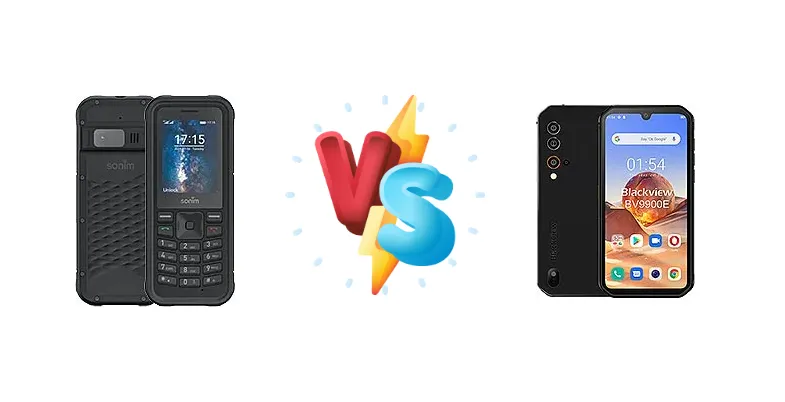
|
🏆 Quick Verdict
For users prioritizing absolute reliability and a no-frills experience in demanding work environments, the Sonim XP100 is the better choice. However, the Blackview BV9900E offers significantly superior performance and features for the price, making it ideal for users who need more than just basic functionality from their rugged device.
| PHONES | ||
|---|---|---|
| Phone Names | Sonim XP100 | Blackview BV9900E |
| Network | ||
|---|---|---|
| 2G bands | GSM 850 / 900 / 1800 / 1900 | GSM 850 / 900 / 1800 / 1900 |
| 3G bands | HSDPA 850 / 900 / 1900 / 2100 | HSDPA 800 / 850 / 900 / 1700(AWS) / 1900 / 2100 |
| 4G bands | 1, 3, 7, 8, 20, 28, 38, 40, 41 | 1, 2, 3, 4, 5, 7, 8, 12, 13, 17, 18, 19, 20, 25, 26, 28, 34, 38, 39, 40, 41, 66 |
| Speed | HSPA, LTE | HSPA, LTE |
| Technology | GSM / HSPA / LTE | GSM / CDMA / HSPA / CDMA2000 / LTE |
| Launch | ||
|---|---|---|
| Announced | 2024, October 24 | 2020, September 10. Released 2020, September |
| Status | Available. Released 2024, October 24 | Discontinued |
| Body | ||
|---|---|---|
| Dimensions | 145 x 62 x 16.2 mm (5.71 x 2.44 x 0.64 in) | 156.5 x 78.3 x 14.2 mm (6.16 x 3.08 x 0.56 in) |
| SIM | Nano-SIM + Nano-SIM | Nano-SIM + Nano-SIM |
| Weight | 165 g (5.82 oz) | 273 g (9.63 oz) |
| Display | ||
|---|---|---|
| Protection | Corning Gorilla Glass | Corning Gorilla Glass 5 |
| Resolution | 240 x 320 pixels, 4:3 ratio (~167 ppi density) | 1080 x 2280 pixels, 19:9 ratio (~432 ppi density) |
| Size | 2.4 inches, 17.8 cm2 (~19.8% screen-to-body ratio) | 5.84 inches, 85.1 cm2 (~69.5% screen-to-body ratio) |
| Type | TFT LCD | IPS LCD |
| Platform | ||
|---|---|---|
| CPU | 1.0 GHz | Octa-core (2x2.2 GHz Cortex-A75 & 6x2.0 GHz Cortex-A55) |
| Chipset | Unisoc T127 | Mediatek MT6779V/CE Helio P90 (12 nm) |
| GPU | - | PowerVR GM9446 |
| OS | - | Android 10 |
| Memory | ||
|---|---|---|
| Call records | Yes | - |
| Card slot | microSDXC | microSDXC |
| Internal | 128MB 64MB RAM | 128GB 6GB RAM |
| Phonebook | Yes | - |
| Main Camera | ||
|---|---|---|
| Features | - | LED flash, HDR, panorama |
| Quad | - | 48 MP, f/1.8, (wide), PDAF 16 MP, 120˚ (ultrawide) 2 MP (macro) Auxiliary lens |
| Single | 2 MP | - |
| Video | Yes | 4K@30fps, 1080p@60fps |
| Selfie camera | ||
|---|---|---|
| Single | - | 16 MP, f/2.0, (wide) |
| Video | - | 1080p@30fps |
| Sound | ||
|---|---|---|
| 35mm jack | Yes | No |
| Loudspeaker | Yes | Yes |
| Comms | ||
|---|---|---|
| Bluetooth | 5.0, A2DP, LE | 5.0, A2DP, LE |
| NFC | No | Yes |
| Positioning | No | GPS, GLONASS, GALILEO, BDS |
| Radio | FM radio | FM radio |
| USB | USB Type-C 2.0 | USB Type-C 2.0, OTG |
| WLAN | No | Wi-Fi 802.11 a/b/g/n/ac |
| Features | ||
|---|---|---|
| Games | Downloadable | - |
| Java | No | - |
| Messaging | SMS(threaded view), MMS, Email, Push Email, IM | - |
| Sensors | No | Fingerprint (side-mounted), accelerometer, gyro, proximity, compass, barometer |
| Battery | ||
|---|---|---|
| Charging | - | 15W wired 18W wireless |
| Type | Li-Ion 1800 mAh, removable | 4380 mAh |
| Misc | ||
|---|---|---|
| Colors | Black | Black, Silver |
| Price | - | About 260 EUR |
Sonim XP100
- Extremely durable and reliable construction
- Dedicated push-to-talk (PTT) functionality
- Long-term software support (likely)
- Significantly underpowered processor
- Basic camera system
- Lacks modern features like wireless charging
Blackview BV9900E
- Powerful Helio P90 processor for smooth performance
- Wireless charging support
- More versatile camera system
- Build quality may not match Sonim’s extreme durability
- Software updates may be less frequent
- Potentially less focused on enterprise features
Display Comparison
Neither device boasts a cutting-edge display. Details regarding the XP100's panel are scarce, suggesting a basic LCD. The BV9900E, while also likely LCD, benefits from the Helio P90's image signal processor, potentially offering slightly better color reproduction. Both will likely struggle in direct sunlight, but the BV9900E’s more powerful chipset *could* allow for higher brightness settings, though this is speculative without specific nit ratings. Bezels are expected to be substantial on both, reflecting their ruggedized design.
Camera Comparison
Camera capabilities are likely a secondary concern for both manufacturers, but the BV9900E has a clear advantage. While specific sensor details are missing for the XP100, it’s safe to assume a basic sensor. The BV9900E’s Helio P90 includes an image signal processor capable of handling more complex image processing, potentially resulting in better dynamic range and low-light performance. The presence of a dedicated ISP in the BV9900E suggests a more refined camera experience, even if the main sensor resolution isn’t exceptionally high. Avoid placing much stock in the likely 2MP macro cameras on either device.
Performance
The performance gap is substantial. The Sonim XP100’s Unisoc T127, with its single 1.0 GHz core, is designed for basic tasks like calls and messaging. The Blackview BV9900E’s MediaTek Helio P90, a 12nm octa-core processor (2x2.2 GHz Cortex-A75 & 6x2.0 GHz Cortex-A55), delivers a significantly more responsive experience. The Helio P90’s architecture allows for parallel processing, crucial for multitasking and running demanding applications. This translates to faster app loading, smoother scrolling, and the ability to handle more complex tasks. The XP100 will likely struggle with anything beyond basic apps, while the BV9900E can handle moderate gaming and video playback.
Battery Life
Battery life is a critical factor for rugged phones. While the exact capacity of the XP100’s battery is unknown, Sonim typically prioritizes long standby times. The BV9900E offers 15W wired and 18W wireless charging, a significant convenience the XP100 lacks. The faster charging speeds of the BV9900E mitigate the impact of potentially lower battery capacity, allowing for quicker top-ups when access to power is limited. The Helio P90’s efficiency, despite its higher performance, could also contribute to comparable real-world battery life, especially with optimized software.
Buying Guide
Buy the Sonim XP100 if you need a virtually indestructible phone for critical communication in harsh conditions, prioritizing longevity and guaranteed support over processing power. This is the phone for construction workers, first responders, and those who absolutely cannot afford downtime. Buy the Blackview BV9900E if you prefer a rugged phone that can also handle everyday tasks with ease, offering a smoother user experience, faster app loading times, and the convenience of wireless charging – all at a more competitive price point.