
Sonim XP10 vs. Ulefone Armor 12 5G: A Deep Dive into Rugged 5G Smartphones
| Phones Images | |||||
|---|---|---|---|---|---|
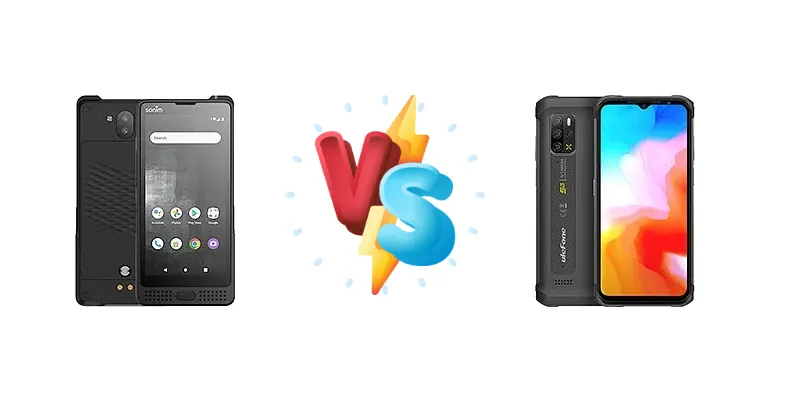
|
🏆 Quick Verdict
For users prioritizing long-term reliability and potentially easier access to Sonim’s specialized support network, the Sonim XP10 is the better choice. However, the Ulefone Armor 12 5G offers a more modern chipset and faster charging, making it appealing for those who value performance and convenience over brand reputation.
| PHONES | ||
|---|---|---|
| Phone Names | Sonim XP10 | Ulefone Armor 12 5G |
| Network | ||
|---|---|---|
| 2G bands | GSM 850 / 900 / 1800 / 1900 | GSM 850 / 900 / 1800 / 1900 |
| 3G bands | HSDPA 850 / 900 / 1700(AWS) / 1900 / 2100 | HSDPA 850 / 900 / 1700(AWS) / 1900 / 2100 |
| 4G bands | 1, 2, 3, 4, 5, 7, 8, 12, 13, 14, 20, 25, 26, 29, 30, 38, 39, 40, 41, 42, 43, 46, 48, 66, 71 | 1, 2, 3, 4, 5, 7, 8, 12, 13, 17, 18, 19, 20, 25, 26, 28, 34, 38, 39, 40, 41, 66 |
| 5G bands | 2, 5, 14, 25, 30, 41, 48, 66, 71, 77, 78 SA/NSA/Sub6 | 1, 3, 28, 38, 41, 77, 78 SA/NSA |
| Speed | HSPA, LTE, 5G | HSPA, LTE, 5G |
| Technology | GSM / HSPA / LTE / 5G | GSM / CDMA / HSPA / EVDO / LTE / 5G |
| - | CDMA2000 1xEV-DO | |
| Launch | ||
|---|---|---|
| Announced | 2022, December 02 | 2021, August 14 |
| Status | Available. Released 2023, Q1 | Available. Released 2021, August 23 |
| Body | ||
|---|---|---|
| Build | - | Front glass, aluminum back with rubber, aluminum frame |
| Dimensions | 161 x 77.5 x 16.4 mm (6.34 x 3.05 x 0.65 in) | 175.9 x 82.5 x 14.3 mm (6.93 x 3.25 x 0.56 in) |
| SIM | Nano-SIM + Nano-SIM | Nano-SIM + Nano-SIM |
| Weight | 320 g (11.29 oz) | 296 g (10.44 oz) |
| - | IP68 dust/water resistant (up to 1.5m for 30 min) Drop-to-concrete resistance from up to 1.2m MIL-STD-810G compliant | |
| Display | ||
|---|---|---|
| Protection | Corning Gorilla Glass Victus | - |
| Resolution | 1080 x 2160 pixels, 18:9 ratio (~439 ppi density) | 720 x 1560 pixels, 19.5:9 ratio (~264 ppi density) |
| Size | 5.5 inches, 78.1 cm2 (~62.6% screen-to-body ratio) | 6.52 inches, 104.4 cm2 (~71.9% screen-to-body ratio) |
| Type | IPS LCD | IPS LCD |
| Platform | ||
|---|---|---|
| CPU | Octa-core (2x2.2 GHz Cortex-A76 & 6x1.9 GHz Cortex-A55) | Octa-core (2x2.2 GHz Cortex-A76 & 6x2.0 GHz Cortex-A55) |
| Chipset | Qualcomm SM4350 Snapdragon 480 5G (8 nm) | Mediatek Dimensity 700 (7 nm) |
| GPU | Adreno 619 | Mali-G57 MC2 |
| OS | Android 12, upgradable to Android 13, up to 2 major Android upgrades | Android 11 |
| Memory | ||
|---|---|---|
| Card slot | microSDXC | microSDXC |
| Internal | 128GB 6GB RAM | 128GB 8GB RAM |
| Main Camera | ||
|---|---|---|
| Dual | 50 MP, (wide), PDAF 8 MP, (ultrawide) | - |
| Features | LED flash | Dual-LED flash, HDR, panorama |
| Quad | - | 48 MP, f/1.8, 26mm (wide), 1/2.0", 0.8µm, PDAF 8 MP, f/2.2, (ultrawide) 2 MP (macro) Auxiliary lens |
| Single | - | 16 MP, f/2.2 |
| Video | 1080p@30fps | 1440p@30fps |
| Selfie camera | ||
|---|---|---|
| Features | - | HDR, panorama |
| Single | 8 MP, (wide) | 16 MP, f/2.2 |
| Video | 1080p@30fps | 1080p@30fps |
| Sound | ||
|---|---|---|
| 3.5mm jack | - | No |
| 35mm jack | No | No |
| Loudspeaker | Yes, with stereo speakers (100dB+) | Yes, with dual speakers |
| Comms | ||
|---|---|---|
| Bluetooth | 5.1, A2DP, LE, aptX | 5.1, A2DP, LE |
| NFC | Yes | Yes |
| Positioning | GPS (L1+L5), GALILEO, GLONASS, BDS | GPS, GLONASS, GALILEO, BDS |
| Radio | Unspecified | Wireless FM radio, RDS |
| USB | USB Type-C, magnetic connector pins | USB Type-C 2.0, OTG |
| WLAN | Wi-Fi 802.11 a/b/g/n/ac/mc, dual-band | Wi-Fi 802.11 a/b/g/n/ac, Wi-Fi Direct |
| Features | ||
|---|---|---|
| Sensors | Fingerprint (front-mounted), accelerometer, gyro, proximity, compass, barometer | Fingerprint (side-mounted), accelerometer, gyro, proximity, compass, coulombmeter |
| Battery | ||
|---|---|---|
| Charging | Wireless charging | 18W wired 15W wireless |
| Type | Li-Ion 5000 mAh, removable | Li-Po 5180 mAh |
| Misc | ||
|---|---|---|
| Colors | Black | Black/Orange, Gray/Black |
| Price | About 500 EUR | About 370 EUR |
Sonim XP10
- Established brand reputation for ruggedness
- Wireless charging convenience
- Potentially better long-term software support (Sonim's focus)
- Older, less efficient Snapdragon 480 chipset
- Slower charging options (wireless only)
- Limited performance headroom
Ulefone Armor 12 5G
- More efficient MediaTek Dimensity 700 chipset
- Faster 18W wired and 15W wireless charging
- Potentially better sustained performance
- Less established brand in the rugged phone market
- Potential for less frequent software updates
- Long-term durability remains to be proven
Display Comparison
Neither device boasts a cutting-edge display. Details regarding panel type, resolution, and refresh rate are absent from the provided data, suggesting both likely utilize standard LCD panels. The focus here is on durability, not visual fidelity. However, the lack of specifics means we can't assess viewing angles or color accuracy. Bezels are likely substantial on both to contribute to the ruggedized design.
Camera Comparison
Without detailed camera specifications, a direct comparison is limited. Both phones likely feature multiple rear cameras, but the quality will heavily depend on sensor size and image processing. The absence of information suggests neither phone is positioned as a photography powerhouse. Any additional cameras beyond the main sensor are likely low-resolution macro or depth sensors, offering limited practical benefit. The Ulefone may have a slight advantage if it utilizes a larger main sensor, but this is speculative.
Performance
The core difference lies in the chipsets. The Ulefone Armor 12 5G’s MediaTek Dimensity 700, fabricated on a 7nm process, theoretically offers a slight edge in efficiency and performance compared to the Sonim XP10’s Qualcomm Snapdragon 480 5G (8nm). Both CPUs share the same core configuration (2x2.2 GHz Cortex-A76 & 6x1.9/2.0 GHz Cortex-A55), but the 7nm node of the Dimensity 700 should translate to better thermal management under sustained load. This means the Ulefone is more likely to maintain peak performance for longer periods during demanding tasks. The Snapdragon 480 is a proven performer, but the Dimensity 700 represents a generation leap in efficiency.
Battery Life
Battery capacity is not provided for either device, making a direct mAh comparison impossible. However, the charging capabilities reveal a key difference. The Ulefone Armor 12 5G supports 18W wired charging and 15W wireless charging, offering greater flexibility and potentially faster charging times. The Sonim XP10 only offers wireless charging, which, while convenient, is generally slower than wired charging. The Ulefone’s 18W wired charging will likely result in a significantly quicker 0-100% charge cycle.
Buying Guide
Buy the Sonim XP10 if you need a phone built to withstand extreme conditions and require a device backed by a brand known for its focus on industrial and public safety applications. Buy the Ulefone Armor 12 5G if you prefer a more feature-rich experience with a slightly more powerful chipset and faster charging, and are comfortable with a less established brand in the rugged phone space.