
Sonim XP10 vs Nokia XR20: A Head-to-Head Rugged Smartphone Showdown
| Phones Images | |||||
|---|---|---|---|---|---|
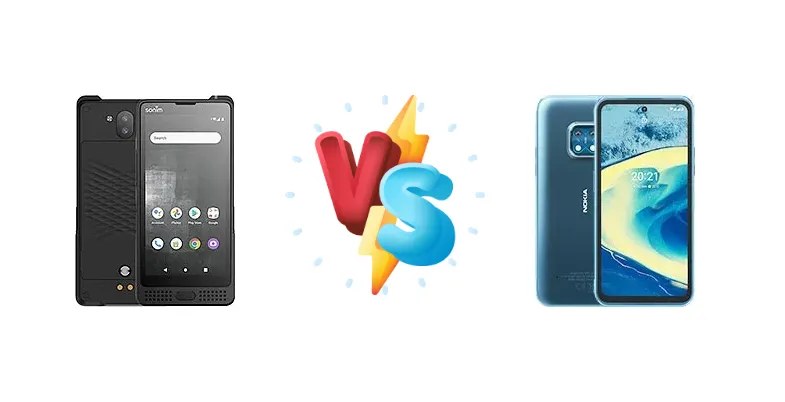
|
🏆 Quick Verdict
For users prioritizing wireless charging convenience and a slightly more refined software experience, the Nokia XR20 is the better choice. However, the Sonim XP10’s focus on extreme durability and potentially longer-term software support for enterprise clients makes it ideal for harsh work environments where reliability is paramount.
| PHONES | ||
|---|---|---|
| Phone Names | Sonim XP10 | Nokia XR20 |
| Network | ||
|---|---|---|
| 2G bands | GSM 850 / 900 / 1800 / 1900 | GSM 850 / 900 / 1800 / 1900 |
| 3G bands | HSDPA 850 / 900 / 1700(AWS) / 1900 / 2100 | HSDPA 850 / 900 / 1700(AWS) / 1900 / 2100 |
| 4G bands | 1, 2, 3, 4, 5, 7, 8, 12, 13, 14, 20, 25, 26, 29, 30, 38, 39, 40, 41, 42, 43, 46, 48, 66, 71 | 1, 2, 3, 4, 5, 7, 8, 12, 13, 14, 20, 25, 26, 28, 30, 38, 40, 41, 48, 66, 71 |
| 5G bands | 2, 5, 14, 25, 30, 41, 48, 66, 71, 77, 78 SA/NSA/Sub6 | 2, 5, 25, 38, 41, 48, 66, 77, 78 SA/NSA |
| Speed | HSPA, LTE, 5G | HSPA, LTE, 5G |
| Technology | GSM / HSPA / LTE / 5G | GSM / CDMA / HSPA / EVDO / LTE / 5G |
| - | CDMA2000 1xEV-DO | |
| Launch | ||
|---|---|---|
| Announced | 2022, December 02 | 2021, July 27 |
| Status | Available. Released 2023, Q1 | Available. Released 2021, August 04 |
| Body | ||
|---|---|---|
| Dimensions | 161 x 77.5 x 16.4 mm (6.34 x 3.05 x 0.65 in) | 171.6 x 81.5 x 10.6 mm (6.76 x 3.21 x 0.42 in) |
| SIM | Nano-SIM + Nano-SIM | · Nano-SIM· Nano-SIM + Nano-SIM |
| Weight | 320 g (11.29 oz) | 248 g (8.75 oz) |
| - | IP68 dust/water resistant (up to 1.5m for 60 min) Drop-to-concrete resistance from up to 1.8m MIL-STD-810H compliant | |
| Display | ||
|---|---|---|
| Protection | Corning Gorilla Glass Victus | Corning Gorilla Glass Victus |
| Resolution | 1080 x 2160 pixels, 18:9 ratio (~439 ppi density) | 1080 x 2400 pixels, 20:9 ratio (~395 ppi density) |
| Size | 5.5 inches, 78.1 cm2 (~62.6% screen-to-body ratio) | 6.67 inches, 107.4 cm2 (~76.8% screen-to-body ratio) |
| Type | IPS LCD | IPS LCD, 550 nits |
| Platform | ||
|---|---|---|
| CPU | Octa-core (2x2.2 GHz Cortex-A76 & 6x1.9 GHz Cortex-A55) | Octa-core (2x2.0 GHz Kryo 460 & 6x1.8 GHz Kryo 460) |
| Chipset | Qualcomm SM4350 Snapdragon 480 5G (8 nm) | Qualcomm SM4350 Snapdragon 480 5G (8 nm) |
| GPU | Adreno 619 | Adreno 619 |
| OS | Android 12, upgradable to Android 13, up to 2 major Android upgrades | Android 11, upgradable to Android 13 |
| Memory | ||
|---|---|---|
| Card slot | microSDXC | microSDXC (uses shared SIM slot) |
| Internal | 128GB 6GB RAM | 64GB 4GB RAM, 128GB 6GB RAM |
| Main Camera | ||
|---|---|---|
| Dual | 50 MP, (wide), PDAF 8 MP, (ultrawide) | 48 MP, f/1.8, (wide), 1/2.25", 0.8µm, PDAF 13 MP, f/2.4, 123˚ (ultrawide), 1/3.0", 1.12µm |
| Features | LED flash | Zeiss optics, Dual-LED dual-tone flash, second LED flash, HDR, panorama |
| Single | - | 8 MP, f/2.0 (wide), 1/4.0", 1.12µm |
| Video | 1080p@30fps | 1080p@30fps |
| Selfie camera | ||
|---|---|---|
| Single | 8 MP, (wide) | 8 MP, f/2.0 (wide), 1/4.0", 1.12µm |
| Video | 1080p@30fps | 1080p@30fps |
| Sound | ||
|---|---|---|
| 3.5mm jack | - | Yes |
| 35mm jack | No | Yes |
| Loudspeaker | Yes, with stereo speakers (100dB+) | Yes, with stereo speakers |
| Comms | ||
|---|---|---|
| Bluetooth | 5.1, A2DP, LE, aptX | 5.1, A2DP, LE, aptX Adaptive |
| NFC | Yes | Yes |
| Positioning | GPS (L1+L5), GALILEO, GLONASS, BDS | GPS (L1+L5), GLONASS, BDS, GALILEO, QZSS, NavIC |
| Radio | Unspecified | Unspecified |
| USB | USB Type-C, magnetic connector pins | USB Type-C 3.0 |
| WLAN | Wi-Fi 802.11 a/b/g/n/ac/mc, dual-band | Wi-Fi 802.11 a/b/g/n/ac/6, dual-band, Wi-Fi Direct |
| Features | ||
|---|---|---|
| Sensors | Fingerprint (front-mounted), accelerometer, gyro, proximity, compass, barometer | Fingerprint (side-mounted), accelerometer, gyro, proximity, compass, barometer |
| Battery | ||
|---|---|---|
| Charging | Wireless charging | 18W wired 15W wireless |
| Type | Li-Ion 5000 mAh, removable | Li-Po 4630 mAh |
| Misc | ||
|---|---|---|
| Colors | Black | Ultra Blue, Granite Gray |
| Models | - | TA-1368, TA-1362 |
| Price | About 500 EUR | About 270 EUR |
| SAR EU | - | 1.13 W/kg (head) 1.43 W/kg (body) |
Sonim XP10
- Potentially slightly faster CPU performance
- Wireless charging for port protection
- Focus on extreme durability and enterprise support
- Wireless charging only – slower than wired
- Limited detailed specifications available
Nokia XR20
- Wireless and 18W wired charging options
- More consumer-focused software experience
- Potentially more readily available
- Slightly lower CPU clock speeds
- May not be as robust as the Sonim XP10
Display Comparison
Neither Sonim nor Nokia provide detailed display specifications beyond the basic panel type. Given the focus on ruggedness, expect both to utilize reinforced glass. The absence of high refresh rates or OLED panels is unsurprising, prioritizing durability and battery life over visual fidelity. The real-world impact will be similar viewing experiences, with neither phone aiming for color accuracy or peak brightness found in flagship devices.
Camera Comparison
Detailed camera specifications are unavailable for either device. Given the target audience, image quality is likely a secondary concern to durability. Expect both phones to feature basic camera setups capable of capturing acceptable photos in good lighting conditions. The absence of detailed sensor information suggests neither phone will excel in low-light photography. Focusing on practical utility, both will likely prioritize quick capture and reliable operation over advanced features like high-resolution sensors or complex image processing algorithms.
Performance
Both the Sonim XP10 and Nokia XR20 are powered by the Qualcomm SM4350 Snapdragon 480 5G (8 nm) chipset. However, the CPU clock speeds differ slightly: the XP10 features a 2x2.2 GHz Cortex-A76 & 6x1.9 GHz Cortex-A55 configuration, while the XR20 has a 2x2.0 GHz Kryo 460 & 6x1.8 GHz Kryo 460 setup. This suggests a marginal performance advantage for the XP10 in CPU-intensive tasks, though the difference will likely be imperceptible in most real-world scenarios. The 8nm process node ensures reasonable thermal efficiency, but sustained heavy workloads will still lead to throttling. Both devices likely share similar RAM configurations, impacting multitasking performance more significantly than the minor CPU clock speed difference.
Battery Life
Battery capacity is not specified for either device. However, the charging capabilities highlight a key difference. The Nokia XR20 supports 18W wired charging and 15W wireless charging, offering flexibility and convenience. The Sonim XP10 only offers wireless charging, suggesting a focus on minimizing port vulnerabilities. While 15W wireless charging isn’t fast, it provides a convenient top-up option. The XR20’s 18W wired charging will likely result in faster 0-100% charge times compared to the XP10’s wireless-only approach, assuming similar battery capacities.
Buying Guide
Buy the Sonim XP10 if you need a virtually indestructible phone for demanding professional use – construction, first responders, or field service – and value long-term support and specialized accessories. Buy the Nokia XR20 if you prefer a more consumer-friendly rugged phone with a balance of durability, modern features like wireless charging, and a more approachable price point for outdoor adventures or everyday peace of mind.