
Sonim XP10 vs. Blackview BV9900E: A Deep Dive into Rugged Smartphone Performance
| Phones Images | |||||
|---|---|---|---|---|---|
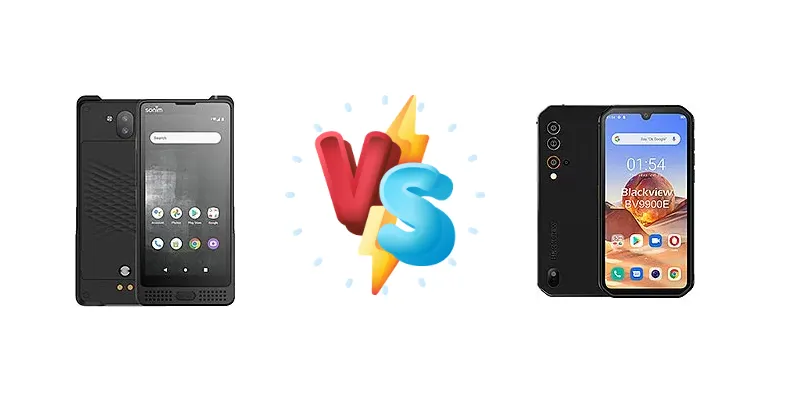
|
🏆 Quick Verdict
For users prioritizing reliable 5G connectivity and a brand known for extreme durability, the Sonim XP10 is the better choice. However, the Blackview BV9900E offers a more powerful processor for demanding tasks and faster wireless charging, making it ideal for users who value performance over network speed.
| PHONES | ||
|---|---|---|
| Phone Names | Sonim XP10 | Blackview BV9900E |
| Network | ||
|---|---|---|
| 2G bands | GSM 850 / 900 / 1800 / 1900 | GSM 850 / 900 / 1800 / 1900 |
| 3G bands | HSDPA 850 / 900 / 1700(AWS) / 1900 / 2100 | HSDPA 800 / 850 / 900 / 1700(AWS) / 1900 / 2100 |
| 4G bands | 1, 2, 3, 4, 5, 7, 8, 12, 13, 14, 20, 25, 26, 29, 30, 38, 39, 40, 41, 42, 43, 46, 48, 66, 71 | 1, 2, 3, 4, 5, 7, 8, 12, 13, 17, 18, 19, 20, 25, 26, 28, 34, 38, 39, 40, 41, 66 |
| 5G bands | 2, 5, 14, 25, 30, 41, 48, 66, 71, 77, 78 SA/NSA/Sub6 | - |
| Speed | HSPA, LTE, 5G | HSPA, LTE |
| Technology | GSM / HSPA / LTE / 5G | GSM / CDMA / HSPA / CDMA2000 / LTE |
| Launch | ||
|---|---|---|
| Announced | 2022, December 02 | 2020, September 10. Released 2020, September |
| Status | Available. Released 2023, Q1 | Discontinued |
| Body | ||
|---|---|---|
| Dimensions | 161 x 77.5 x 16.4 mm (6.34 x 3.05 x 0.65 in) | 156.5 x 78.3 x 14.2 mm (6.16 x 3.08 x 0.56 in) |
| SIM | Nano-SIM + Nano-SIM | Nano-SIM + Nano-SIM |
| Weight | 320 g (11.29 oz) | 273 g (9.63 oz) |
| Display | ||
|---|---|---|
| Protection | Corning Gorilla Glass Victus | Corning Gorilla Glass 5 |
| Resolution | 1080 x 2160 pixels, 18:9 ratio (~439 ppi density) | 1080 x 2280 pixels, 19:9 ratio (~432 ppi density) |
| Size | 5.5 inches, 78.1 cm2 (~62.6% screen-to-body ratio) | 5.84 inches, 85.1 cm2 (~69.5% screen-to-body ratio) |
| Type | IPS LCD | IPS LCD |
| Platform | ||
|---|---|---|
| CPU | Octa-core (2x2.2 GHz Cortex-A76 & 6x1.9 GHz Cortex-A55) | Octa-core (2x2.2 GHz Cortex-A75 & 6x2.0 GHz Cortex-A55) |
| Chipset | Qualcomm SM4350 Snapdragon 480 5G (8 nm) | Mediatek MT6779V/CE Helio P90 (12 nm) |
| GPU | Adreno 619 | PowerVR GM9446 |
| OS | Android 12, upgradable to Android 13, up to 2 major Android upgrades | Android 10 |
| Memory | ||
|---|---|---|
| Card slot | microSDXC | microSDXC |
| Internal | 128GB 6GB RAM | 128GB 6GB RAM |
| Main Camera | ||
|---|---|---|
| Dual | 50 MP, (wide), PDAF 8 MP, (ultrawide) | - |
| Features | LED flash | LED flash, HDR, panorama |
| Quad | - | 48 MP, f/1.8, (wide), PDAF 16 MP, 120˚ (ultrawide) 2 MP (macro) Auxiliary lens |
| Video | 1080p@30fps | 4K@30fps, 1080p@60fps |
| Selfie camera | ||
|---|---|---|
| Single | 8 MP, (wide) | 16 MP, f/2.0, (wide) |
| Video | 1080p@30fps | 1080p@30fps |
| Sound | ||
|---|---|---|
| 35mm jack | No | No |
| Loudspeaker | Yes, with stereo speakers (100dB+) | Yes |
| Comms | ||
|---|---|---|
| Bluetooth | 5.1, A2DP, LE, aptX | 5.0, A2DP, LE |
| NFC | Yes | Yes |
| Positioning | GPS (L1+L5), GALILEO, GLONASS, BDS | GPS, GLONASS, GALILEO, BDS |
| Radio | Unspecified | FM radio |
| USB | USB Type-C, magnetic connector pins | USB Type-C 2.0, OTG |
| WLAN | Wi-Fi 802.11 a/b/g/n/ac/mc, dual-band | Wi-Fi 802.11 a/b/g/n/ac |
| Features | ||
|---|---|---|
| Sensors | Fingerprint (front-mounted), accelerometer, gyro, proximity, compass, barometer | Fingerprint (side-mounted), accelerometer, gyro, proximity, compass, barometer |
| Battery | ||
|---|---|---|
| Charging | Wireless charging | 15W wired 18W wireless |
| Type | Li-Ion 5000 mAh, removable | 4380 mAh |
| Misc | ||
|---|---|---|
| Colors | Black | Black, Silver |
| Price | About 500 EUR | About 260 EUR |
Sonim XP10
- 5G Connectivity with Qualcomm's modem
- More efficient 8nm Snapdragon 480 chipset
- Wireless Charging Convenience
- Potentially lower peak CPU performance compared to the Helio P90
- Less powerful charging speeds
Blackview BV9900E
- More powerful Mediatek Helio P90 processor
- Faster 18W Wireless Charging
- Potentially lower price point
- Less efficient 12nm process
- No 5G connectivity
Display Comparison
Neither device boasts a cutting-edge display. Details are missing, but given the rugged focus, expect both to prioritize durability over peak visual fidelity. The absence of LTPO or high refresh rates is likely. Bezels will likely be substantial to protect the screen. Color accuracy will be secondary to visibility in direct sunlight.
Camera Comparison
Camera details are limited, but the focus here isn't likely on photography prowess. Both phones will likely feature a multi-camera setup, but image quality will be dictated more by software processing than sensor size. The absence of details suggests neither phone will challenge flagship camera performance. Expect the Blackview to potentially offer more features due to its more powerful processor enabling more complex image processing algorithms.
Performance
The core difference lies in the chipsets. The Sonim XP10’s Qualcomm Snapdragon 480 5G (8nm) offers a modern architecture with Cortex-A76 cores, providing a solid everyday experience and 5G capabilities. The Blackview BV9900E utilizes the older Mediatek Helio P90 (12nm). While the P90’s Cortex-A75 cores have a similar peak clock speed (2.2 GHz), the 12nm process is less efficient, potentially leading to more heat and lower sustained performance. The Snapdragon 480’s 8nm node provides better thermal efficiency, crucial for prolonged use. The Blackview's CPU may offer a slight edge in raw benchmark scores, but the Sonim's chipset benefits from Qualcomm's optimized software and 5G modem integration.
Battery Life
Battery capacity is not specified, but the charging capabilities reveal key differences. The Sonim XP10 offers wireless charging, a convenience feature often absent in this segment. The Blackview BV9900E supports 15W wired and 18W wireless charging, offering faster wireless top-ups. The Blackview’s higher wireless charging wattage is a clear advantage, but real-world battery life will depend on the actual battery capacity of each device and the efficiency of their respective chipsets. The Snapdragon 480’s 8nm process should contribute to better battery life under moderate use.
Buying Guide
Buy the Sonim XP10 if you need a phone certified to withstand harsh environments, require guaranteed 5G access for remote work or emergency services, and value a brand with a long track record in ruggedized devices. Buy the Blackview BV9900E if you prefer a phone with a more powerful processor for gaming or multitasking, appreciate faster wireless charging, and are comfortable with a less established, but rapidly improving, rugged phone brand.