
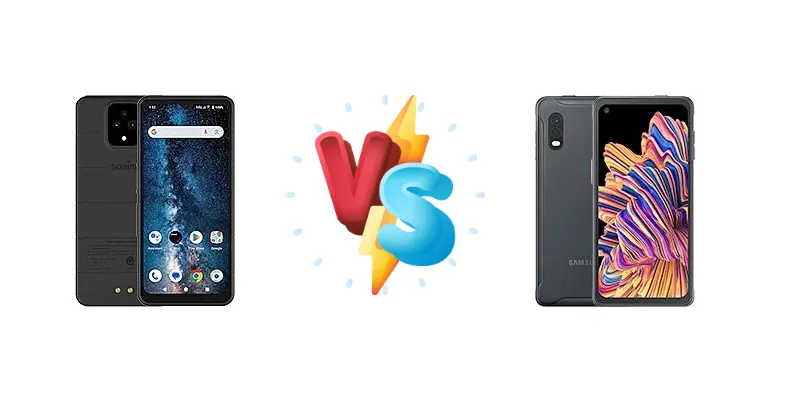
Sonim XP Pro vs. Samsung Galaxy XCover Pro: Which Rugged Phone Reigns Supreme?
| Phones Images | |||||
|---|---|---|---|---|---|
|
🏆 Quick Verdict
For users prioritizing performance and future-proofing, the Sonim XP Pro is the clear winner. Its Snapdragon 7 Gen 3 chipset offers a significant leap in processing power and efficiency over the Galaxy XCover Pro’s aging Exynos 9611. While the Samsung offers 15W wired charging, the Sonim’s wireless charging adds convenience.
| PHONES | ||
|---|---|---|
| Phone Names | Sonim XP Pro | Samsung Galaxy XCover Pro |
| Network | ||
|---|---|---|
| 2G bands | GSM 850 / 900 / 1800 / 1900 | GSM 850 / 900 / 1800 / 1900 |
| 3G bands | HSDPA 850 / 900 / 1700(AWS) / 1900 / 2100 | HSDPA 850 / 900 / 1900 / 2100 - International |
| 4G bands | 1, 2, 3, 4, 5, 7, 8, 12, 13, 14, 18, 20, 25, 26, 28, 29, 30, 38, 39, 40, 41, 42, 43, 46, 48, 66, 71 | 1, 2, 3, 5, 7, 8, 20, 28, 38, 40, 41 - International |
| 5G bands | 1, 2, 3, 5, 7, 14, 20, 25, 26, 28, 30, 38, 40, 41, 48, 66, 70, 71, 77, 78, 257, 260, 261 SA/NSA/Sub6/mmWave | - |
| Speed | HSPA, LTE, 5G | HSPA 42.2/5.76 Mbps, LTE (3CA) Cat11 600/50 Mbps |
| Technology | GSM / HSPA / LTE / 5G | GSM / HSPA / LTE |
| - | 1, 2, 3, 4, 5, 7, 12, 13, 14, 20, 29, 38, 40, 41, 66 - Canada | |
| Launch | ||
|---|---|---|
| Announced | 2024, November 21 | 2020, January |
| Status | Available. Released 2024, November 21 | Available. Released 2020, January |
| Body | ||
|---|---|---|
| Dimensions | 171 x 80 x 12 mm (6.73 x 3.15 x 0.47 in) | 159.9 x 76.7 x 10 mm (6.30 x 3.02 x 0.39 in) |
| SIM | Nano-SIM + eSIM | · Nano-SIM· Nano-SIM + Nano-SIM |
| Weight | 277 g (9.77 oz) | 218 g (7.69 oz) |
| - | IP68 dust/water resistant (up to 1.5m for 35 min) Drop-to-concrete resistance from up to 1.5m MIL-STD-810G compliant* *does not guarantee ruggedness or use in extreme conditions | |
| Display | ||
|---|---|---|
| Protection | Corning Gorilla Glass Victus 2 | Corning Gorilla Glass 5 |
| Resolution | 1080 x 2408 pixels, 20:9 ratio (~401 ppi density) | 1080 x 2340 pixels, 19.5:9 ratio (~409 ppi density) |
| Size | 6.58 inches, 104.3 cm2 (~76.2% screen-to-body ratio) | 6.3 inches, 97.4 cm2 (~79.4% screen-to-body ratio) |
| Type | IPS LCD, 90Hz | IPS LCD |
| Platform | ||
|---|---|---|
| CPU | Octa-core (1x2.63 GHz Cortex-A715 & 3x2.4 GHz Cortex-A715 & 4x1.8 GHz Cortex-A510) | Octa-core (4x2.3 GHz Cortex-A73 & 4x1.7 GHz Cortex-A53) |
| Chipset | Qualcomm SM7550-AB Snapdragon 7 Gen 3 (4 nm) | Exynos 9611 (10 nm) |
| GPU | Adreno 720 | Mali-G72 MP3 |
| OS | Android 14, up to 2 major Android upgrades | Android 10, upgradable to Android 13, One UI 5 |
| Memory | ||
|---|---|---|
| Card slot | microSDXC (dedicated slot) | microSDXC (dedicated slot) |
| Internal | 256GB 8GB RAM | 64GB 4GB RAM |
| Main Camera | ||
|---|---|---|
| Dual | - | 25 MP, f/1.7, 26mm (wide), PDAF 8 MP, f/2.2, 123˚ (ultrawide), 1/4.0", 1.12µm |
| Features | LED flash | Dual-LED flash, HDR, panorama |
| Triple | 50 MP, (wide), PDAF 13 MP, (ultrawide) 2 MP (macro) | - |
| Video | 4K@30fps, 1080p@30fps | 1080p@30fps |
| Selfie camera | ||
|---|---|---|
| Features | - | HDR |
| Single | 16 MP, (wide) | 13 MP, f/2.0, (wide), 1/3.1", 1.12µm |
| Video | 1080p@30fps | 1080p@30fps |
| Sound | ||
|---|---|---|
| 3.5mm jack | - | Yes |
| 35mm jack | No | Yes |
| Loudspeaker | Yes, with stereo speakers (100dB+) | Yes |
| Comms | ||
|---|---|---|
| Bluetooth | 5.3, A2DP, LE | 5.0, A2DP, LE |
| NFC | Yes | Yes |
| Positioning | GPS (L1+L5), GALILEO | GPS, GLONASS, GALILEO, BDS |
| Radio | Unspecified | FM radio (market/region dependent) |
| USB | USB Type-C, magnetic connector pins | USB Type-C 2.0 |
| WLAN | Wi-Fi 802.11 a/b/g/n/ac/6, dual-band | Wi-Fi 802.11 a/b/g/n/ac/k/v/r, dual-band, Wi-Fi Direct |
| Features | ||
|---|---|---|
| Sensors | Fingerprint (side-mounted), accelerometer, gyro, proximity, compass, barometer | Fingerprint (side-mounted), accelerometer, gyro, proximity, compass |
| - | ANT+ | |
| Battery | ||
|---|---|---|
| Charging | Wireless charging | 15W wired |
| Type | 5000 mAh | Li-Po 4050 mAh, removable |
| Misc | ||
|---|---|---|
| Colors | Black | Black |
| Models | - | SM-G715FN/DS, SM-G715FN, SM-G715F, SM-G715W, SM-G715U, SM-G715U1 |
| Price | About 530 EUR | About 120 EUR |
| SAR EU | - | 0.47 W/kg (head) 1.23 W/kg (body) |
Sonim XP Pro
- Significantly faster and more efficient Snapdragon 7 Gen 3 chipset
- Wireless charging for added convenience
- Potentially more durable construction due to newer design
- Likely better software support and updates
- Price is likely higher than the Samsung Galaxy XCover Pro
- Specific display details are currently unknown
Samsung Galaxy XCover Pro
- More affordable price point
- Familiar Samsung One UI software experience
- Replaceable battery (historically a Samsung XCover feature)
- Dedicated programmable keys
- Outdated Exynos 9611 chipset with limited performance
- Slow 15W wired charging only
- Potentially shorter software support lifespan
- LCD display likely offers lower visual quality
Display Comparison
Detailed display specifications are unavailable for both devices. However, given the rugged focus, both likely employ reinforced glass. The Samsung Galaxy XCover Pro has historically used LCD panels, which generally offer lower contrast ratios than the AMOLED panels increasingly common in other smartphones. The Sonim XP Pro’s display tech is unknown, but the newer chipset suggests a potentially more advanced panel. Bezels are expected to be substantial on both to contribute to drop protection. Color accuracy is likely secondary to visibility in direct sunlight for both models.
Camera Comparison
Camera details beyond sensor counts are limited. Both phones likely prioritize functionality over photographic excellence. The Samsung Galaxy XCover Pro’s camera system is known to be adequate for basic documentation, but image processing is not a strength. The Sonim XP Pro’s camera specs are less readily available, but the newer chipset suggests improved image signal processing capabilities. The presence or absence of Optical Image Stabilization (OIS) is unknown for both, but its inclusion would be a significant advantage for capturing stable images in challenging conditions. The focus should be on reliable image capture for documentation, rather than artistic photography.
Performance
The performance gap between these two devices is substantial. The Sonim XP Pro’s Qualcomm Snapdragon 7 Gen 3 (4nm) is a modern mid-range SoC, boasting an octa-core configuration with a prime Cortex-A715 core clocked at 2.63 GHz. This architecture is significantly more efficient and powerful than the Samsung Galaxy XCover Pro’s Exynos 9611 (10nm). The Exynos utilizes older Cortex-A73 cores at 2.3 GHz, resulting in lower single-core and multi-core performance. The 4nm process node of the Snapdragon allows for better thermal management, reducing throttling during sustained workloads. This translates to smoother operation of demanding applications and improved multitasking for the Sonim. The Sonim also benefits from potentially faster RAM (LPDDR5x is likely, though unconfirmed) compared to the XCover Pro.
Battery Life
Battery capacity is not specified for either device. However, the Sonim XP Pro’s more efficient Snapdragon 7 Gen 3 chipset will likely deliver superior battery life despite potentially having a similar capacity to the Galaxy XCover Pro. The Samsung is limited to 15W wired charging, which is slow by modern standards. The Sonim XP Pro offers the convenience of wireless charging, a feature absent on the Samsung. This allows for easy top-ups without needing to fumble with cables, particularly useful in environments where ports may be exposed to dust or moisture.
Buying Guide
Buy the Sonim XP Pro if you need a phone that can withstand truly punishing conditions and demands consistent performance for data-intensive tasks like remote diagnostics or field mapping. Its modern chipset ensures longevity and responsiveness. Buy the Samsung Galaxy XCover Pro if you prefer a more affordable option with a familiar Samsung interface and are willing to compromise on raw processing power and charging convenience for a lower upfront cost. It’s a solid choice for basic communication and task management in less extreme environments.