
Sonim XP Pro Thermal vs. Blackview BV9800 Pro: A Rugged Reliability Face-Off
| Phones Images | |||||
|---|---|---|---|---|---|
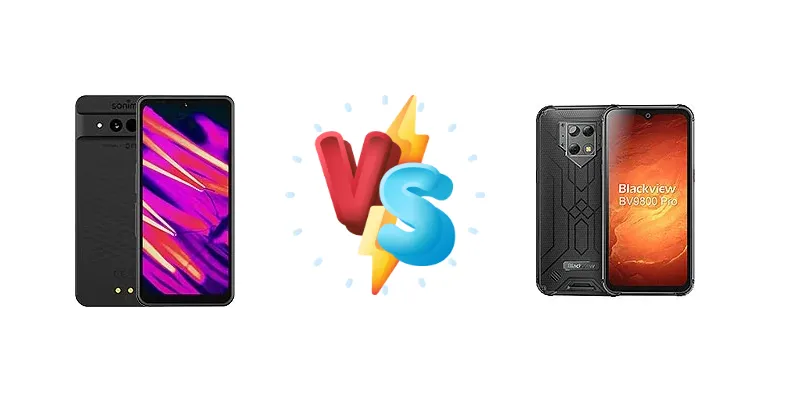
|
🏆 Quick Verdict
For users prioritizing performance and longevity, the Sonim XP Pro Thermal is the clear winner. Its Snapdragon 7 Gen 3 chipset and 41:21h battery endurance significantly outperform the Blackview BV9800 Pro’s older Helio P70. However, the BV9800 Pro remains a viable option for budget-conscious buyers needing basic rugged functionality.
| PHONES | ||
|---|---|---|
| Phone Names | Sonim XP Pro Thermal | Blackview BV9800 Pro |
| Network | ||
|---|---|---|
| 2G bands | GSM 850 / 900 / 1800 / 1900 | GSM 850 / 900 / 1800 / 1900 |
| 3G bands | HSDPA 850 / 900 / 1700(AWS) / 1900 / 2100 | HSDPA 800 / 850 / 900 / 1700(AWS) / 1900 / 2100 |
| 4G bands | 1, 2, 3, 4, 5, 7, 8, 12, 13, 14, 18, 20, 25, 26, 28, 29, 30, 38, 39, 40, 41, 42, 43, 46, 48, 66, 68, 71 | 1, 2, 3, 4, 5, 6, 7, 8, 12, 13, 17, 18, 19, 20, 25, 26, 28, 34, 38, 39, 40, 41, 66 |
| 5G bands | 1, 2, 3, 5, 7, 14, 20, 25, 26, 28, 30, 38, 40, 41, 48, 66, 70, 71, 77, 78 SA/NSA/Sub6/mmWave | - |
| Speed | HSPA, LTE, 5G | HSPA, LTE |
| Technology | GSM / HSPA / LTE / 5G | GSM / CDMA / HSPA / CDMA2000 / LTE |
| Launch | ||
|---|---|---|
| Announced | 2025, February 27 | 2019, October 28. Released 2019, November |
| Status | Available. Released 2025, July 24 | Discontinued |
| Body | ||
|---|---|---|
| Dimensions | 171.5 x 80 x 11.5 mm (6.75 x 3.15 x 0.45 in) | 168.5 x 81 x 14.8 mm (6.63 x 3.19 x 0.58 in) |
| SIM | Nano-SIM | Nano-SIM + Nano-SIM |
| Weight | 267 g (9.42 oz) | 322 g (11.36 oz) |
| Display | ||
|---|---|---|
| Protection | Corning Gorilla Glass Victus 2, Mohs level 5 | - |
| Resolution | 1080 x 2408 pixels, 20:9 ratio (~401 ppi density) | 1080 x 2340 pixels, 19.5:9 ratio (~409 ppi density) |
| Size | 6.58 inches, 104.3 cm2 (~76.0% screen-to-body ratio) | 6.3 inches, 97.4 cm2 (~71.4% screen-to-body ratio) |
| Type | IPS LCD, 90Hz | IPS LCD |
| Platform | ||
|---|---|---|
| CPU | Octa-core (1x2.63 GHz Cortex-A715 & 3x2.4 GHz Cortex-A715 & 4x1.8 GHz Cortex-A510) | Octa-core (4x2.1 GHz Cortex-A73 & 4x2.0 GHz Cortex-A53) |
| Chipset | Qualcomm SM7550-AB Snapdragon 7 Gen 3 (4 nm) | Mediatek MT6771V/CT Helio P70 (12 nm) |
| GPU | Adreno 720 | Mali-G72 MP3 |
| OS | Android 14, up to 2 major Android upgrades | Android 9.0 (Pie) |
| Memory | ||
|---|---|---|
| Card slot | microSDXC (dedicated slot) | microSDXC |
| Internal | 256GB 8GB RAM | 128GB 6GB RAM |
| Main Camera | ||
|---|---|---|
| Dual | 50 MP, (wide), PDAF FLIR thermal camera (Lepton 3.5 module) | - |
| Features | LED flash | Thermal imaging, LED flash |
| Triple | - | 48 MP, (wide), PDAF 5 MP, thermal assisted camera FLIR thermal camera (Lepton module) |
| Video | 4K@30fps, 1080p@30fps | 1080p@30fps |
| Selfie camera | ||
|---|---|---|
| Single | 16 MP, (wide) | 16 MP, f/2.0, (wide) |
| Video | 1080p@30fps | 1080p@30fps |
| Sound | ||
|---|---|---|
| 35mm jack | No | Yes |
| Loudspeaker | Yes, with stereo speakers (100dB+) | Yes |
| Comms | ||
|---|---|---|
| Bluetooth | 5.3, A2DP, LE | 4.1, A2DP |
| NFC | Yes | Yes |
| Positioning | GPS (L1+L5), GALILEO | GPS, GLONASS, GALILEO |
| Radio | Unspecified | FM radio |
| USB | USB Type-C, magnetic connector pins | USB Type-C 2.0, OTG |
| WLAN | Wi-Fi 802.11 a/b/g/n/ac/6, tri-band | Wi-Fi 802.11 a/b/g/n/ac |
| Features | ||
|---|---|---|
| Sensors | Fingerprint (side-mounted), accelerometer, gyro, proximity, compass, barometer | Fingerprint (side-mounted), accelerometer, gyro, proximity, compass, barometer |
| Battery | ||
|---|---|---|
| Charging | Wireless charging | 18W wired |
| Type | 5000 mAh | 6580 mAh |
| Misc | ||
|---|---|---|
| Colors | Black | Black, Orange |
| Models | X802 | - |
| Price | € 799.00 | About 340 EUR |
| EU LABEL | ||
|---|---|---|
| Battery | 41:21h endurance, 1000 cycles | - |
| Energy | Class C | - |
| Free fall | Class A (300 falls) | - |
| Repairability | Class C | - |
Sonim XP Pro Thermal
- Modern Snapdragon 7 Gen 3 chipset delivers superior performance.
- Exceptional 41:21h battery endurance for all-day use.
- Integrated thermal imaging camera adds unique functionality.
- Price point is likely higher than the Blackview BV9800 Pro.
- Specific display details are currently unavailable.
Blackview BV9800 Pro
- More affordable price point.
- Rugged design provides basic durability.
- Acceptable performance for basic tasks.
- Outdated Helio P70 chipset limits performance and efficiency.
- Shorter battery life compared to the Sonim XP Pro Thermal.
- Limited software support and future updates.
Display Comparison
Display specifications are not provided for either device. However, given Sonim’s focus on usability in bright conditions, we can infer a display optimized for outdoor visibility. The BV9800 Pro, being older, likely utilizes an LCD panel. The lack of information prevents a detailed comparison of resolution, refresh rate, or color accuracy, but the Sonim likely benefits from newer display technology.
Camera Comparison
Camera details are limited. We can assume both phones feature multiple rear cameras, but the quality will vary significantly. The Sonim’s inclusion of thermal imaging is a unique selling point, providing utility beyond standard photography. The BV9800 Pro likely relies on software processing to enhance image quality, but its older chipset will limit the effectiveness of these algorithms. Without sensor size or aperture information, a direct comparison is difficult, but the Sonim’s thermal camera provides a distinct advantage for specific use cases.
Performance
The performance gap is substantial. The Sonim XP Pro Thermal’s Qualcomm Snapdragon 7 Gen 3 (4nm) is a modern mid-range powerhouse, featuring an octa-core CPU with a prime Cortex-A715 core clocked at 2.63 GHz. This contrasts sharply with the Blackview BV9800 Pro’s MediaTek Helio P70 (12nm), an older chipset with a Cortex-A73 based CPU peaking at 2.1 GHz. The 4nm process node of the Snapdragon offers significantly improved power efficiency and thermal performance, translating to sustained performance under load. The Sonim will handle multitasking, demanding apps, and future software updates with ease, while the BV9800 Pro will likely show its age more quickly.
Battery Life
Battery life is a key differentiator. The Sonim XP Pro Thermal boasts an impressive 41:21h endurance, suggesting a large battery capacity optimized by the efficient Snapdragon 7 Gen 3. The Blackview BV9800 Pro lacks this endurance data, but its older chipset and larger process node suggest lower efficiency. Furthermore, the Sonim supports wireless charging, a convenience absent on the BV9800 Pro, which is limited to 18W wired charging. The Sonim’s 1000 charge cycle rating also indicates a longer lifespan.
Buying Guide
Buy the Sonim XP Pro Thermal if you need a modern, powerful rugged phone with long-term software support and the added utility of thermal imaging. This is ideal for field workers, inspectors, or anyone requiring reliable performance in harsh conditions. Buy the Blackview BV9800 Pro if you prioritize affordability and a rugged build over cutting-edge performance. It’s a good choice for occasional outdoor use or as a durable backup device.