
Sonim XP Pro E vs. Ulefone Armor 10 5G: A Deep Dive into Rugged Smartphone Performance
| Phones Images | |||||
|---|---|---|---|---|---|
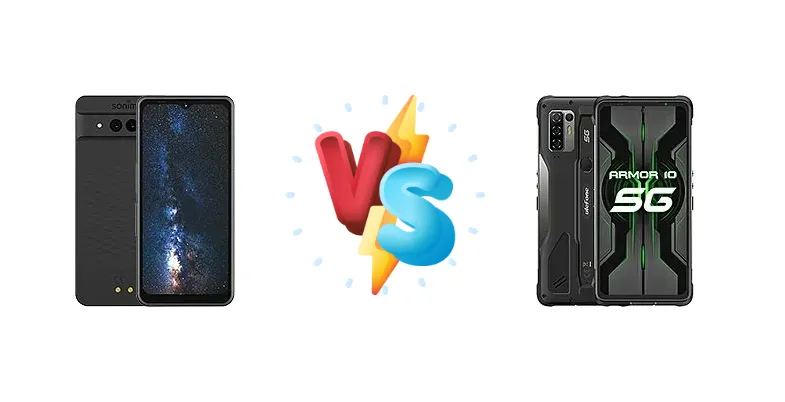
|
🏆 Quick Verdict
For the average user prioritizing sustained performance and longevity, the Sonim XP Pro E is the superior choice. Its Snapdragon 7 Gen 3 chipset, built on a 4nm process, offers a substantial advantage in processing power and efficiency over the Ulefone's older Dimensity 800, despite the Ulefone offering 5G connectivity.
| PHONES | ||
|---|---|---|
| Phone Names | Sonim XP Pro E | Ulefone Armor 10 5G |
| Network | ||
|---|---|---|
| 2G bands | GSM 850 / 900 / 1800 / 1900 | GSM 850 / 900 / 1800 / 1900 |
| 3G bands | HSDPA 850 / 900 / 1700(AWS) / 1900 / 2100 | HSDPA 850 / 900 / 1700(AWS) / 1900 / 2100 |
| 4G bands | 1, 2, 3, 4, 5, 7, 8, 12, 13, 14, 18, 20, 25, 26, 28, 29, 30, 38, 39, 40, 41, 42, 43, 46, 48, 66, 68, 71 | 1, 2, 3, 4, 5, 7, 8, 12, 13, 17, 18, 19, 20, 25, 26, 28, 34, 38, 39, 40, 41, 66 |
| 5G bands | 1, 2, 3, 5, 7, 14, 20, 25, 26, 28, 30, 38, 40, 41, 48, 66, 70, 71, 77, 78 SA/NSA/Sub6/mmWave | 1, 3, 41, 77, 78, 79 SA/NSA |
| Speed | HSPA, LTE, 5G | HSPA, LTE, 5G |
| Technology | GSM / HSPA / LTE / 5G | GSM / CDMA / HSPA / EVDO / LTE / 5G |
| - | CDMA2000 1xEV-DO | |
| Launch | ||
|---|---|---|
| Announced | 2025, July 09 | 2020, November 17. Released 2020, December 07 |
| Status | Available. Released 2025, October | Discontinued |
| Body | ||
|---|---|---|
| Build | - | Front glass, aluminum back with rubber, aluminum frame |
| Dimensions | 171.5 x 80 x 11.5 mm (6.75 x 3.15 x 0.45 in) | 176.5 x 82.8 x 14.6 mm (6.95 x 3.26 x 0.57 in) |
| SIM | Nano-SIM | Nano-SIM + Nano-SIM |
| Weight | 267 g (9.42 oz) | 328 g (11.57 oz) |
| - | IP68 dust/water resistant (up to 1.5m for 30 min) Drop-to-concrete resistance from up to 1.2m MIL-STD-810G compliant | |
| Display | ||
|---|---|---|
| Protection | Corning Gorilla Glass Victus 2, Mohs level 5 | Scratch-resistant glass, oleophobic coating |
| Resolution | 1080 x 2408 pixels, 20:9 ratio (~401 ppi density) | 1080 x 2400 pixels, 20:9 ratio (~395 ppi density) |
| Size | 6.58 inches, 104.3 cm2 (~76.0% screen-to-body ratio) | 6.67 inches, 107.4 cm2 (~73.5% screen-to-body ratio) |
| Type | IPS LCD, 90Hz | IPS LCD |
| Platform | ||
|---|---|---|
| CPU | Octa-core (1x2.63 GHz Cortex-A715 & 3x2.4 GHz Cortex-A715 & 4x1.8 GHz Cortex-A510) | Octa-core (4x2.0 GHz Cortex-A76 & 4x2.0 GHz Cortex-A55) |
| Chipset | Qualcomm SM7550-AB Snapdragon 7 Gen 3 (4 nm) | Mediatek Dimensity 800 (7 nm) |
| GPU | Adreno 720 | Mali-G57 MP4 |
| OS | Android 14, up to 2 major Android upgrades | Android 10, planned upgrade to Android 11 |
| Memory | ||
|---|---|---|
| Card slot | microSDXC (dedicated slot) | microSDXC (uses shared SIM slot) |
| Internal | 256GB 8GB RAM | 128GB 8GB RAM |
| Main Camera | ||
|---|---|---|
| Dual | 50 MP, (wide), PDAF 13 MP, (ultrawide) | - |
| Features | LED flash | LED flash, Panorama, HDR |
| Quad | - | 64 MP, f/1.9, 26mm (wide), 1/1.72", 0.8µm, PDAF 8 MP, f/2.2, 119˚ (ultrawide) 5 MP (macro) Auxiliary lens |
| Video | 4K@30fps, 1080p@30fps | 4K@30fps, 1080p@30fps |
| Selfie camera | ||
|---|---|---|
| Single | 16 MP, (wide) | 16 MP, f/2.2 |
| Video | 1080p@30fps | 1080p@30fps |
| Sound | ||
|---|---|---|
| 3.5mm jack | - | Yes |
| 35mm jack | No | Yes |
| Loudspeaker | Yes, with stereo speakers (100dB+) | Yes |
| Comms | ||
|---|---|---|
| Bluetooth | 5.3, A2DP, LE | 5.2, A2DP, LE |
| NFC | Yes | Yes |
| Positioning | GPS (L1+L5), GALILEO | GPS, GLONASS, GALILEO, BDS |
| Radio | Unspecified | FM radio, RDS, recording |
| USB | USB Type-C, magnetic connector pins | USB Type-C 2.0, OTG |
| WLAN | Wi-Fi 802.11 a/b/g/n/ac/6, tri-band | Wi-Fi 802.11 a/b/g/n/ac, Wi-Fi Direct |
| Features | ||
|---|---|---|
| Sensors | Fingerprint (side-mounted), accelerometer, gyro, proximity, compass, barometer | Fingerprint (side-mounted), accelerometer, gyro, proximity, compass, baroceptor, coulombmeter |
| Battery | ||
|---|---|---|
| Charging | Wireless charging | 15W wired 15W wireless |
| Type | 5000 mAh | Li-Po 5800 mAh |
| Misc | ||
|---|---|---|
| Colors | Black | Black |
| Models | X802 | - |
| Price | About 670 EUR | About 420 EUR |
| EU LABEL | ||
|---|---|---|
| Battery | 41:21h endurance, 1000 cycles | - |
| Energy | Class C | - |
| Free fall | Class A (300 falls) | - |
| Repairability | Class C | - |
Sonim XP Pro E
- Superior chipset performance with Snapdragon 7 Gen 3
- Excellent battery endurance (41:21h)
- Long battery lifespan (1000 charge cycles)
- Wireless charging support
- Potentially higher price point
- 5G connectivity not explicitly stated (may be absent)
Ulefone Armor 10 5G
- 5G connectivity
- More affordable price point
- Wireless charging support
- Rugged design
- Less powerful chipset (Dimensity 800)
- Shorter battery life expected
- Slower charging speeds (15W)
Display Comparison
Neither device's display specifications are provided, so a direct comparison is limited. However, given Sonim's focus on professional use, it's likely the XP Pro E prioritizes outdoor visibility with a higher peak brightness. The Ulefone, being a more consumer-focused device, may lean towards color accuracy. The absence of details like refresh rate or resolution makes a definitive statement impossible, but the Sonim's target audience suggests a focus on practicality over visual fidelity.
Camera Comparison
Without detailed camera specifications, a thorough comparison is challenging. However, rugged phones often prioritize durability over camera quality. It's reasonable to assume both devices feature capable cameras for basic documentation, but neither is likely to compete with flagship smartphone photography. The absence of information regarding sensor size, aperture, or optical image stabilization (OIS) prevents a deeper analysis. The Ulefone may attempt to compensate with software processing, but the Sonim’s more powerful chipset could provide an edge in image processing speed.
Performance
The core difference lies in the chipsets. The Sonim XP Pro E’s Snapdragon 7 Gen 3 (4nm) is a significant leap forward compared to the Ulefone Armor 10 5G’s MediaTek Dimensity 800 (7nm). The 4nm fabrication process inherently provides better power efficiency and thermal management, meaning the Sonim will likely experience less throttling under sustained load. The Snapdragon 7 Gen 3’s CPU architecture – a mix of Cortex-A715 and A510 cores – is also more modern and efficient than the Dimensity 800’s Cortex-A76 and A55 configuration. This translates to faster application loading, smoother multitasking, and improved gaming performance for the Sonim.
Battery Life
The Sonim XP Pro E boasts an impressive 41:21h endurance rating, suggesting excellent battery optimization. While the Ulefone’s battery capacity isn’t specified, the Dimensity 800’s less efficient 7nm process will likely result in shorter battery life. The Sonim also supports wireless charging, a convenience absent from the Ulefone’s slower 15W wired and wireless charging. Furthermore, the Sonim’s battery is rated for 1000 charge cycles, indicating a longer lifespan and sustained capacity over time – a critical feature for users relying on the device for extended periods.
Buying Guide
Buy the Sonim XP Pro E if you need a workhorse device capable of handling demanding applications and prolonged use in harsh environments, and value long-term battery health with its 1000 cycle lifespan. Buy the Ulefone Armor 10 5G if you prioritize 5G connectivity on a budget and are willing to compromise on raw processing power and sustained performance, accepting slower charging speeds and potentially shorter battery lifespan.