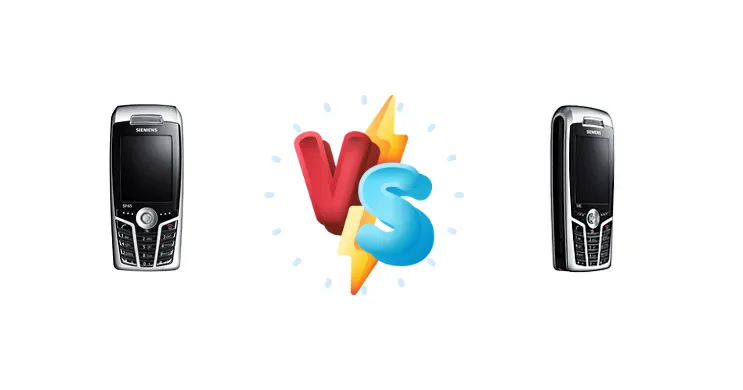
The Siemens SP65 and S65 represent a pivotal era in mobile phone design – the transition from basic handsets to feature-rich devices. Both phones were popular in the early 2000s, but catered to slightly different user preferences. This comparison delves into their nuances, examining design choices and available features to understand their individual appeal and lasting legacy.
🏆 Quick Verdict
For the collector prioritizing a more robust build and potentially wider accessory availability, the Siemens SP65 is the better choice. However, the S65’s slightly more compact form factor and potentially lower price point on the used market make it appealing for those seeking a more pocketable classic.
| Network |
|---|
| 2G bands | GSM 900 / 1800 / 1900 | GSM 900 / 1800 / 1900 |
| EDGE | No | No |
| GPRS | Class 10 | Class 10 |
| Technology | GSM | GSM |
| Launch |
|---|
| Announced | 2005, March | 2004, March |
| Status | Discontinued | Discontinued |
| Body |
|---|
| Dimensions | 109 x 48 x 18 mm, 85 cc (4.29 x 1.89 x 0.71 in) | 109 x 48 x 18 mm, 85 cc (4.29 x 1.89 x 0.71 in) |
| SIM | Mini-SIM | Mini-SIM |
| Weight | 98 g (3.46 oz) | 98 g (3.46 oz) |
| Display |
|---|
| Resolution | 132 x 176 pixels, 9 lines, 4:3 ratio (~105 ppi density) | 132 x 176 pixels, 9 lines, 4:3 ratio (~105 ppi density) |
| Size | 2.1 inches, 32 x 42 mm, 13.7 cm2 (~26.1% screen-to-body ratio) | 2.1 inches, 32 x 42 mm, 13.7 cm2 (~26.1% screen-to-body ratio) |
| Type | TFT, 65K colors | TFT, 65K colors |
| | Download assistant for logos | Download assistant for logos |
| Memory |
|---|
| Call records | 100 dialed, 100 received, 100 missed calls | 100 dialed, 100 received, 100 missed calls |
| Card slot | RS-MMC | RS-MMC, 32 MB included |
| Internal | - | 11MB |
| Phonebook | 1000 x 20 fields | 1000 x 20 fields |
| Main Camera |
|---|
| Single | - | 1.3 MP |
| Video | - | Yes |
| Sound |
|---|
| 3.5mm jack | No | No |
| 35mm jack | No | No |
| Alert types | Vibration; Downloadable polyphonic ringtones | Vibration; Downloadable polyphonic ringtones |
| Loudspeaker | Yes | Yes |
| Comms |
|---|
| Bluetooth | 1.2 | 1.2 |
| Infrared port | Yes | Yes |
| Positioning | No | No |
| Radio | No | No |
| USB | Proprietary | Proprietary |
| WLAN | No | No |
| Features |
|---|
| Browser | WAP 2.0/xHTML | WAP 2.0/xHTML |
| Games | Yes + downloadable | Yes + downloadable |
| Java | Yes, MIDP 2.0 | Yes, MIDP 2.0 |
| Messaging | SMS, EMS, MMS, Email, Instant messaging | SMS, EMS, MMS, Email, Instant messaging |
| | Predictive text input
Organizer
Stopwatch
Reminder list
Voice memo
SyncML | Predictive text input
Organizer
Stopwatch
Voice memo
SyncML |
| Battery |
|---|
| Stand-by | Up to 250 h | Up to 250 h |
| Talk time | Up to 5 h | Up to 5 h |
| Type | Removable Li-Ion 750 mAh battery | Removable Li-Ion 750 mAh battery (EBA-660) |
| Misc |
|---|
| Colors | Steel black, Bordeaux | Steel Black |
Siemens SP65
- Potentially more durable build quality due to larger size.
- Likely wider availability of aftermarket accessories.
- May have slightly better thermal management.
- Larger and heavier than the S65.
- Potentially less pocketable.
Siemens S65
- More compact and lightweight design.
- Potentially lower acquisition cost on the used market.
- Slightly more streamlined aesthetic.
- Potentially less durable build quality.
- Fewer aftermarket accessories available.
Display Comparison
Both the SP65 and S65 feature monochrome LCD screens, typical for the era. While exact resolutions are difficult to ascertain, the SP65’s slightly larger overall size suggests a potentially marginally larger display area. However, the impact on usability is minimal given the limited functionality of the time. Both screens prioritize legibility over vibrant color reproduction, focusing on clear text display for SMS messages and basic menu navigation. Bezels were substantial on both models, dictated by the technology and design trends of the early 2000s.
Camera Comparison
Neither the SP65 nor the S65 features a built-in camera. This was common for phones in this price segment and era. The absence of a camera simplifies the design and reduces the overall cost. Users relied on separate digital cameras for image capture, a standard practice at the time.
Performance
Performance, in the context of these phones, refers to responsiveness of the user interface and speed of basic functions like making calls and sending SMS. Both phones utilize similar Siemens proprietary chipsets. The SP65, being slightly larger, *may* have benefited from slightly better thermal dissipation, potentially leading to marginally more consistent performance during extended use, though this is speculative. RAM capacity was limited on both devices, sufficient only for the basic tasks they were designed for. The user experience will be largely identical in terms of speed.
Battery Life
Both phones utilize NiMH (Nickel-Metal Hydride) batteries. Battery life was a key selling point for both models, typically offering several days of standby time and several hours of talk time. The SP65, with its larger size, *may* have accommodated a slightly larger battery capacity, potentially extending its usable life between charges. However, battery degradation over time is a significant factor for these vintage devices, and actual performance will vary greatly depending on the battery’s condition.
Buying Guide
Buy the Siemens SP65 if you value a more substantial feel in the hand, a potentially wider range of aftermarket accessories (given its slightly higher initial popularity), and a phone that feels built to last. Buy the Siemens S65 if you prioritize a more compact and lightweight device, potentially at a lower acquisition cost, and prefer a slightly more streamlined aesthetic.
Frequently Asked Questions
❓ Are replacement batteries readily available for either the SP65 or S65?
Finding original replacement batteries can be challenging. Third-party batteries are available, but quality can vary significantly. It's crucial to research the seller and read reviews before purchasing a replacement battery to ensure compatibility and safety.
❓ What type of SIM card do the Siemens SP65 and S65 use?
Both phones utilize a standard-size SIM card, the type commonly used before the advent of micro and nano SIMs. Adapters are available if you need to use a smaller SIM card, but ensure a secure fit to avoid connectivity issues.
❓ Is it possible to unlock either the SP65 or S65 if it's carrier-locked?
Unlocking these phones can be difficult, as unlocking services for older Siemens models are scarce. Some specialized mobile phone repair shops may offer unlocking services, but success is not guaranteed. It's important to verify the legitimacy of any unlocking service before providing your phone.