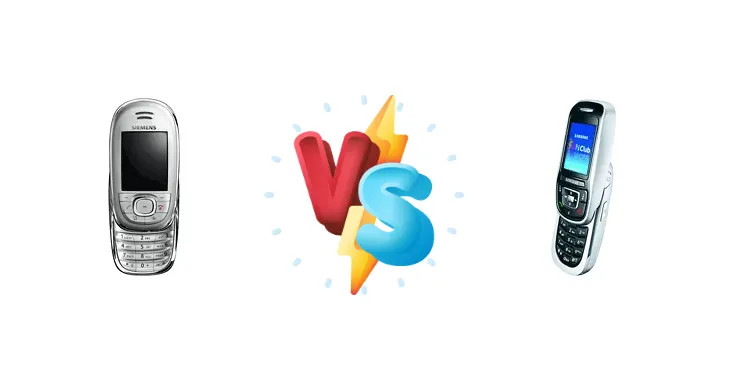
Before smartphones dominated our pockets, Siemens and Samsung were fierce competitors in the feature phone market. The Siemens SL75, known for its slider design and advanced (for the time) features, clashed with the Samsung E350, a more mainstream and affordable option. This comparison revisits these iconic devices, analyzing their strengths and weaknesses in the context of their era.
🏆 Quick Verdict
For the collector prioritizing design and a premium feel, the Siemens SL75 is the winner. However, the Samsung E350’s broader availability, simpler interface, and likely lower price point made it the more practical choice for the average user in the early 2000s.
| Network |
|---|
| 2G bands | GSM 900 / 1800 / 1900 | GSM 900 / 1800 / 1900 |
| EDGE | Yes | No |
| GPRS | Class 10 | Class 10 |
| Technology | GSM | GSM |
| Launch |
|---|
| Announced | 2005, Q2 | 2005, Q1 |
| Status | Discontinued | Discontinued |
| Body |
|---|
| Dimensions | 92 x 48 x 23 mm, 78 cc (3.62 x 1.89 x 0.91 in) | 85 x 43 x 21 mm (3.35 x 1.69 x 0.83 in) |
| SIM | Mini-SIM | Mini-SIM |
| Weight | 99 g (3.49 oz) | 78 g (2.75 oz) |
| Display |
|---|
| Resolution | 132 x 176 pixels, 4:3 ratio | 128 x 160 pixels (~128 ppi density) |
| Size | - | 1.6 inches, 8.1 cm2 (~22.0% screen-to-body ratio) |
| Type | TFT, 256K colors | TFT, 65K colors |
| Memory |
|---|
| Call records | 100 dialed, 100 received, 100 missed calls | 20 dialed, 20 received, 20 missed calls |
| Card slot | No | No |
| Internal | 52MB | 40MB |
| Phonebook | 1000 x 23 fields, Photo call | 1000 x 10 fields, Photo call |
| | - | 4 MB for Java apps
200 short messages |
| Main Camera |
|---|
| Features | LED flash | LED flash |
| Single | 1.3 MP | VGA |
| Video | Yes | Yes |
| Sound |
|---|
| 3.5mm jack | No | No |
| 35mm jack | No | No |
| Alert types | Vibration; Downloadable polyphonic, MP3, AAC ringtones | Vibration; Downloadable polyphonic ringtones |
| Loudspeaker | No | Yes |
| Comms |
|---|
| Bluetooth | 1.2 | No |
| Infrared port | - | Yes |
| Positioning | No | No |
| Radio | No | No |
| USB | Proprietary | Proprietary |
| WLAN | No | No |
| Features |
|---|
| Browser | WAP 2.0/xHTML | WAP 2.0/xHTML |
| Games | SeaBattle, Wappo 2, Golf + downloadable | 3 + downloadable |
| Java | Yes, MIDP 2.0 | Yes, MIDP 2.0 |
| Messaging | SMS, MMS, Email, Instant Messaging | SMS, MMS, Email |
| | MP3/AAC/MP4 player
Predictive text input
Organizer
Voice memo | MP3/AAC+/MP4 player
Predictive text input
Organizer
SyncML
Voice memo |
| Battery |
|---|
| Stand-by | Up to 300 h | Up to 220 h |
| Talk time | Up to 5 h | Up to 3 h |
| Type | Removable Li-Ion 700 mAh battery | Removable Li-Ion 800 mAh battery |
| Misc |
|---|
| Colors | Pure Silver, Polar White, Onyx Black | Metallic Silver, Black, White |
| SAR EU | - | 0.47 W/kg (head) |
Siemens SL75
- Unique and stylish slider design
- Potentially more advanced software features (Siemens' focus)
- Premium build quality (likely)
- Slider mechanism introduces potential failure point
- Potentially higher price point
- Potentially slower performance due to complex software
Samsung E350
- Affordable and widely available
- Simple and easy-to-use interface
- Reliable candybar design
- Less distinctive design
- Fewer advanced features
- Potentially lower build quality
Display Comparison
Given the era, both the Siemens SL75 and Samsung E350 featured small, low-resolution color LCD screens. The SL75 likely benefited from a slightly larger display area due to its slider form factor, potentially offering a marginally better viewing experience for text and basic graphics. However, neither device offered any advanced display technology like transflective or high-contrast ratios; both were limited by the constraints of early 2000s mobile display tech. The SL75’s slider mechanism, while visually appealing, introduced a potential point of failure not present in the E350’s simpler candybar design.
Camera Comparison
Both the Siemens SL75 and Samsung E350 likely included basic VGA (0.3MP) cameras, a novelty at the time. Image quality would have been extremely limited, suitable only for very small prints or MMS messaging. The E350, being a more mainstream device, may have had slightly better software optimization for its camera, but the fundamental limitations of the sensor and lens would have been the primary constraint. Neither phone offered features like autofocus or flash.
Performance
Performance in these devices isn't about GHz or RAM; it's about the efficiency of the firmware and the responsiveness of the user interface. Siemens, historically, focused on more complex software features, meaning the SL75’s processor likely had more to handle than the E350’s. This could translate to slightly slower menu navigation on the SL75, despite potentially having a similar processor architecture. Both phones relied on 2G networks, limiting data speeds to GPRS, making web browsing a slow and cumbersome experience on both.
Battery Life
Battery life was a key selling point for feature phones. Both the SL75 and E350 likely offered several days of standby time and a reasonable amount of talk time. The SL75’s slider mechanism and potentially more power-hungry features might have resulted in slightly shorter battery life compared to the E350. However, the difference would likely have been marginal, as both devices were designed for efficient power consumption.
Buying Guide
Buy the Siemens SL75 if you value a distinctive, slider-based design and are interested in a phone that represented a more aspirational, technologically advanced image. Buy the Samsung E350 if you prioritize affordability, ease of use, and a reliable, widely-supported device for basic communication and limited multimedia.
Frequently Asked Questions
❓ Was the Siemens SL75 considered a luxury phone at the time?
Yes, the Siemens SL75 was positioned as a more premium device compared to many of its competitors. Its slider design, advanced features (for the era), and likely higher price point contributed to its luxury image. It appealed to users who wanted a phone that stood out from the crowd.
❓ Did the Samsung E350 have any standout features beyond its affordability?
The Samsung E350 focused on reliability and ease of use. It offered a straightforward interface, solid build quality for its price range, and good battery life. While it lacked the flashy features of the SL75, it excelled at the core functions of a feature phone: making calls and sending texts.
❓ Are replacement parts readily available for either of these phones today?
Replacement parts for both the Siemens SL75 and Samsung E350 are extremely difficult to find. Both phones are quite old, and manufacturers no longer support them. Collectors and enthusiasts may occasionally find parts on online auction sites, but availability is limited and prices can be high.