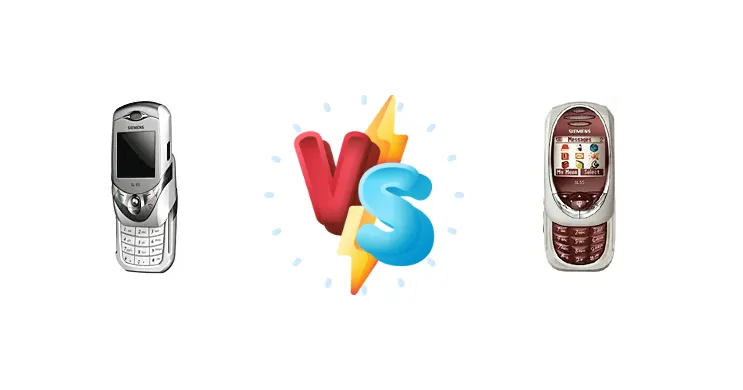
The Siemens SL65 and SL55 represent a pivotal moment in mobile phone evolution – the rise of the slider phone. Released in the early 2000s, these devices aimed to bridge the gap between compact form factors and larger, more usable displays. This comparison revisits these phones, analyzing their design choices and features within the context of their era.
🏆 Quick Verdict
For the average user seeking a piece of mobile history, the Siemens SL55 likely offers a slightly more refined experience due to its potentially more robust build quality and wider availability. However, both phones are valuable collectibles, and the SL65’s rarity may appeal to dedicated enthusiasts.
| Network |
|---|
| 2G bands | GSM 900 / 1800 / 1900 | GSM 900 / 1800 / 1900 |
| EDGE | No | No |
| GPRS | Class 10 | Class 8 |
| Technology | GSM | GSM |
| | - | GSM 850 / 1900 - Siemens SL56 |
| Launch |
|---|
| Announced | 2004, June | 2003, Q2 |
| Status | Discontinued | Discontinued |
| Body |
|---|
| Dimensions | 90 x 47.6 x 21 mm, 78 cc (3.54 x 1.87 x 0.83 in) | 82 x 45 x 22 mm, 63 cc (3.23 x 1.77 x 0.87 in) |
| SIM | Mini-SIM | Mini-SIM |
| Weight | 99 g (3.49 oz) | 79 g (2.79 oz) |
| Display |
|---|
| Resolution | 130 x 130 pixels, 7 lines, 1:1 ratio (~102 ppi density) | 101 x 80 pixels |
| Size | 1.8 inches, 10.5 cm2 (~24.4% screen-to-body ratio) | - |
| Type | TFT, 65K colors | CSTN, 4096 colors |
| | 5-way navi key
Downloadable logos | Navi key
Retractable keyboard, like in Siemens SL10 |
| Memory |
|---|
| Call records | 100 dialed, 100 received, 100 missed calls | 10 dialed, 10 received, 10 missed calls |
| Card slot | No | No |
| Internal | 11MB | 1.6MB |
| Phonebook | Yes | 500 x 14 fields |
| | - | 20 voice dial numbers
20 voice commands
100 short messages
SMS templates |
| Main Camera |
|---|
| Single | VGA | - |
| Video | Yes | - |
| Sound |
|---|
| 3.5mm jack | No | No |
| 35mm jack | No | No |
| Alert types | Vibration; Downloadable polyphonic ringtones | Vibration; Downloadable polyphonic ringtones, composer |
| Loudspeaker | Yes | No |
| Comms |
|---|
| Bluetooth | No | No |
| Infrared port | Yes | Yes |
| Positioning | No | No |
| Radio | No | No |
| USB | Proprietary | - |
| WLAN | No | No |
| Features |
|---|
| Alarm | - | Yes |
| Browser | WAP 2.0/xHTML | WAP 1.2.1 |
| Clock | - | Yes |
| Games | Yes - Golf, Rally + downloadable | Yes |
| Java | Yes, MIDP 2.0 | Yes |
| Messaging | SMS, MMS, Email, Instant Messaging | SMS, EMS, MMS, Email |
| | Predictive text input
Stopwatch
Organizer
SyncML | Predictive text input
Stopwatch
Organizer
Voice dial
Voice command
Voice memo
User profiles
SyncML
Optional digital camera |
| Battery |
|---|
| Stand-by | Up to 230 | Up to 210 h |
| Talk time | Up to 4h 3 min | Up to 5 h |
| Type | Removable Li-Ion 700 mAh battery (EBA-650) | Removable Li-Po 500 mAh battery (EBA-520) |
| Misc |
|---|
| Colors | 2 - Ivory, Ebony | - |
Siemens SL65
- Potentially rarer collector's item
- May have a slightly improved display
- Later model, potentially benefiting from minor refinements
- Finding a functional unit can be difficult
- Limited availability of accessories
- Potentially higher price due to rarity
Siemens SL55
- More readily available and affordable
- Potentially more robust build quality
- Wider range of available accessories
- Less exclusive than the SL65
- May lack the SL65’s minor feature enhancements
- Commonly shows signs of age due to wider use
Display Comparison
Given the era, both the SL65 and SL55 featured relatively small color displays, likely utilizing TFT LCD technology. The key difference likely resided in screen size and resolution; the SL65, being a later model, *may* have benefited from a slightly larger display area. However, neither phone would compete with modern display standards in terms of brightness or color accuracy. The slider mechanism itself was crucial, maximizing screen real estate while maintaining pocketability.
Camera Comparison
Both the SL65 and SL55 included integrated cameras, a relatively new feature at the time. These cameras were likely VGA resolution (0.3 megapixels) and lacked features like optical image stabilization or autofocus. Image quality would have been poor by modern standards, suitable only for basic snapshots. The SL65 *may* have offered a slightly improved sensor or image processing algorithm, but the difference would be marginal. The inclusion of a camera was more of a marketing feature than a significant photographic tool.
Performance
Both phones operated on 2G networks and relied on proprietary Siemens platforms. Performance differences would have been minimal and largely dictated by RAM allocation and processor clock speed – specifications that are difficult to ascertain definitively. The SL65, released later, *might* have incorporated a slightly more efficient processor, but the impact on real-world usage would have been subtle. The primary performance bottleneck was the limited processing power available for applications beyond basic calling and SMS.
Battery Life
Battery life on both devices would have been measured in days, not hours, due to the limited functionality and low-power displays. Both likely utilized NiMH or Li-Ion batteries with capacities around 700-1000 mAh. Standby time was a key selling point, as these phones were primarily used for voice communication. Charging times would have been significantly longer than modern smartphones, typically requiring several hours for a full charge.
Buying Guide
Buy the Siemens SL65 if you prioritize rarity and a unique collector's item, understanding that finding a fully functional unit may be challenging. Buy the Siemens SL55 if you prefer a more readily available device with potentially better long-term reliability and a more common accessory ecosystem, even if it lacks the SL65’s exclusivity.
Frequently Asked Questions
❓ Are accessories for the Siemens SL65 and SL55 still available?
Finding original accessories can be challenging. Some third-party chargers and batteries may be available, but compatibility is not guaranteed. Online auction sites and retro mobile phone communities are the best sources for original accessories.
❓ What kind of network connectivity do these phones offer?
Both phones are 2G-only devices. They will not function on modern 3G, 4G, or 5G networks. They support GSM connectivity for voice calls and SMS messaging.
❓ Is it possible to use these phones as a daily driver in 2024?
While technically possible, it's highly impractical. The lack of modern network compatibility, limited functionality, and poor app support make them unsuitable for everyday use. They are best suited as collector's items or for nostalgic purposes.