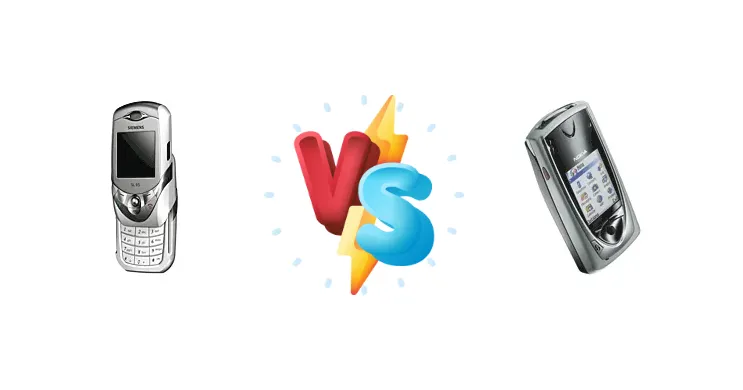
The early 2000s saw the nascent smartphone market take shape, with manufacturers experimenting with form factors and features. The Siemens SL65 and Nokia 7650 represent two distinct approaches to this new mobile landscape. The SL65, with its slider design, aimed for a more compact experience, while the 7650 boldly embraced a larger form factor and integrated a camera, a relatively novel feature at the time.
🏆 Quick Verdict
For the average user in 2002, the Nokia 7650 offered a more compelling package. Its integrated camera, coupled with the more established Symbian OS and wider application support, provided a more versatile and future-proof experience despite its bulkier design. The SL65, while innovative, lacked the software ecosystem to truly compete.
| Network |
|---|
| 2G bands | GSM 900 / 1800 / 1900 | GSM 900 / 1800 |
| EDGE | No | No |
| GPRS | Class 10 | Class 5 |
| Technology | GSM | GSM |
| Launch |
|---|
| Announced | 2004, June | 2002, Q1 |
| Status | Discontinued | Discontinued |
| Body |
|---|
| Dimensions | 90 x 47.6 x 21 mm, 78 cc (3.54 x 1.87 x 0.83 in) | 114 x 56 x 26 mm, 138 cc (4.49 x 2.20 x 1.02 in) |
| SIM | Mini-SIM | Mini-SIM |
| Weight | 99 g (3.49 oz) | 154 g (5.43 oz) |
| Display |
|---|
| Resolution | 130 x 130 pixels, 7 lines, 1:1 ratio (~102 ppi density) | 176 x 208 pixels, 35 x 41mm (~130 ppi density) |
| Size | 1.8 inches, 10.5 cm2 (~24.4% screen-to-body ratio) | 2.1 inches, 14.0 cm2 (~22.0% screen-to-body ratio) |
| Type | TFT, 65K colors | TFT, 4096 colors |
| | 5-way navi key
Downloadable logos | Act as a camera viewfinder
Advanced User Interface
Joystick with 5-way navigation
Photo album |
| Platform |
|---|
| CPU | - | 104 MHz ARM 9 |
| OS | - | Symbian 6.1, Series 60 v1.0 UI |
| Memory |
|---|
| Call records | 100 dialed, 100 received, 100 missed calls | - |
| Card slot | No | No |
| Internal | 11MB | 4MB |
| Phonebook | Yes | - |
| | - | 3 phone numbers per name
25 voice dial numbers |
| Main Camera |
|---|
| Single | VGA | VGA |
| Video | Yes | No |
| Sound |
|---|
| 3.5mm jack | No | No |
| 35mm jack | No | No |
| Alert types | Vibration; Downloadable polyphonic ringtones | Vibration; Downloadable polyphonic, monophonic ringtones |
| Loudspeaker | Yes | No |
| | - | Ascending ringing tones
Personal alert tones |
| Comms |
|---|
| Bluetooth | No | 1.1 |
| Infrared port | Yes | Yes |
| Positioning | No | No |
| Radio | No | No |
| USB | Proprietary | - |
| WLAN | No | No |
| Features |
|---|
| Alarm | - | Yes |
| Browser | WAP 2.0/xHTML | WAP 1.2.1, xHTML |
| Clock | - | Yes |
| Games | Yes - Golf, Rally + downloadable | - |
| Java | Yes, MIDP 2.0 | - |
| Languages | - | English + 2 other per phone (28 total) |
| Messaging | SMS, MMS, Email, Instant Messaging | - |
| | Predictive text input
Stopwatch
Organizer
SyncML | Predictive text input
Calculator
Profile Selection |
| Battery |
|---|
| Stand-by | Up to 230 | 90 h - 230 h |
| Talk time | Up to 4h 3 min | 2 h - 4 h |
| Type | Removable Li-Ion 700 mAh battery (EBA-650) | Removable Li-Ion 750 mAh battery (BLB-2) |
| Misc |
|---|
| Colors | 2 - Ivory, Ebony | - |
| SAR EU | - | 0.35 W/kg (head) |
Siemens SL65
- Compact slider design for portability
- Potentially simpler user interface
- Unique aesthetic appeal
- Lack of integrated camera
- Limited software ecosystem
- Unknown processor performance
Nokia 7650
- Integrated 0.3MP camera for mobile photography
- Symbian OS with wider application support
- Larger screen for multimedia consumption
- Bulky form factor
- Higher price point
- Relatively short battery life with heavy use
Display Comparison
Given the era, neither device boasted a particularly high-resolution display. The Nokia 7650’s larger screen size, though specific resolution is unavailable, likely offered a more comfortable viewing experience for multimedia content. The Siemens SL65, constrained by its slider form factor, would have had a smaller display, prioritizing portability over screen real estate. Color accuracy and viewing angles were likely limited on both devices, typical of LCD technology at the time.
Camera Comparison
The Nokia 7650’s integrated camera was a defining feature, offering a 0.3-megapixel sensor. While image quality was rudimentary by modern standards, it represented a significant innovation for mobile devices. The Siemens SL65 did not feature a built-in camera, placing it at a disadvantage for users interested in mobile photography. The 7650’s camera, though low-resolution, allowed for immediate sharing of photos via MMS, a popular feature at the time.
Performance
The Nokia 7650’s 104 MHz ARM 9 processor provided a foundation for running the Symbian OS and its applications. While not a powerhouse by today’s standards, this processor was a significant step up from the feature phones of the time. The Siemens SL65’s processor specifications are unknown, but given its market positioning, it likely featured a comparable, if not slightly less powerful, processor. The Symbian OS on the 7650 benefited from wider developer support, leading to a more robust application ecosystem than what was likely available for the SL65’s operating system.
Battery Life
Battery life on both devices would have been heavily dependent on usage patterns, particularly the use of the camera and data connectivity. The Nokia 7650’s larger size likely allowed for a slightly larger battery capacity, potentially offering longer standby times. However, the power consumption of the ARM 9 processor and the camera would have offset some of this advantage. Charging times were likely slow, typical of the battery technology available in the early 2000s.
Buying Guide
Buy the Siemens SL65 if you prioritized a compact, pocketable design and were less concerned with advanced features like a built-in camera or extensive software support. Buy the Nokia 7650 if you wanted a device that pushed the boundaries of mobile functionality, offering a built-in camera, a larger screen for media consumption, and access to the growing Symbian platform.
Frequently Asked Questions
❓ Was the Nokia 7650’s camera quality any good?
The 7650’s 0.3-megapixel camera produced images that are very low resolution by today’s standards. However, for the time, it was a groundbreaking feature. Image quality was acceptable for sharing via MMS and viewing on the phone’s small screen, but not suitable for printing or detailed viewing.
❓ How did the Symbian OS on the Nokia 7650 compare to other mobile operating systems of the time?
Symbian OS was the dominant smartphone operating system in the early 2000s, offering a more robust and feature-rich experience than most competitors. It supported multitasking, application installation, and data synchronization. While not as user-friendly as later operating systems, it provided a level of functionality that was unmatched by other platforms at the time.
❓ Did the Siemens SL65 have any expandable storage options?
Information regarding expandable storage for the Siemens SL65 is scarce. Given the era and its focus on compactness, it likely had limited internal storage and lacked support for memory cards. This was a significant limitation compared to the Nokia 7650, which may have offered some form of expandable storage.