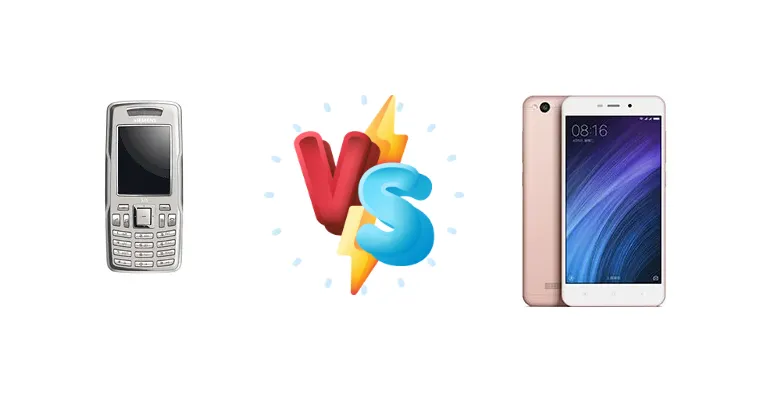
Comparing the Siemens S75 and the Xiaomi Redmi 4A is a study in contrasts. The S75 represents a bygone era of feature phones, while the Redmi 4A embodies the modern budget smartphone. Given the limited publicly available specifications for the S75, this comparison will focus on contextualizing its likely capabilities against the Redmi 4A’s known hardware and the market positioning of both devices.
🏆 Quick Verdict
For the average user in 2024, the Xiaomi Redmi 4A is the clear winner. Its Qualcomm Snapdragon 425 chipset provides a functional smartphone experience with access to apps and basic multimedia, something the S75, as a feature phone, simply cannot match. The Redmi 4A offers a modern, connected experience at an incredibly low price point.
| Network |
|---|
| 2G bands | GSM 900 / 1800 / 1900 | GSM 850 / 900 / 1800 / 1900 - SIM 1 & SIM 2 |
| 3G bands | - | HSDPA 850 / 900 / 1900 / 2100 |
| 4G bands | - | 1, 3, 4, 5, 7, 20, 38, 40 |
| EDGE | Yes | - |
| GPRS | Class 10 | - |
| Speed | - | HSPA, LTE |
| Technology | GSM | GSM / HSPA / LTE |
| Launch |
|---|
| Announced | 2005, Q2 | 2016, November. Released 2016, November |
| Status | Discontinued | Discontinued |
| Body |
|---|
| Build | - | Glass front, plastic back, plastic frame |
| Dimensions | 103 x 47 x 18.5 mm, 84 cc (4.06 x 1.85 x 0.73 in) | 139.9 x 70.4 x 8.5 mm (5.51 x 2.77 x 0.33 in) |
| SIM | Mini-SIM | Nano-SIM + Micro-SIM |
| Weight | 99 g (3.49 oz) | 131.5 g (4.66 oz) |
| Display |
|---|
| Resolution | 132 x 176 pixels, 4:3 ratio (~116 ppi density) | 720 x 1280 pixels, 16:9 ratio (~296 ppi density) |
| Size | 1.9 inches, 28 x 38 mm, 11.2 cm2 (~23.1% screen-to-body ratio) | 5.0 inches, 68.0 cm2 (~69.0% screen-to-body ratio) |
| Type | TFT, 256K colors | IPS LCD |
| Platform |
|---|
| CPU | - | Quad-core 1.4 GHz Cortex-A53 |
| Chipset | - | Qualcomm MSM8917 Snapdragon 425 (28 nm) |
| GPU | - | Adreno 308 |
| OS | - | Android 6.0.1 (Marshmallow), MIUI 10 |
| Memory |
|---|
| Call records | 100 dialed, 100 received, 100 missed calls | - |
| Card slot | RS-MMC, up to 1 GB, 128 MB included | microSDXC (uses shared SIM slot) |
| Internal | 20MB | 16GB 2GB RAM, 32GB 2GB RAM, 32GB 3GB RAM |
| Phonebook | 1000 x 43 fields, Photo call | - |
| | 100 short messages | eMMC 5.1 |
| Main Camera |
|---|
| Features | LED flash | LED flash, HDR, panorama |
| Single | 1.3 MP | 13 MP, f/2.2, AF |
| Video | Yes | 1080p@30fps |
| Selfie camera |
|---|
| Single | - | 5 MP, f/2.2 |
| | No | - |
| Sound |
|---|
| 3.5mm jack | No | Yes |
| 35mm jack | No | Yes |
| Alert types | Vibration; Downloadable polyphonic, MP3, AAC ringtones | - |
| Loudspeaker | No | Yes |
| Comms |
|---|
| Bluetooth | 1.2 | 4.1, A2DP, LE |
| Infrared port | Yes | Yes |
| NFC | - | No |
| Positioning | No | GPS, GLONASS, BDS |
| Radio | No | FM radio |
| USB | Proprietary | microUSB 2.0 |
| WLAN | No | Wi-Fi 802.11 b/g/n, Wi-Fi Direct |
| Features |
|---|
| Browser | WAP 2.0/xHTML | - |
| Games | Yes + downloadable | - |
| Java | Yes, MIDP 2.0 | - |
| Messaging | SMS, MMS, EMail, Instant Messaging | - |
| Sensors | - | Accelerometer, gyro, proximity |
| | Push to Talk
MP3/AAC/MP4 player
Predictive text input
Organizer
SyncML
Voice memo | - |
| Battery |
|---|
| Stand-by | Up to 300 h | - |
| Talk time | Up to 5 h | - |
| Type | Removable Li-Ion 820 mAh battery | Li-Ion 3120 mAh, non-removable |
| Misc |
|---|
| Colors | Piano Black, Zirconia | Gold, Rose Gold, Dark Gray |
| Models | - | 2016117 |
| Price | - | About 110 EUR |
| SAR | - | 0.53 W/kg (head) 1.18 W/kg (body) |
| Tests |
|---|
| Camera | - |
Photo / Video |
| Performance | - |
GeekBench: 1781 (v4.4) |
Siemens S75
- Potentially exceptional battery life (typical of feature phones)
- Robust build quality (Siemens phones were known for durability)
- Collector's item appeal
- Limited functionality compared to a smartphone
- No app ecosystem
- Lack of modern connectivity (no 4G, Wi-Fi)
Xiaomi Redmi 4A
- Full smartphone functionality (apps, internet, social media)
- Qualcomm Snapdragon 425 processor for basic tasks
- Affordable price point
- Limited performance for demanding applications
- Basic camera capabilities
- May not receive software updates
Display Comparison
The Siemens S75 likely features a small, low-resolution LCD screen typical of feature phones from its era. In contrast, the Xiaomi Redmi 4A boasts a larger display, though specifications regarding its exact panel type and resolution are not provided in the context data. The Redmi 4A’s larger screen size is a significant advantage for media consumption and general usability. The S75’s display, while potentially durable, will be limited in viewing angles and color reproduction.
Camera Comparison
The Xiaomi Redmi 4A includes a camera capable of both photo and video capture, though the sensor specifications are not detailed. The Siemens S75, if equipped with a camera (specifications are unavailable), would likely feature a very low-resolution sensor with limited functionality. The Redmi 4A’s camera, even if basic, offers the ability to capture and share photos and videos, a feature entirely absent or severely limited on the S75.
Performance
The Xiaomi Redmi 4A is powered by the Qualcomm MSM8917 Snapdragon 425, a quad-core 1.4 GHz Cortex-A53 processor built on a 28nm process. This chipset provides sufficient power for basic Android tasks. The Siemens S75, lacking a modern application processor, relies on its internal firmware for functionality. Its processing power is orders of magnitude lower, limiting it to calls, texts, and simple pre-installed applications. The 28nm node of the Snapdragon 425, while not cutting-edge, offers a reasonable balance between performance and power efficiency.
Battery Life
The Siemens S75, being a feature phone, likely boasts exceptional battery life due to its low-power components and simple functionality. However, the Xiaomi Redmi 4A, despite its more demanding processor and larger display, offers a reasonable battery life for a full day of moderate use. The Redmi 4A’s battery capacity and charging wattage are not specified, but it likely supports standard micro-USB charging. The S75 likely uses a proprietary charger and offers significantly longer standby times.
Buying Guide
Buy the Siemens S75 if you are a collector of vintage mobile phones, appreciate the build quality and durability of older devices, and prioritize long battery life over modern features. Buy the Xiaomi Redmi 4A if you need a functional, affordable smartphone for basic communication, social media, and light multimedia consumption. The Redmi 4A is the practical choice for everyday use.
Frequently Asked Questions
❓ Is the Snapdragon 425 in the Redmi 4A powerful enough for modern apps?
The Snapdragon 425 is an entry-level processor. While it can handle basic apps like messaging, social media, and web browsing, it will struggle with demanding games or multitasking. Expect some lag when running multiple applications simultaneously.
❓ What kind of network connectivity does the Siemens S75 support?
The Siemens S75, being a feature phone from its era, likely supports 2G and potentially 3G networks. It will not be compatible with modern 4G or 5G networks, limiting its usability in areas with limited older network coverage.
❓ Can I install apps on the Siemens S75?
No, the Siemens S75 does not support app installation. It operates on a closed system with pre-installed applications only. This is a fundamental difference from the Android-based Xiaomi Redmi 4A, which offers access to millions of apps through the Google Play Store.
❓ How durable is the Xiaomi Redmi 4A?
The Redmi 4A is constructed with a plastic frame and back. While not exceptionally rugged, it's reasonably durable for everyday use. However, it lacks any official IP rating for water or dust resistance, so caution is advised.