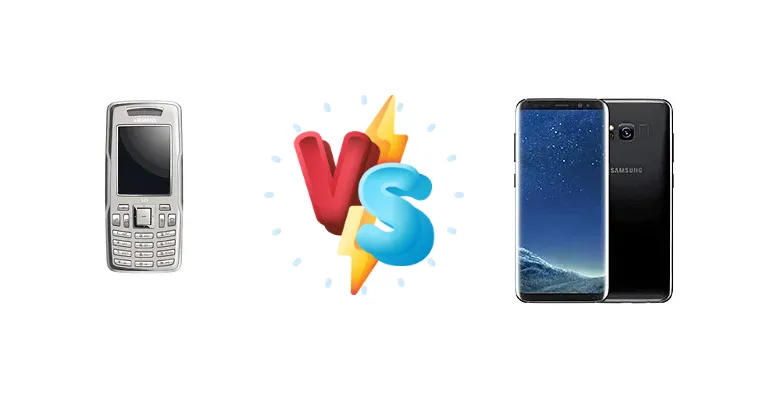
Comparing the Siemens S75 and the Samsung Galaxy S8 is a study in contrasts. The S75 represents a late-stage feature phone era, prioritizing durability and basic communication, while the Galaxy S8 heralded the arrival of the modern, bezel-less smartphone. This comparison isn't about 'better,' but understanding how mobile technology evolved and what each device offered its users at the time.
🏆 Quick Verdict
For the average user today, the Samsung Galaxy S8 is the clear winner. Its advanced features, including a vibrant display, capable camera, and smartphone functionality, far outweigh the S75’s limited capabilities. However, the S75’s potential durability and simplicity may appeal to niche users.
| Network |
|---|
| 2G bands | GSM 900 / 1800 / 1900 | GSM 850 / 900 / 1800 / 1900 - SIM 1 & SIM 2 (dual-SIM model only) |
| 3G bands | - | HSDPA 850 / 900 / 1700(AWS) / 1900 / 2100 |
| 4G bands | - | 1, 2, 3, 4, 5, 7, 8, 12, 13, 17, 18, 19, 20, 25, 26, 28, 32, 66, 38, 39, 40, 41 |
| EDGE | Yes | - |
| GPRS | Class 10 | - |
| Speed | - | HSPA 42.2/5.76 Mbps, LTE (5CA) Cat16 1024/150 Mbps |
| Technology | GSM | GSM / HSPA / LTE |
| Launch |
|---|
| Announced | 2005, Q2 | 2017, March 29. Released 2017, April 24 |
| Status | Discontinued | Discontinued |
| Body |
|---|
| Build | - | Glass front (Gorilla Glass 5), glass back (Gorilla Glass 5), aluminum frame |
| Dimensions | 103 x 47 x 18.5 mm, 84 cc (4.06 x 1.85 x 0.73 in) | 148.9 x 68.1 x 8 mm (5.86 x 2.68 x 0.31 in) |
| SIM | Mini-SIM | · Nano-SIM· Nano-SIM + Nano-SIM |
| Weight | 99 g (3.49 oz) | 155 g (5.47 oz) |
| | - | IP68 dust/water resistant (up to 1.5m for 30 mins) |
| Display |
|---|
| Protection | - | Corning Gorilla Glass 5 |
| Resolution | 132 x 176 pixels, 4:3 ratio (~116 ppi density) | 1440 x 2960 pixels, 18.5:9 ratio (~570 ppi density) |
| Size | 1.9 inches, 28 x 38 mm, 11.2 cm2 (~23.1% screen-to-body ratio) | 5.8 inches, 84.8 cm2 (~83.6% screen-to-body ratio) |
| Type | TFT, 256K colors | Super AMOLED, HDR10 |
| | - | 3D Touch (home button only)
Always-on display |
| Platform |
|---|
| CPU | - | Octa-core (4x2.3 GHz Mongoose M2 & 4x1.7 GHz Cortex-A53) - EMEAOcta-core (4x2.35 GHz Kryo & 4x1.9 GHz Kryo) - USA & China |
| Chipset | - | Exynos 8895 (10 nm) - EMEAQualcomm MSM8998 Snapdragon 835 (10 nm) - USA & China |
| GPU | - | Mali-G71 MP20 - EMEAAdreno 540 - USA & China |
| OS | - | Android 7.0 (Nougat), upgradable to Android 9.0 (Pie), One UI |
| Memory |
|---|
| Call records | 100 dialed, 100 received, 100 missed calls | - |
| Card slot | RS-MMC, up to 1 GB, 128 MB included | microSDXC (uses shared SIM slot) - dual SIM model only |
| Internal | 20MB | 64GB 4GB RAM |
| Phonebook | 1000 x 43 fields, Photo call | - |
| | 100 short messages | UFS 2.0 or UFS 2.1 |
| Main Camera |
|---|
| Features | LED flash | LED flash, auto-HDR, panorama |
| Single | 1.3 MP | 12 MP, f/1.7, 26mm (wide), 1/2.55", 1.4µm, dual pixel PDAF, OIS |
| Video | Yes | 4K@30fps, 1080p@30/60fps, 720p@240fps, HDR, stereo sound rec., gyro-EIS, OIS |
| Selfie camera |
|---|
| Dual | - | 8 MP, f/1.7, 25mm (wide), 1/3.6", 1.22µm, AF
2 MP (dedicated iris scanner camera) |
| Features | - | HDR |
| Video | - | 1440p@30fps |
| | No | - |
| Sound |
|---|
| 3.5mm jack | No | Yes |
| 35mm jack | No | Yes |
| Alert types | Vibration; Downloadable polyphonic, MP3, AAC ringtones | - |
| Loudspeaker | No | Yes |
| | - | 32-bit/384kHz audio
|
| Comms |
|---|
| Bluetooth | 1.2 | 5.0, A2DP, LE, aptX |
| Infrared port | Yes | - |
| NFC | - | Yes |
| Positioning | No | GPS, GLONASS, BDS, GALILEO |
| Radio | No | No |
| USB | Proprietary | USB Type-C 3.1 |
| WLAN | No | Wi-Fi 802.11 a/b/g/n/ac, dual-band, Wi-Fi Direct |
| Features |
|---|
| Browser | WAP 2.0/xHTML | - |
| Games | Yes + downloadable | - |
| Java | Yes, MIDP 2.0 | - |
| Messaging | SMS, MMS, EMail, Instant Messaging | - |
| Sensors | - | Iris scanner, fingerprint (rear-mounted), accelerometer, gyro, proximity, compass, barometer, heart rate, SpO2 |
| | Push to Talk
MP3/AAC/MP4 player
Predictive text input
Organizer
SyncML
Voice memo | Samsung DeX (desktop experience support)
ANT+
Bixby natural language commands and dictation
Samsung Pay (Visa, MasterCard certified) |
| Battery |
|---|
| Charging | - | 15W wired, QC2
Wireless (Qi) (market dependent) |
| Music play | - | Up to 67 h |
| Stand-by | Up to 300 h | - |
| Talk time | Up to 5 h | Up to 20 h (3G) |
| Type | Removable Li-Ion 820 mAh battery | Li-Ion 3000 mAh, non-removable (11.55 Wh) |
| Misc |
|---|
| Colors | Piano Black, Zirconia | Midnight Black, Orchid Gray, Arctic Silver, Coral Blue, Maple Gold, Rose Pink, Burgundy Red |
| Models | - | SM-G950FD, SM-G950W, SM-G950S, SM-G950K, SM-G950L, SM-G9500, SM-G950A, SM-G950P, SM-G950T, SM-G950U, SM-G950V, SM-G950F, SM-G950U1, SM-G950N, SC-02J, SCV36, SM-G950, G950F |
| Price | - | About 230 EUR |
| SAR | - | 0.44 W/kg (head) 0.75 W/kg (body) |
| SAR EU | - | 0.32 W/kg (head) 1.27 W/kg (body) |
| Tests |
|---|
| Audio quality | - |
Noise -92.5dB / Crosstalk -92.8dB |
| Battery life | - | Endurance rating 84h |
| Camera | - |
Photo / Video |
| Display | - |
Contrast ratio: Infinite (nominal), 4.768 (sunlight) |
| Loudspeaker | - |
Voice 66dB / Noise 70dB / Ring 72dB |
| Performance | - |
AnTuTu: 199022 (v7)
GeekBench: 6656 (v4.4)
GFXBench: 13fps (ES 3.1 onscreen) |
Siemens S75
- Potentially exceptional durability
- Long standby time (likely)
- Simplicity and ease of use
- Limited functionality
- Low-resolution display
- Basic camera
Samsung Galaxy S8
- High-quality display with excellent contrast
- Powerful processor for smooth performance
- Versatile camera with photo and video capabilities
- Access to apps and smartphone features
- Battery life may be limited by modern standards
- Older chipset may struggle with demanding tasks
- Software support has ended
Display Comparison
The Samsung Galaxy S8 boasts a significantly more advanced display. With an 'Infinite' contrast ratio (nominal) and 4.768 in sunlight, it offers vibrant colors and excellent visibility. The S75, typical of feature phones, likely utilizes a smaller, lower-resolution LCD with limited viewing angles and color reproduction. The S8’s display is a key differentiator, enabling immersive video consumption and a superior user experience. The S8's display technology was a major leap forward, setting a new standard for smartphone screens.
Camera Comparison
The Samsung Galaxy S8’s camera, while not groundbreaking by today’s standards, offered a significant upgrade over the cameras found in feature phones like the S75. While specific sensor details are unavailable, the S8’s camera supports both photo and video capture, likely with features like autofocus and image stabilization. The S75 likely features a basic camera with limited resolution and functionality. The S8’s image processing capabilities would also be far superior, resulting in better image quality in various lighting conditions.
Performance
The Galaxy S8’s Exynos 8895 (EMEA) or Snapdragon 835 (USA & China) chipset, built on a 10nm process, represents a massive performance jump over anything available in the S75’s era. The octa-core CPU configuration – 4x2.3 GHz Mongoose M2/Kryo and 4x1.7/1.9 GHz Cortex-A53/Kryo – allows for multitasking, demanding applications, and smooth gaming. The S75’s processor, while sufficient for calls and texts, would struggle with even basic smartphone tasks. The 10nm fabrication process of the S8’s chipset also contributes to improved power efficiency.
Battery Life
The Samsung Galaxy S8 achieves an impressive endurance rating of 84 hours, indicating excellent battery life for a smartphone of its time. It supports 15W wired charging with Quick Charge 2.0 and wireless charging (Qi, market dependent). The S75, lacking the power demands of a smartphone, likely offers a comparable or even longer standby time, but its charging capabilities would be limited to a standard wall charger. The S8’s fast charging and wireless charging options provide convenience and flexibility.
Buying Guide
Buy the Siemens S75 if you need an extremely durable, long-lasting device for basic communication, and value simplicity above all else. Its appeal lies in its potential robustness and long standby time. Buy the Samsung Galaxy S8 if you prioritize a large, high-quality display, a versatile camera, access to apps, and the full suite of smartphone features. It’s a device for those who want connectivity and multimedia capabilities.
Frequently Asked Questions
❓ Does the Exynos 8895 chip in the Galaxy S8 overheat during prolonged use?
The Exynos 8895, while powerful, was known to exhibit some thermal throttling under sustained heavy loads, such as extended gaming sessions. However, for typical daily use, overheating is unlikely to be a significant issue. The Snapdragon 835 variant generally performed better in thermal management.
❓ Is the Samsung Galaxy S8 still secure to use in 2024, considering it no longer receives security updates?
Using a Galaxy S8 in 2024 carries security risks due to the lack of ongoing security updates. It's vulnerable to known exploits and malware. If you choose to use it, avoid storing sensitive information and use a strong, unique password. Consider using it only on a trusted network.
❓ What kind of connectivity does the Siemens S75 offer beyond basic cellular calls and texts?
The Siemens S75 primarily focuses on basic cellular connectivity. It likely supports SMS messaging and potentially limited data services like WAP for accessing basic internet content. It lacks the advanced connectivity options of the Galaxy S8, such as Wi-Fi, Bluetooth, and NFC.