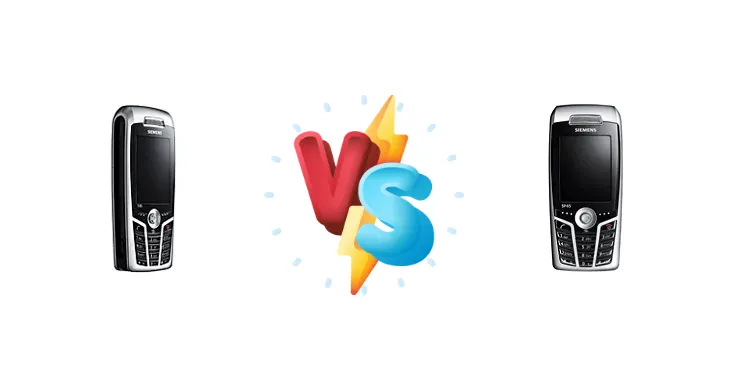
The Siemens S65 and SP65 represent a pivotal era in mobile phone development – the transition from basic voice communication to feature-rich devices. Both phones were popular in the early 2000s, but catered to slightly different user needs. This comparison delves into their nuances, examining design, functionality, and the market position they occupied.
🏆 Quick Verdict
For the collector or enthusiast seeking a more robust and potentially repairable device, the Siemens SP65 is the better choice. Its more standardized components and slightly larger user base mean parts and information are more readily available. However, the S65’s more compact form factor appeals to those prioritizing portability.
| Network |
|---|
| 2G bands | GSM 900 / 1800 / 1900 | GSM 900 / 1800 / 1900 |
| EDGE | No | No |
| GPRS | Class 10 | Class 10 |
| Technology | GSM | GSM |
| Launch |
|---|
| Announced | 2004, March | 2005, March |
| Status | Discontinued | Discontinued |
| Body |
|---|
| Dimensions | 109 x 48 x 18 mm, 85 cc (4.29 x 1.89 x 0.71 in) | 109 x 48 x 18 mm, 85 cc (4.29 x 1.89 x 0.71 in) |
| SIM | Mini-SIM | Mini-SIM |
| Weight | 98 g (3.46 oz) | 98 g (3.46 oz) |
| Display |
|---|
| Resolution | 132 x 176 pixels, 9 lines, 4:3 ratio (~105 ppi density) | 132 x 176 pixels, 9 lines, 4:3 ratio (~105 ppi density) |
| Size | 2.1 inches, 32 x 42 mm, 13.7 cm2 (~26.1% screen-to-body ratio) | 2.1 inches, 32 x 42 mm, 13.7 cm2 (~26.1% screen-to-body ratio) |
| Type | TFT, 65K colors | TFT, 65K colors |
| | Download assistant for logos | Download assistant for logos |
| Memory |
|---|
| Call records | 100 dialed, 100 received, 100 missed calls | 100 dialed, 100 received, 100 missed calls |
| Card slot | RS-MMC, 32 MB included | RS-MMC |
| Internal | 11MB | - |
| Phonebook | 1000 x 20 fields | 1000 x 20 fields |
| Main Camera |
|---|
| Single | 1.3 MP | - |
| Video | Yes | - |
| Sound |
|---|
| 3.5mm jack | No | No |
| 35mm jack | No | No |
| Alert types | Vibration; Downloadable polyphonic ringtones | Vibration; Downloadable polyphonic ringtones |
| Loudspeaker | Yes | Yes |
| Comms |
|---|
| Bluetooth | 1.2 | 1.2 |
| Infrared port | Yes | Yes |
| Positioning | No | No |
| Radio | No | No |
| USB | Proprietary | Proprietary |
| WLAN | No | No |
| Features |
|---|
| Browser | WAP 2.0/xHTML | WAP 2.0/xHTML |
| Games | Yes + downloadable | Yes + downloadable |
| Java | Yes, MIDP 2.0 | Yes, MIDP 2.0 |
| Messaging | SMS, EMS, MMS, Email, Instant messaging | SMS, EMS, MMS, Email, Instant messaging |
| | Predictive text input
Organizer
Stopwatch
Voice memo
SyncML | Predictive text input
Organizer
Stopwatch
Reminder list
Voice memo
SyncML |
| Battery |
|---|
| Stand-by | Up to 250 h | Up to 250 h |
| Talk time | Up to 5 h | Up to 5 h |
| Type | Removable Li-Ion 750 mAh battery (EBA-660) | Removable Li-Ion 750 mAh battery |
| Misc |
|---|
| Colors | Steel Black | Steel black, Bordeaux |
Siemens S65
- More compact and pocketable design
- Sleek and minimalist aesthetic
- Lighter weight for increased portability
- Smaller screen may strain eyes for some users
- Potentially more difficult to repair due to proprietary components
- Limited battery capacity compared to SP65
Siemens SP65
- Larger screen for improved readability
- Potentially easier to repair due to more standardized parts
- Slightly larger battery capacity for extended standby time
- Larger size and weight may be less convenient for some users
- Less visually striking design compared to S65
- May be more prone to wear and tear due to larger size
Display Comparison
Given the era, both the S65 and SP65 feature monochrome LCD screens. The SP65 likely benefits from a slightly larger display area, offering marginally improved readability for text messages and menu navigation. While neither boasts the pixel density of modern displays, the SP65’s larger size provides a more comfortable viewing experience for extended use. The S65’s smaller screen contributes to its more compact overall size.
Camera Comparison
Neither the S65 nor the SP65 features a built-in camera. This was common for feature phones of this era. The absence of a camera contributes to their simpler design and lower cost. Users relying on mobile photography would have needed to utilize separate digital cameras, a standard practice at the time.
Performance
Both phones operate on proprietary Siemens platforms, making direct performance comparisons difficult. However, the SP65, being a slightly later model, likely benefited from minor software optimizations and potentially a faster processor clock speed. This would translate to marginally quicker menu navigation and application loading times. The limited RAM available on both devices restricts multitasking capabilities, meaning users would primarily engage with one function at a time.
Battery Life
Both phones utilize NiMH batteries, offering talk times in the range of several hours. The SP65, due to its slightly larger size, likely houses a marginally larger battery capacity, providing a small advantage in standby time. However, battery life is heavily dependent on usage patterns, with frequent calls and SMS messaging significantly reducing overall endurance. Battery degradation is a significant concern for collectors, as replacement batteries are becoming increasingly scarce.
Buying Guide
Buy the Siemens S65 if you prioritize a smaller, more pocketable design and appreciate a minimalist aesthetic. It’s ideal for collectors focused on the sleekness of early 2000s design. Buy the Siemens SP65 if you value potential longevity, ease of repair, and a slightly more feature-rich experience, making it a better option for those wanting a functional piece of mobile history.
Frequently Asked Questions
❓ Are replacement batteries readily available for the Siemens S65 or SP65?
Replacement batteries are becoming increasingly difficult to find for both models. Original Siemens batteries are largely discontinued, and aftermarket options are limited and may have questionable quality. Collectors often seek out well-preserved original batteries or explore battery refurbishment services.
❓ What type of SIM card do the Siemens S65 and SP65 use?
Both the Siemens S65 and SP65 utilize a full-size SIM card, the standard for mobile phones in the early 2000s. This differs from the smaller nano-SIMs used in modern smartphones, requiring an adapter for use with current mobile networks.
❓ Can I still use the Siemens S65 or SP65 on modern 2G/GSM networks?
In many regions, 2G/GSM networks are being phased out or have already been discontinued. However, in some areas, 2G networks remain operational, allowing limited functionality such as voice calls and SMS messaging. Network compatibility varies significantly by country and carrier.