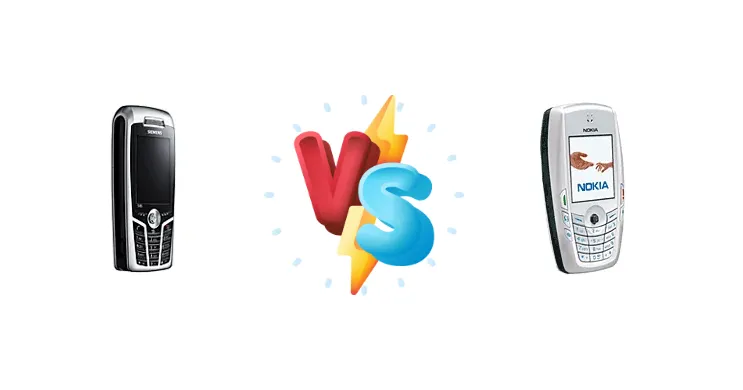
The early 2000s saw a rapid evolution in mobile phones, bridging the gap between basic feature phones and the emerging smartphone category. The Siemens S65 and Nokia 6620 represent distinct approaches to this transition. The S65, from Siemens, focused on refined design and usability, while the Nokia 6620 aimed to deliver a more advanced, application-driven experience, powered by a Texas Instruments chipset.
🏆 Quick Verdict
For the average user seeking a reliable and stylish feature phone, the Siemens S65 likely offers a more polished experience, assuming comparable availability. However, the Nokia 6620, with its TI OMAP 1510 chipset and ARM925T CPU, represents a significant step towards smartphone functionality, appealing to early adopters.
| Network |
|---|
| 2G bands | GSM 900 / 1800 / 1900 | GSM 850 / 1800 / 1900 |
| EDGE | No | Yes, 118.4 kbps |
| GPRS | Class 10 | Class 4 |
| Technology | GSM | GSM |
| Launch |
|---|
| Announced | 2004, March | 2004, Q1 |
| Status | Discontinued | Discontinued |
| Body |
|---|
| Dimensions | 109 x 48 x 18 mm, 85 cc (4.29 x 1.89 x 0.71 in) | 109 x 58 x 24 mm, 113 cc (4.29 x 2.28 x 0.94 in) |
| SIM | Mini-SIM | Mini-SIM |
| Weight | 98 g (3.46 oz) | 122 g (4.30 oz) |
| Display |
|---|
| Resolution | 132 x 176 pixels, 9 lines, 4:3 ratio (~105 ppi density) | 176 x 208 pixels (~130 ppi density) |
| Size | 2.1 inches, 32 x 42 mm, 13.7 cm2 (~26.1% screen-to-body ratio) | 2.1 inches, 35 x 41 mm, 14.0 cm2 (~22.2% screen-to-body ratio) |
| Type | TFT, 65K colors | TFT, 65k colors |
| | Download assistant for logos | 5-way joystick navigation
Selectable themes |
| Platform |
|---|
| CPU | - | 150 MHz ARM925T |
| Chipset | - | TI OMAP 1510 |
| OS | - | Symbian 7.0s, Series 60 v2.0 UI |
| Memory |
|---|
| Call records | 100 dialed, 100 received, 100 missed calls | - |
| Card slot | RS-MMC, 32 MB included | RS-MMC, 32 MB included |
| Internal | 11MB | 12MB |
| Phonebook | 1000 x 20 fields | - |
| | - | 25 voice command slots
Voice memo |
| Main Camera |
|---|
| Single | 1.3 MP | VGA |
| Video | Yes | QCIF |
| Sound |
|---|
| 3.5mm jack | No | No |
| 35mm jack | No | No |
| Alert types | Vibration; Downloadable polyphonic ringtones | Vibration; Downloadable polyphonic ringtones |
| Loudspeaker | Yes | Yes |
| Comms |
|---|
| Bluetooth | 1.2 | 1.1 |
| Infrared port | Yes | Yes |
| Positioning | No | No |
| Radio | No | No |
| USB | Proprietary | Pop-Port |
| WLAN | No | No |
| Features |
|---|
| Browser | WAP 2.0/xHTML | WAP 2.0/xHTML, HTML |
| Games | Yes + downloadable | - |
| Java | Yes, MIDP 2.0 | - |
| Languages | - | Major Europe and Asia-Pacific |
| Messaging | SMS, EMS, MMS, Email, Instant messaging | - |
| | Predictive text input
Organizer
Stopwatch
Voice memo
SyncML | Stereo MP3/AAC player
Predictive text input
Voice dial |
| Battery |
|---|
| Stand-by | Up to 250 h | Up to 190 h |
| Talk time | Up to 5 h | Up to 4 h |
| Type | Removable Li-Ion 750 mAh battery (EBA-660) | Removable Li-Ion 850 mAh battery (BL-5C) |
| Misc |
|---|
| Colors | Steel Black | Light Gray |
| SAR | - | 1.16 W/kg (head) 0.74 W/kg (body) |
| SAR EU | - | 0.81 W/kg (head) |
Siemens S65
- Likely superior build quality and design (based on Siemens brand reputation)
- Potentially longer battery life due to lower power consumption
- Simplified user interface for ease of use
- Limited functionality compared to the Nokia 6620
- Lack of application support
- Limited camera capabilities (if present)
Nokia 6620
- More powerful processor (TI OMAP 1510 with ARM925T)
- Symbian OS support for basic applications
- Integrated 0.3-megapixel camera
- Potentially shorter battery life
- Less refined design compared to Siemens
- Symbian OS was relatively complex for the time
Display Comparison
Specific display details for the Siemens S65 are unavailable. However, Siemens phones of this era typically prioritized clarity and readability over large screen sizes. The Nokia 6620 featured a 176x208 pixel color LCD. While resolution was modest, the Nokia’s display benefited from being integral to a device aiming for application use, requiring a functional, if basic, interface. The Nokia’s screen size (2.2 inches) was typical for the time, but the S65 likely focused on maximizing perceived quality within a similar footprint.
Camera Comparison
Details regarding the Siemens S65’s camera are scarce. Nokia 6620 included a 0.3-megapixel camera. While image quality was limited by the sensor size and technology of the time, it represented a significant step forward for mobile photography. The Nokia’s camera allowed for basic image capture and sharing, a feature likely absent or significantly less capable on the Siemens S65. The inclusion of a camera, even a low-resolution one, positioned the Nokia 6620 as a more versatile device.
Performance
The Nokia 6620’s TI OMAP 1510 chipset, featuring a 150 MHz ARM925T CPU, was a key differentiator. This processor allowed for more complex tasks than typical feature phones, including running Symbian OS applications and handling multimedia. The Siemens S65, lacking publicly available chipset information, likely utilized a more standard, lower-powered processor focused on call handling, SMS, and basic features. The ARM925T’s architecture, while dated by today’s standards, provided a significant performance boost over the processors found in simpler feature phones, enabling a more responsive user experience on the Nokia.
Battery Life
Battery life for both devices would have been measured in days, given the limited functionality and power consumption of 2G phones. The Nokia 6620’s more powerful processor and larger screen likely resulted in slightly shorter battery life compared to the Siemens S65. However, the difference would likely be marginal, as both devices were designed for extended standby times and moderate usage. Specific mAh ratings are unavailable for either device.
Buying Guide
Buy the Siemens S65 if you prioritize a sleek design, ease of use, and a focus on core communication features. It's ideal for users who valued aesthetics and a refined user experience over advanced applications. Buy the Nokia 6620 if you're interested in exploring early smartphone capabilities, including basic application support and a more powerful processor for the time, even if it comes with a slightly less refined overall experience.
Frequently Asked Questions
❓ Was the Nokia 6620 considered a smartphone at the time?
The Nokia 6620 is often considered a transitional device between feature phones and smartphones. While it ran Symbian OS and supported basic applications, it lacked many features we associate with modern smartphones, such as a high-resolution touchscreen and robust app ecosystem. It was an early attempt at bringing smartphone functionality to a wider audience.
❓ How did the Siemens S65 compare to other Siemens phones of the same era?
The Siemens S65 was positioned as a premium feature phone within Siemens’ lineup. It emphasized design and usability, offering a refined experience compared to more basic models. Siemens phones of this era were known for their distinctive styling and build quality, and the S65 continued that tradition.
❓ Could you install games on the Nokia 6620?
Yes, the Nokia 6620 supported Java ME applications, allowing users to install and play basic games. However, the game selection was limited compared to modern smartphones, and performance could be sluggish due to the ARM925T processor's limitations.