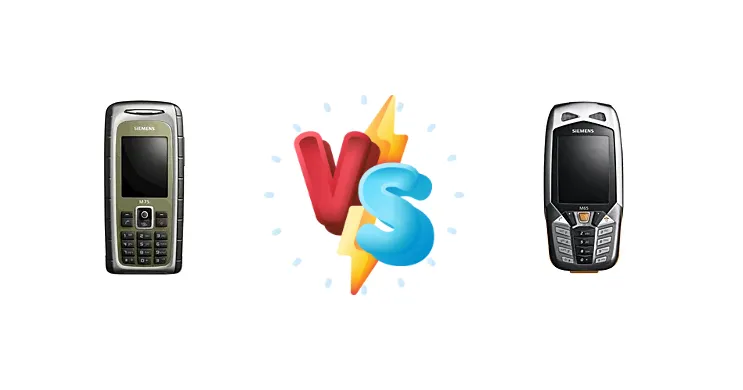
The Siemens M75 and M65 represent a pivotal era in mobile phone design, preceding the smartphone revolution. Both devices aimed for a balance of functionality and portability, but subtle differences in their design and potential feature sets catered to slightly different user needs. Given the lack of detailed specifications, this comparison will focus on likely design philosophies and market positioning based on Siemens' historical trends.
🏆 Quick Verdict
For the collector prioritizing potential advanced features and a slightly more premium feel, the Siemens M75 is the likely winner. However, the M65 likely offered a more accessible price point and potentially better battery life, making it ideal for users focused on core communication.
| Network |
|---|
| 2G bands | GSM 900 / 1800 / 1900 | GSM 900 / 1800 / 1900 |
| EDGE | No | No |
| GPRS | Class 10 | Class 10 |
| Technology | GSM | GSM |
| Launch |
|---|
| Announced | 2005, Q1 | 2004, March |
| Status | Discontinued | Discontinued |
| Body |
|---|
| Dimensions | 110.5 x 51.5 x 20.8 mm, 104 cc (4.35 x 2.03 x 0.82 in) | 109 x 49 x 19 mm, 89 cc (4.29 x 1.93 x 0.75 in) |
| SIM | Mini-SIM | Mini-SIM |
| Weight | 110 g (3.88 oz) | 104 g (3.67 oz) |
| | Dust, shock and splash resistant
Metal frame | Dust, shock and splash resistant
Metal frame |
| Display |
|---|
| Resolution | 132 x 176 pixels, 4:3 ratio (~116 ppi density) | 132 x 176 pixels, 9 lines, 4:3 ratio |
| Size | 1.9 inches, 28 x 38 mm, 11.2 cm2 (~19.6% screen-to-body ratio) | - |
| Type | TFT, 256K colors | TFT, 65K colors |
| Memory |
|---|
| Call records | 10 dialed, 10 received, 10 missed calls | 100 received, 100 dialed and 100 missed calls |
| Card slot | RS-MMC, 32 MB included | No |
| Internal | 14MB | 11MB |
| Phonebook | 1000 x 20 fields, Photo call | 14 fields, in shared memory |
| Main Camera |
|---|
| Single | 1.3 MP | VGA |
| Video | Yes | Yes |
| Sound |
|---|
| 3.5mm jack | No | No |
| 35mm jack | No | No |
| Alert types | Vibration; Downloadable polyphonic, MP3, AAC ringtones | Vibration; Downloadable polyphonic ringtones |
| Loudspeaker | No | Yes |
| Comms |
|---|
| Bluetooth | 1.2 | No |
| Infrared port | Yes | Yes |
| Positioning | No | No |
| Radio | No | No |
| USB | Proprietary | Proprietary |
| WLAN | No | No |
| Features |
|---|
| Browser | WAP 2.0/xHTML | WAP 2.0/xHTML |
| Games | Yes + downloadable | Turrican, Team Point Blank, Stack Attack Advanced |
| Java | Yes, MIDP 2.0 | Yes, MIDP 2.0 |
| Messaging | SMS, MMS, EMail | SMS, EMS, MMS, Email |
| | MP3/AAC player
Video player
Organizer
Voice memo
Predictive text input | Organizer
SyncML
Photo editor
Voice memo
Predictive text input |
| Battery |
|---|
| Stand-by | Up to 250 h | Up to 300 h |
| Talk time | Up to 5 h | Up to 5 h |
| Type | Removable Li-Ion 750 mAh battery | Removable Li-Ion 750 mAh battery (EBA-660) |
| Misc |
|---|
| Colors | Safari Green, Volcano Black | Cool Gray |
Siemens M75
- Potentially more advanced features
- Likely higher build quality
- Possibly larger display
- Likely higher price
- Potentially shorter battery life
Siemens M65
- More affordable price point
- Potentially longer battery life
- Simpler user interface
- Fewer features
- Potentially lower build quality
Display Comparison
Without specific display specs, we can infer that both the M75 and M65 likely utilized monochrome LCD screens, common for the era. The M75, positioned slightly higher, may have featured a slightly larger screen size or a higher resolution display for improved readability. The M65 likely prioritized cost-effectiveness, potentially resulting in a smaller or lower-resolution screen. Backlight technology, if present, would have been a key differentiator, with the M75 potentially offering a brighter, more visible display in sunlight.
Camera Comparison
Given the era, both the M75 and M65, if equipped with cameras, would have featured very low-resolution sensors – likely VGA (0.3MP) or even lower. Image quality would have been rudimentary by today's standards. The M75 might have included a slightly better lens or image processing algorithm, but the overall camera experience would have been similar on both devices. The presence of a camera at all would have been a selling point, but not a primary factor for most users.
Performance
Performance in these devices revolved around the processor and available memory. The M75, being the higher-end model, likely featured a faster processor and more RAM than the M65. This would translate to quicker menu navigation, faster call setup times, and potentially the ability to handle more complex applications, such as early mobile games or PIM (Personal Information Management) software. The M65 would have focused on efficient power consumption, prioritizing talk time and standby duration over raw processing power.
Battery Life
Battery life was a critical factor in the early 2000s. The M65, likely targeting a broader audience, probably prioritized battery capacity over other features. This would have resulted in longer talk times and standby durations. The M75, with its potentially more powerful processor and larger screen, may have sacrificed some battery life for improved performance and usability. Charging times would have been significantly longer than modern smartphones, typically requiring several hours for a full charge.
Buying Guide
Buy the Siemens M75 if you are a collector seeking a potentially more feature-rich device from Siemens' mid-range lineup, and are willing to pay a premium for it. Buy the Siemens M65 if you prioritize affordability, simplicity, and potentially longer battery life for basic communication needs. Both are excellent examples of early 2000s mobile technology.
Frequently Asked Questions
❓ Given the age of these phones, what is the likelihood of finding a working charger?
Finding a compatible charger will be challenging. These phones likely used proprietary chargers, and finding a working one today will require searching online marketplaces or vintage electronics stores. Adapters may be available, but compatibility is not guaranteed.
❓ Are replacement batteries still available for the Siemens M75 or M65?
Replacement batteries are extremely rare. If a battery is found, its condition is likely to be degraded due to age. Sourcing a functional battery will be a significant challenge and may require specialized repair services.
❓ What kind of network compatibility can I expect from these phones in 2024?
Network compatibility will be limited. These phones were designed for 2G networks, which are being phased out in many parts of the world. They may not function at all on modern 3G, 4G, or 5G networks.
❓ Is it possible to transfer data from these phones to a modern smartphone?
Data transfer is highly unlikely. These phones used proprietary data formats and connection methods. Direct data transfer to a modern smartphone is generally not possible without specialized data recovery services, which are often expensive and may not be successful.