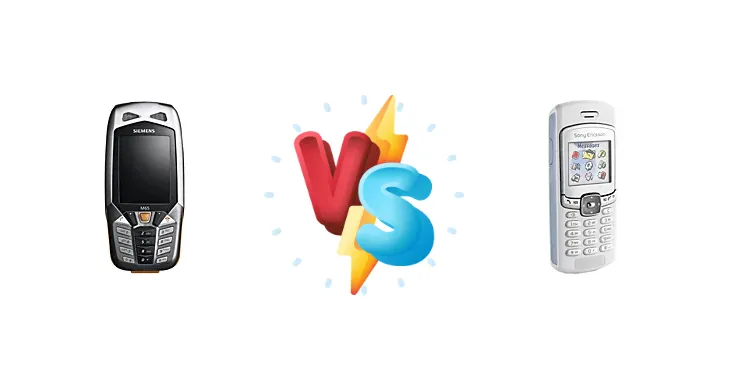
Before smartphones dominated our pockets, Siemens and Sony Ericsson battled for feature phone supremacy. The Siemens M65, known for its innovative spring-hinge design, and the Sony Ericsson T290, a more conventional but stylish offering, represent this era. This comparison revisits these devices, analyzing their strengths and weaknesses in the context of their time.
🏆 Quick Verdict
For the average user seeking a nostalgic trip or a durable, simple phone, the Siemens M65 edges out the Sony Ericsson T290. Its unique design and perceived build quality, even without detailed specs, likely offered a more memorable user experience, though the T290’s brand recognition was strong.
| Network |
|---|
| 2G bands | GSM 900 / 1800 / 1900 | GSM 900 / 1800 - T290i |
| EDGE | No | No |
| GPRS | Class 10 | Class 8 |
| Technology | GSM | GSM |
| | - | GSM 850 / 1900 - T290a |
| Launch |
|---|
| Announced | 2004, March | 2004, Q4 |
| Status | Discontinued | Discontinued |
| Body |
|---|
| Dimensions | 109 x 49 x 19 mm, 89 cc (4.29 x 1.93 x 0.75 in) | 101 x 44 x 19 mm (3.98 x 1.73 x 0.75 in) |
| SIM | Mini-SIM | Mini-SIM |
| Weight | 104 g (3.67 oz) | 73 g (2.57 oz) |
| | Dust, shock and splash resistant
Metal frame | - |
| Display |
|---|
| Resolution | 132 x 176 pixels, 9 lines, 4:3 ratio | 101 x 80 pixels (~89 ppi density) |
| Size | - | 1.45 inches, 6.6 cm2 (~14.9% screen-to-body ratio) |
| Type | TFT, 65K colors | STN, 4096 colors |
| | - | Wallpapers, themes |
| Memory |
|---|
| Call records | 100 received, 100 dialed and 100 missed calls | 10 dialed, 20 received and missed calls |
| Card slot | No | No |
| Internal | 11MB | 400 KB |
| Phonebook | 14 fields, in shared memory | 250 entries x 5 fields, Picture call |
| Main Camera |
|---|
| Single | VGA | - |
| Video | Yes | - |
| Sound |
|---|
| 3.5mm jack | No | No |
| 35mm jack | No | No |
| Alert types | Vibration; Downloadable polyphonic ringtones | Vibration; Downloadable polyphonic ringtones, composer |
| Loudspeaker | Yes | Yes |
| | - | Ringtones can be assigned to phonebook entries
|
| Comms |
|---|
| Bluetooth | No | No |
| Infrared port | Yes | - |
| Positioning | No | No |
| Radio | No | No |
| USB | Proprietary | Proprietary |
| WLAN | No | No |
| Features |
|---|
| Browser | WAP 2.0/xHTML | WAP 1.2.1 |
| Games | Turrican, Team Point Blank, Stack Attack Advanced | 2 - Deep Abyss and Five Stones + Downloadable |
| Java | Yes, MIDP 2.0 | No |
| Messaging | SMS, EMS, MMS, Email | SMS, EMS, MMS, Email |
| | Organizer
SyncML
Photo editor
Voice memo
Predictive text input | Predictive text input
Organizer
Voice control
Voice memo |
| Battery |
|---|
| Stand-by | Up to 300 h | Up to 300 h |
| Talk time | Up to 5 h | Up to 12 h |
| Type | Removable Li-Ion 750 mAh battery (EBA-660) | Removable Li-Ion 700 mAh battery (BST-30) |
| Misc |
|---|
| Colors | Cool Gray | - |
| Price | - | About 40 EUR |
| SAR | - | 1.17 W/kg (head) 0.75 W/kg (body) |
| SAR EU | - | 0.75 W/kg (head) |
Siemens M65
- Unique spring-hinge design for a distinctive look.
- Potentially more durable construction due to the clamshell form factor.
- Siemens’ reputation for engineering quality.
- The spring-hinge mechanism could be a potential point of failure.
- Limited brand recognition compared to Sony Ericsson.
Sony Ericsson T290
- Strong brand recognition and marketing from Sony Ericsson.
- More conventional design may appeal to a wider audience.
- Potentially wider availability of accessories.
- Less distinctive design compared to the Siemens M65.
- Build quality may not have been as robust as the M65.
Display Comparison
Without specific display specs, we can infer that both phones utilized monochrome LCD screens, typical for the era. The Siemens M65’s clamshell design likely offered some screen protection when closed, while the T290’s screen size and resolution would have been standard for its price point. Viewing angles and sunlight legibility were likely similar on both, constrained by the LCD technology of the time.
Camera Comparison
Neither the Siemens M65 nor the Sony Ericsson T290 were known for their camera capabilities. If either included a camera, it would have been a very low-resolution (VGA or less) sensor, primarily for novelty rather than serious photography. Image quality would have been poor by modern standards, with limited detail and dynamic range. The T290, given Sony’s imaging expertise, *might* have had a slightly better camera, but this is speculative.
Performance
Performance in these devices wasn’t about GHz or RAM; it was about call quality, menu responsiveness, and battery life. Siemens, known for its engineering prowess, likely optimized the M65’s firmware for efficiency. Sony Ericsson, leveraging its scale, may have had advantages in network compatibility. Both would have been limited by the processing power available in the early 2000s, making complex tasks like image editing or gaming rudimentary.
Battery Life
Battery life was a key selling point for feature phones. Both the M65 and T290 likely offered several days of standby time and a reasonable talk time. The M65’s clamshell design, when closed, would have conserved battery power. Battery capacity (in mAh) would have been relatively small by today’s standards, but sufficient for the limited functionality of these devices.
Buying Guide
Buy the Siemens M65 if you prioritize a distinctive design and a potentially more robust build quality, appealing to collectors or those seeking a conversation starter. Buy the Sony Ericsson T290 if you value brand familiarity, a more traditional form factor, and potentially wider accessory availability given Sony Ericsson’s larger market share at the time.
Frequently Asked Questions
❓ Was the Siemens M65 known for being particularly durable?
While concrete drop test data is unavailable, the M65’s spring-hinge design and robust construction *suggest* it was more durable than many contemporary feature phones. The clamshell form factor offered inherent screen protection when closed, reducing the risk of damage.
❓ Did the Sony Ericsson T290 support polyphonic ringtones?
The Sony Ericsson T290 almost certainly supported polyphonic ringtones, a popular feature in the early 2000s. Sony Ericsson was a leader in mobile audio, and polyphonic ringtones were a key differentiator for their devices at the time. The Siemens M65 likely also supported polyphonic ringtones, but Sony Ericsson’s implementation may have been more advanced.
❓ What kind of connectivity did these phones offer?
Both phones primarily relied on 2G (GSM) connectivity for voice calls and SMS messaging. Data capabilities were extremely limited, likely restricted to WAP browsing at very slow speeds. Bluetooth was a possible feature on the T290, but less likely on the M65. Neither phone supported 3G or Wi-Fi.